
2026-08-25
Share


In 2026, commercial display is no longer only about showing information.
For many years, digital screens were mainly used to deliver advertisements, brand videos, wayfinding messages, event announcements, and promotional content. The value of a display was often measured by brightness, resolution, size, and playback quality.
But the needs of commercial spaces are changing.
Shopping malls, flagship stores, exhibition halls, museums, airports, brand showrooms, and public art spaces are no longer satisfied with static information display. They need visual installations that can attract foot traffic, create memorable moments, encourage filming and sharing, and become part of the spatial identity.
This is why “creative display” is becoming a stronger category.
According to the market data provided for this article, the creative LED display market is expected to grow from USD 1.879 billion to USD 3.654 billion, with a CAGR of 10.0%. Behind this growth is a clear industry shift: commercial display is moving from information delivery to spatial experience.
In this context, Mlxos series represents a new direction. It does not simply rely on video playback. Instead, it introduces mechanical motion into the space itself. Through independent flipping units arranged in a matrix, the product creates waves, color block switching, lighting variation, and interactive movement. The source material describes this product category as a dynamic mechanical display product designed for commercial spaces, exhibition halls, stage performances, and public art scenarios.
Mlxos series is a dynamic mechanical display system composed of independent flipping units arranged in a matrix, transforming mechanical movement, color changes, lighting effects, and interactive control into a spatial visual experience.
In simple terms, Mlxos series is not only a display product.
It is a moving surface.
It can be used as a storefront feature, exhibition backdrop, ceiling installation, commercial art wall, stage background, brand showroom installation, or interactive public art piece.
The key value is not only what it shows, but how it moves.
Before LED walls became widely used, one of the earliest forms of dynamic commercial display was the traditional tri-vision billboard.
A tri-vision billboard uses rotating triangular prisms. Each prism has three visible faces, allowing one advertising surface to switch between three different printed images. This format once gave outdoor media more flexibility than static billboards, because one physical structure could present multiple advertisements.
However, traditional tri-vision displays have several limitations.
First, the content is fixed. Once the printed materials are installed, changing the visual content requires physical replacement.
Second, the motion logic is simple. Traditional tri-vision systems usually rotate from one printed image to another. The movement is functional, but not highly expressive.
Third, the resolution and detail level are limited by the physical size of each rotating element. For close-range viewing, the visual effect often feels rough.
Fourth, traditional tri-vision products are usually not designed for modern interactive systems. They do not naturally connect with sensors, cameras, LiDAR, lighting consoles, real-time content engines, or digital control workflows.
Mlxos series evolves this idea into a new generation of mechanical display.
Instead of using large printed prisms, Mlxos series uses independent flipping units arranged in a matrix. These units can form waves, graphic patterns, brand visuals, lighting effects, and interactive movements. The product is not only changing content; it is changing the physical surface of the space.
This is the essential upgrade.
Traditional tri-vision displays change images.
Mlxos series changes spatial experience.
The source material explains that this type of mechanical display allows walls, storefront signs, ceilings, exhibition stands, and stage backdrops to become movable, customizable, interactive, and shareable visual surfaces.
That is why Mlxos series is suitable for the current commercial environment. Brands no longer only want to display messages. They want to create moments people remember.
A conventional LED screen creates images through light-emitting pixels. The screen emits brightness and color directly, and the audience sees a digital image.
Mlxos series works differently.
The visual effect is created through physical flipping units. Each unit can rotate or flip to present different visible surfaces. When many units move together, the overall surface can create patterns, waves, logos, gradients, text-like forms, and visual rhythms.
This means the product does not only “display” an image.
It performs the image.
This is why Mlxos series has strong mechanical aesthetics. The movement itself becomes part of the content. The audience can see the surface changing in real space, with physical depth, shadow, reflection, and rhythm.
The product features section of the source material highlights this point clearly: physical mechanical flipping creates dynamic effects such as waves, matrices, and multi-sided flipping, giving the surface a stronger spatial presence than conventional display screens.
For standard mechanical versions, Mlxos series can create visual effects through physical color panels and ambient light reflection.
This is very different from a high-brightness LED wall.
A traditional LED wall depends on emitted light. It is strong, vivid, and suitable for video content, but it may also feel visually intense in some indoor spaces.
Mlxos series can create a softer, more material-based visual experience. The surface can respond to indoor lighting, daylight, stage lighting, spotlights, and environmental reflections.
This makes it suitable for spaces where design texture matters, such as:
l luxury retail stores
l hotel lobbies
l brand experience centers
l cultural exhibition halls
l airport commercial zones
l art installations
l office reception areas
In these spaces, the display is not only a media carrier. It becomes part of the interior design language.
Because standard mechanical versions do not rely on direct LED pixel emission for their main visual output, they can provide a more comfortable viewing experience for long-term exposure.
In shopping malls, airports, museums, galleries, and corporate lobbies, people may stay in the same environment for a long time. A constantly bright LED wall may not always be the best solution.
Mlxos series offers another possibility.
It uses motion, material, color, and reflection to create visual attraction. The viewing experience is closer to kinetic art than to conventional digital signage. For spaces that want to reduce visual fatigue while still creating a strong visual memory point, this is an important advantage.
Energy efficiency is becoming increasingly important for commercial display projects.
Large LED walls can create impressive visual effects, but they usually require continuous power supply, heat management, and higher long-term operating costs.
Mlxos series can offer a more energy-conscious alternative, especially for projects that do not require full-time video playback.
According to the source specifications, the large-unit version listed in the file uses 25 pcs/㎡ and 120W/㎡, while the LED screen version reaches 400W/㎡ because it integrates P10 LED display capability.
In the final naming system, this means:
l Mlxos 168 is suitable for large-area, long-distance, energy-saving applications.
l Mlxos 138P is suitable when video playback is required.
Compared with many conventional LED screen projects that may require significantly higher power for full video output, Mlxos series gives project owners more flexible choices between mechanical motion, lighting atmosphere, and video display.
Mlxos series should not be understood as a simple decorative wall.
It should be understood as a system-level creative display platform.
Its final visual result comes from multiple layers working together:
l mechanical flipping units
l panel colors and surface materials
l lighting or LED extensions
l control protocols
l content programming
l interactive sensors
l space lighting
l audience behavior
The source material shows that the system can support DMX512 and Art-Net protocols, and can be integrated with stage lighting, content production, and interactive control systems. It also supports MADRIX lighting effects and TouchDesigner-based interactive content.
This makes Mlxos series more than a visual surface.
It can become part of an interactive system where cameras, LiDAR, movement data, lighting consoles, and content software work together to produce real-time visual responses.
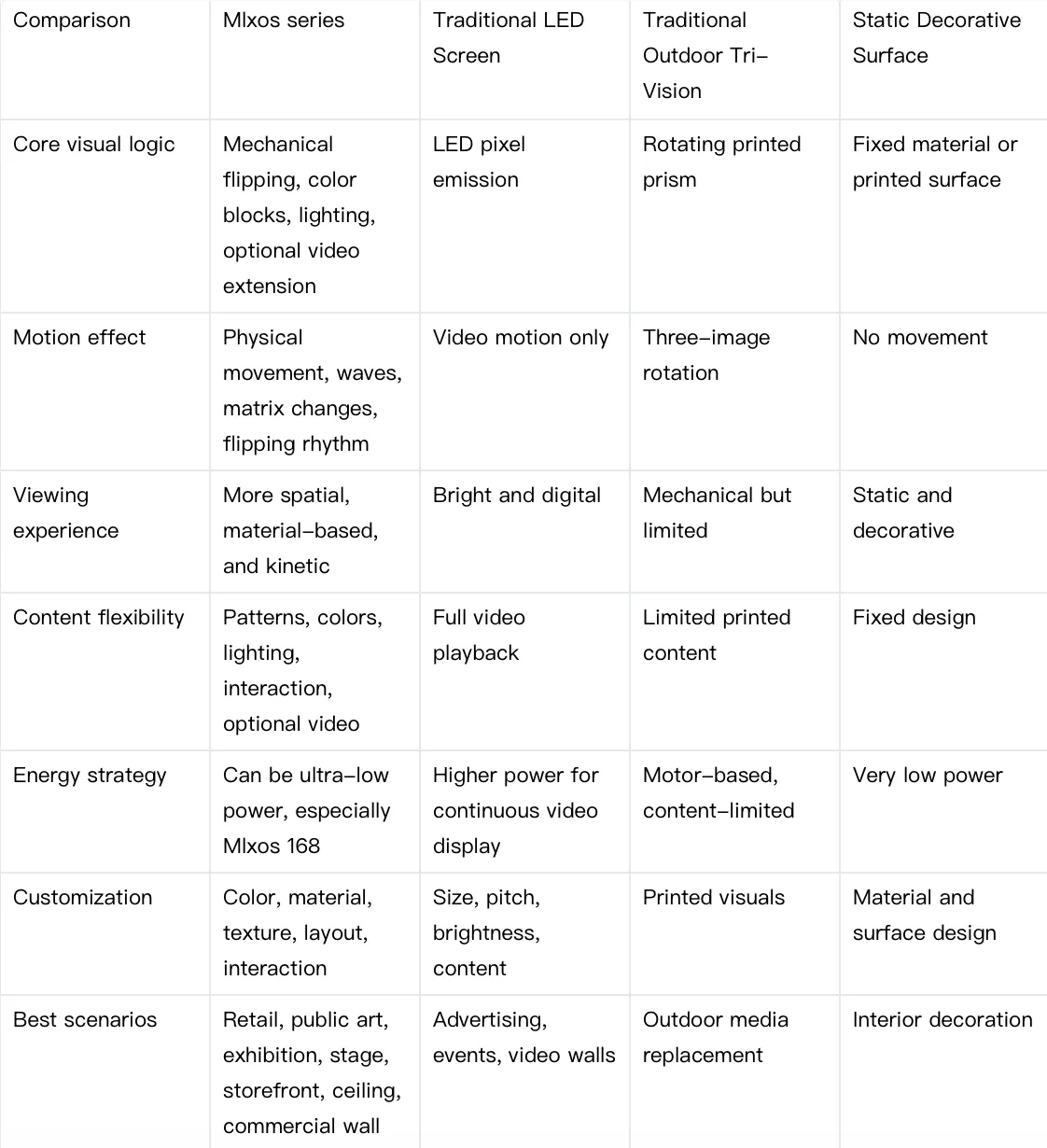
The difference is clear:
Traditional LED screens focus on digital playback.
Traditional tri-vision displays focus on image switching.
Static decorative surfaces focus on material styling.
Mlxos series focuses on mechanical spatial expression.
Mlxos series includes four main models. Each model is designed for a different project requirement.
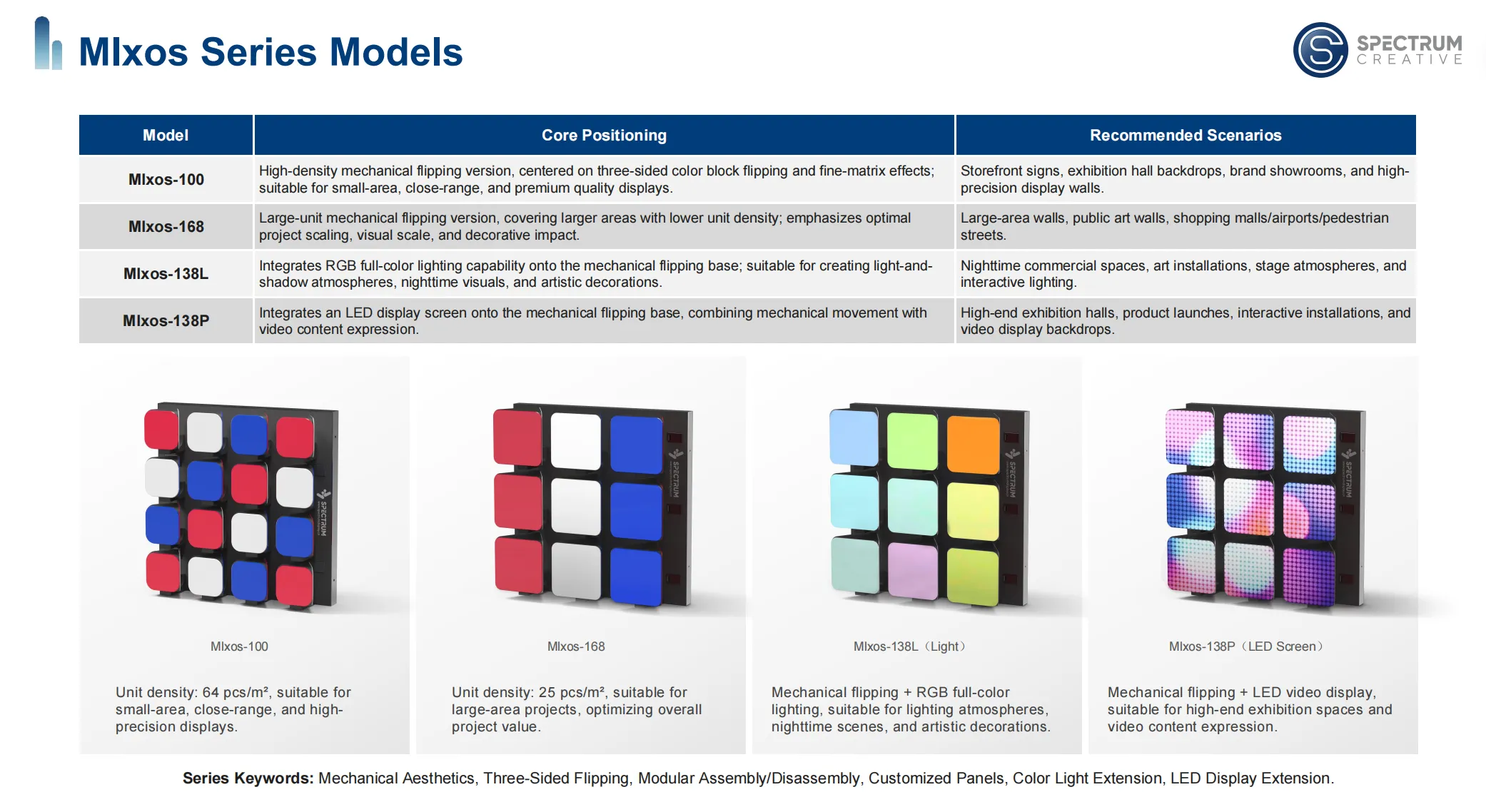
The source material confirms the technical foundation for these four categories: the high-density version uses 64 pcs/㎡, the large-unit version uses 25 pcs/㎡, and both the RGB lighting version and LED screen version use 36 pcs/㎡.
In a market full of LED walls, mechanical motion immediately feels different.
It has rhythm, depth, material texture, shadow, and physical presence. When the surface flips, the audience sees a real object moving, not just a digital animation.
This is why Mlxos series is especially powerful for commercial spaces that need a visual memory point.
A moving wall is more likely to attract attention than a static wall.
A mechanical wave is more likely to be filmed than a conventional advertisement.
A surface that responds to people is more likely to become a social media moment.
For large-area projects, power consumption directly affects operating cost.
Mlxos 168 is designed for long-distance, large-area use. With 25 pcs/㎡ and lower power consumption, it is suitable for public spaces, large commercial walls, airport corridors, pedestrian streets, and urban art installations.
For spaces that need a large visual surface but do not need full-time video playback, this model can provide a more efficient solution.
Commercial projects often have tight installation schedules.
Exhibitions, product launches, pop-up stores, and retail renovation projects need systems that can be installed, removed, transported, and maintained efficiently.
The source material states that quick-install cabinets and front/rear maintenance structures help with installation, disassembly, transportation, and routine inspection.
This makes Mlxos series suitable for both permanent installations and temporary commercial projects.
Mlxos series can be connected with interactive systems.
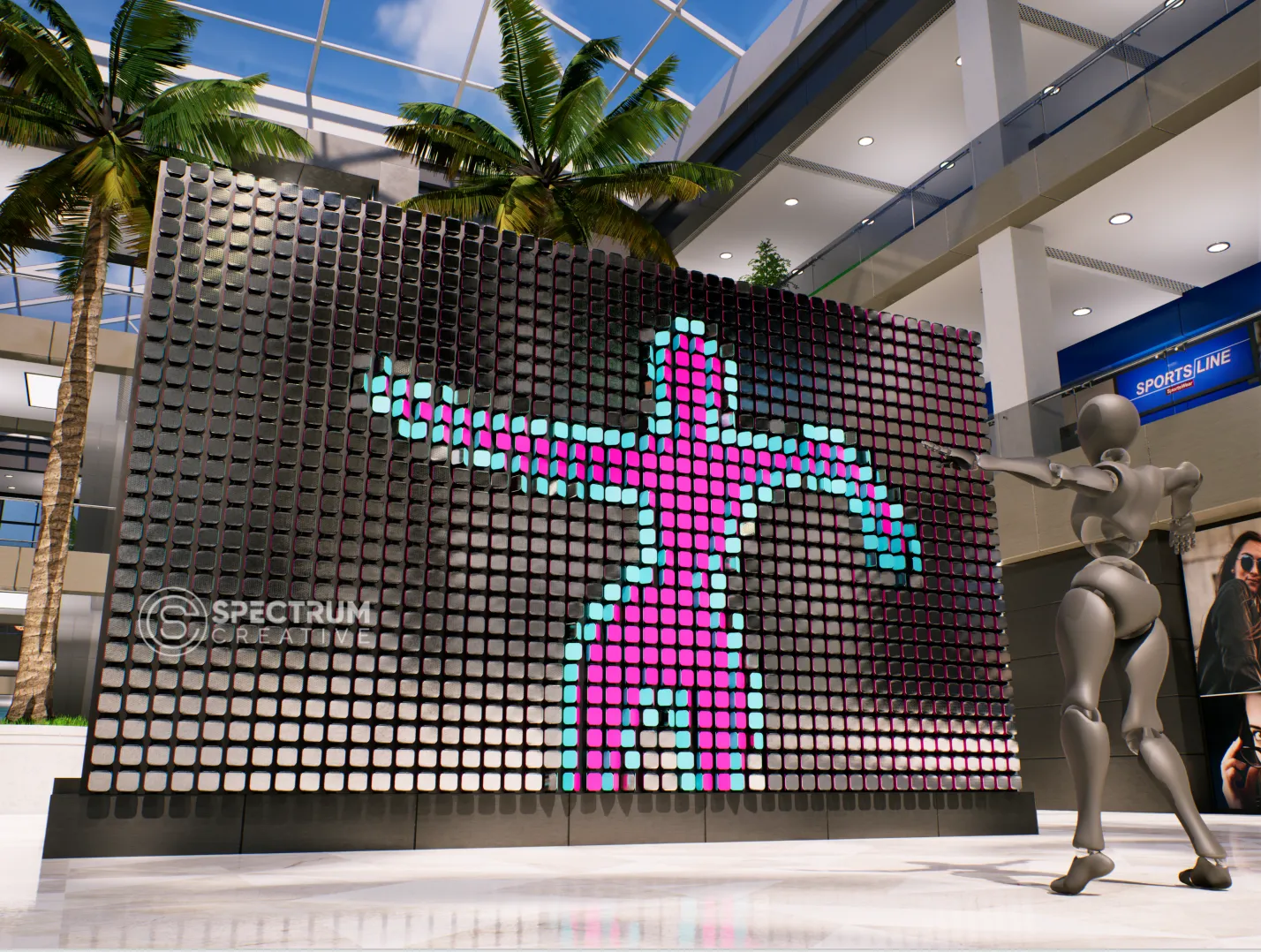
The source material states that it supports integration with TouchDesigner, cameras, and LiDAR, allowing audience movement to trigger screen variations.
This allows the product to become a participatory installation.
For example:
l a person walking past the wall can trigger a wave
l hand movement can activate color changes
l LiDAR can detect distance and create motion feedback
l stage lighting can synchronize with mechanical flipping
l product launch content can be revealed through movement
This changes the display from one-way communication into an interactive experience.
Commercial spaces have different design languages.
A luxury retail store may need metallic gold and mirror finishes.
A technology showroom may need silver, blue, and black.
A nightlife venue may need RGB lighting and high-contrast colors.
A cultural installation may need custom surface patterns.
Mlxos series supports customized panels, colors, materials, and textures. The source material lists optional crafting techniques such as plastic injection molding self-color, metal foil stickers, spray painting, electroplating, stickers, and UV printing, as well as glossy, matte, mirror, and color-changing textures.
This makes the product suitable not only as a display system, but also as a customized architectural surface.
Mlxos series supports multiple panel design directions.
The source material shows six panel color schemes, including red-white-blue, gold-silver-cyan, gold-silver-black, red-silver-gold, pink-mirror-green, and multicolor-silver-blue combinations.
This gives designers greater freedom.
For example:
l Red, white, and blue can work for energetic brand spaces.
l Gold, silver, and black can support luxury environments.
l Pink, mirror, and green can create a more playful commercial atmosphere.
l Multicolor panels can support artistic and entertainment spaces.
l Electroplated or mirror surfaces can strengthen reflections.
l UV printing can support more customized visual identities.
This flexibility allows one product system to serve very different design needs.
It can look industrial.
It can look futuristic.
It can look luxurious.
It can look playful.
It can also be integrated into architecture as a moving material surface.
Mlxos series can be used in multiple commercial and cultural scenarios.
For retail brands, the storefront is the first communication point. Mlxos 100 is suitable for close-range visual quality, logo presentation, and premium brand windows.
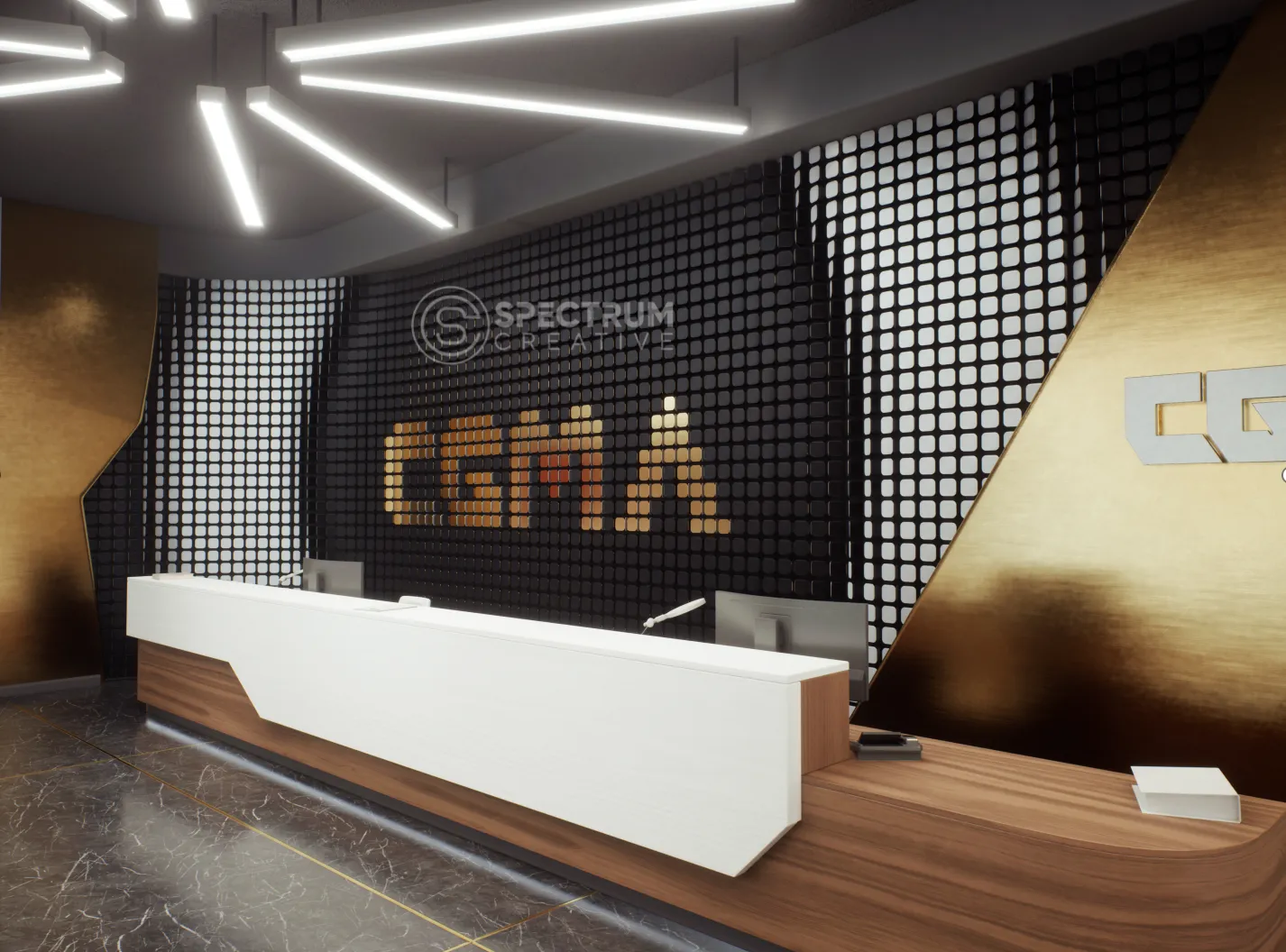
For shopping malls, airports, pedestrian streets, and public buildings, Mlxos 168 is suitable for long-distance viewing and large-area coverage.
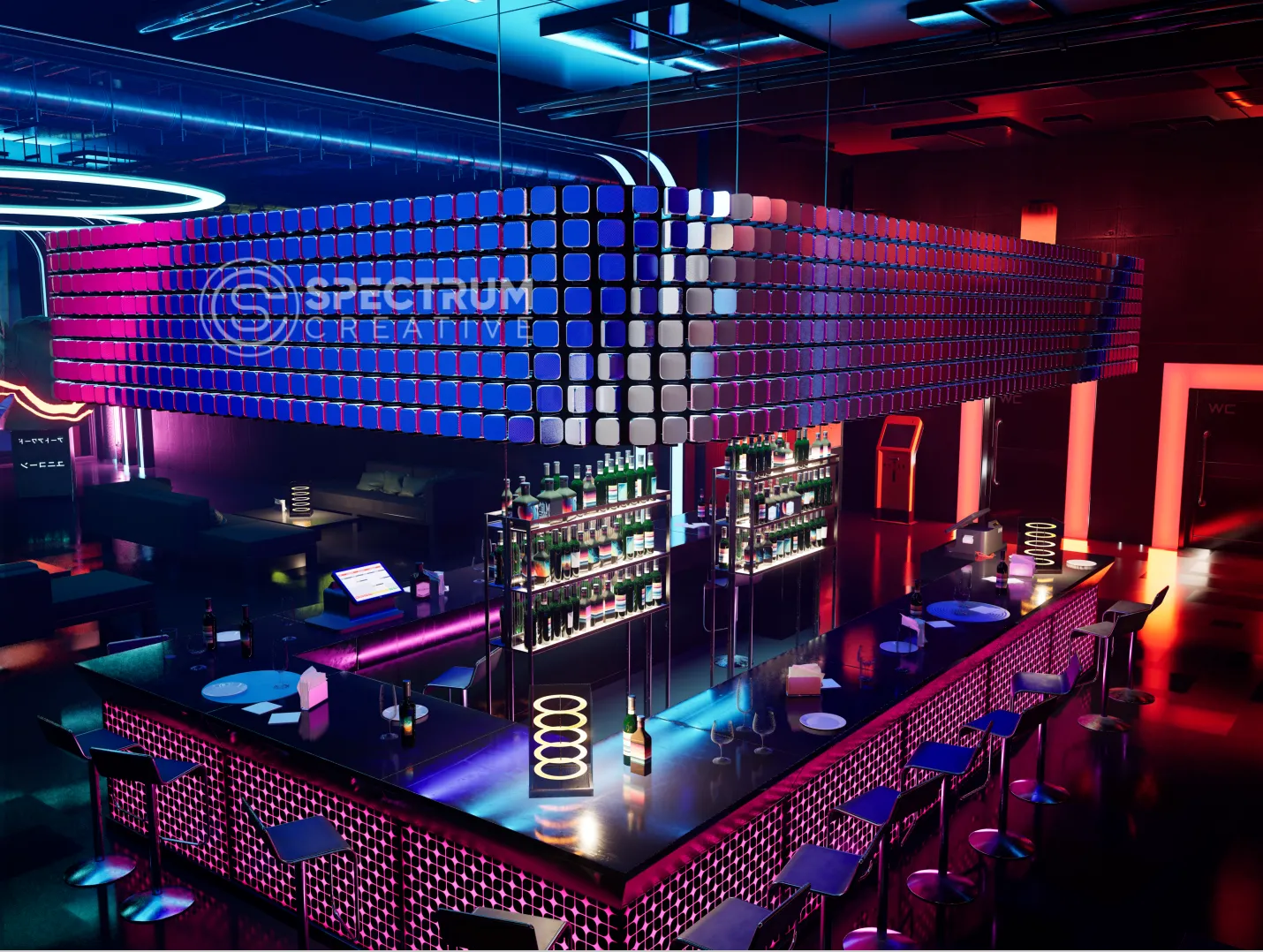
For bars, clubs, night markets, entertainment venues, and performance spaces, Mlxos 138L can create RGB full-color lighting atmosphere.
For corporate showrooms, product launches, technology museums, and planning halls, Mlxos 138P can combine mechanical movement with P10 LED video playback.
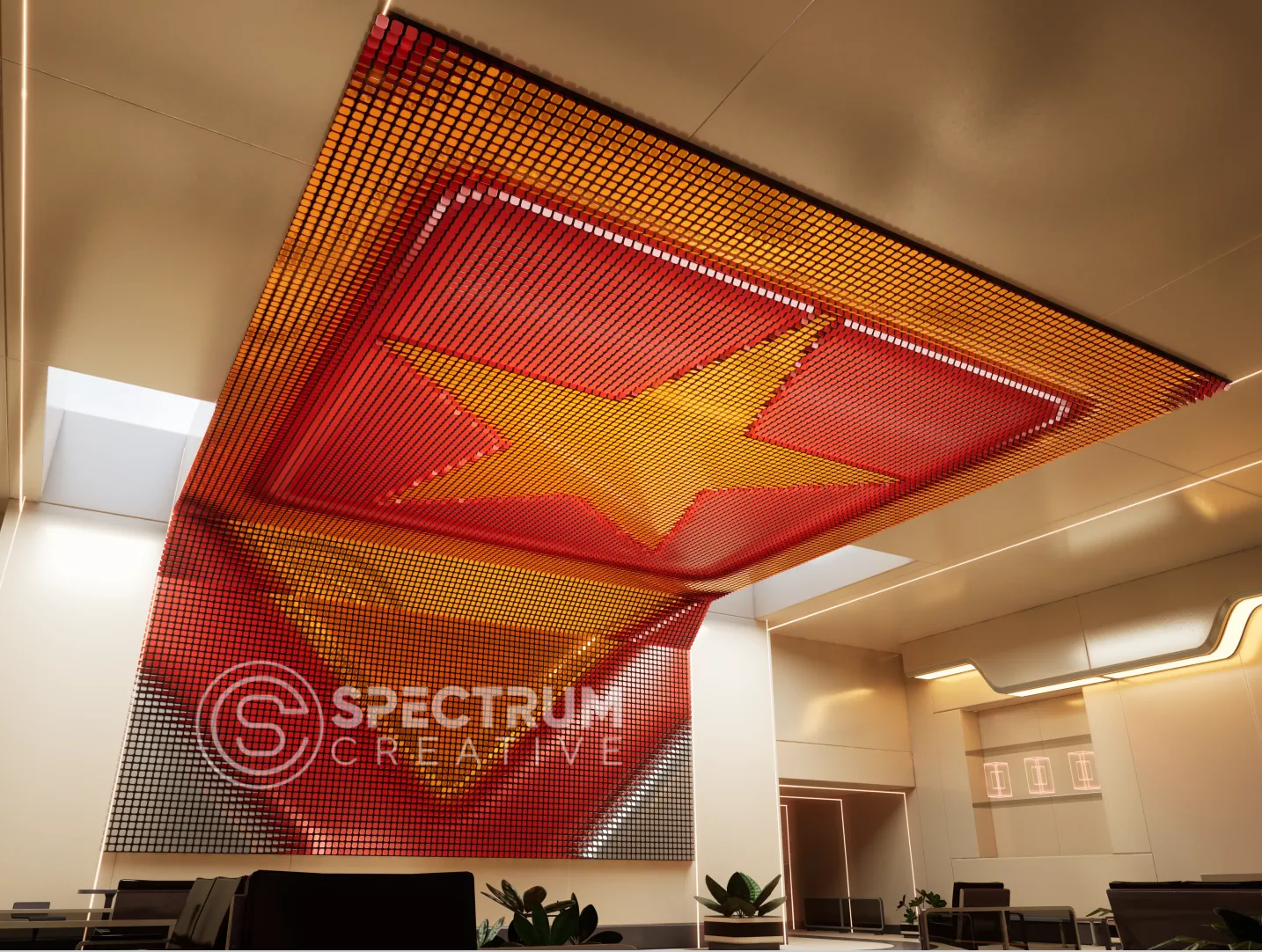
With TouchDesigner, cameras, LiDAR, DMX512, Art-Net, and MADRIX workflows, Mlxos series can become an interactive public installation. The source material lists exhibition rental, public space art, exhibition halls, theatrical performances, storefront decoration, and commercial advertising as typical applications.
Mlxos series is a dynamic mechanical display system composed of independent flipping units arranged in a matrix. It creates visual effects through physical movement, color switching, lighting effects, optional video display, and interactive control.
Not exactly. Some models are mechanical display systems based on physical flipping and color panels, while Mlxos 138P integrates a P10 LED screen for video playback. Therefore, Mlxos series should be understood as a mechanical display system with different extension options.
Its biggest advantage is mechanical aesthetics. Instead of only displaying digital content, it makes the physical surface move, creating a stronger spatial memory point and a more shareable visual experience.
Mlxos 168 is recommended for large-area projects. It uses 25 pcs/㎡, supports viewing distances over 8m, and is the energy-saving choice for large commercial walls or public art surfaces.
Yes. The system can work with TouchDesigner, cameras, LiDAR, DMX512, Art-Net, and MADRIX to create human-machine interaction, stage lighting effects, and sensor-based visual responses.
l Mlxos Series Model Selection Guide: How to Choose Mlxos 100, Mlxos 168, Mlxos 138L and Mlxos 138P
l Robotic LED Display Systems: Structure, Motion and Control Technology
l How Mechanical Display Systems Transform Commercial Space Design
l Immersive LED Screens vs Mechanical Display Systems: Which One Fits Your Project?
l Custom Creative LED Installations for Retail, Exhibition and Public Art Space