2026-08-18
Share


Immersive LED brand experience solutions integrate panoramic LED display systems—spanning curved, spherical, ceiling, and floor tile forms—with systematic imaging technologies (full-chain signal control from video source to individual LEDs, 3D Mapping spatial geometry mapping, multi-screen frame synchronization, and per-pixel color calibration) to transform brand messaging into perceptible, participatory, and shareable immersive spatial experiences—significantly enhancing brand recall, dwell time, and social sharing value.
1. Elevating Brand Experience: From "Display" to "Narrative" — How Imaging Logic Determines Experience Depth
2. Four Core Commercial Values of Immersive LED
l Dwell Time: Making Consumers "Reluctant to Leave"
l Social Sharing: Turning Spaces into "Traffic-Generating" Destinations
l Brand Premium: Making Experience Itself a Brand Asset
l Data Insights: Interactive Behavior Informing Operational Decisions
1. Case Study 1: Sayram Lake 428㎡ Dome Theater — How the Technical Foundation Supports Brand Narrative
2. Case Study 2: HKUST CAVE Space — The "Reconfigurable" Value from Research Platform to Academic Curation
3. Immersive LED vs. Traditional Marketing Materials: ROI Gap Driven by Imaging Technology Differences
4. How to Plan an Immersive LED Brand Experience Project — Five Steps from Concept to Deployment
5. FAQ
6. Further Reading
The logic of traditional brand display is "informing"—conveying brand messages to consumers through posters, light boxes, and flat LED screens. The limitation of this one-way communication is that consumers remain "observers" rather than "participants." There is a screen, a poster, a distance between the brand and the consumer—information is delivered, but emotion is not established.
The logic of immersive LED brand experience is "narrative"—using irregular LED spaces to envelop consumers in a visual world constructed by the brand, transforming brand stories from "being seen" to "being felt." When a consumer stands at the center of a space enclosed by LED screens, with images flowing from all directions and sound penetrating through the screens, they are no longer "watching" the brand—they are "inside" it.
The essential difference lies in the imaging logic.
Traditional flat LED imaging logic: Single-plane display. Each frame of the video source is directly mapped onto a fixed X-Y grid. There is a physical boundary between the audience and the screen—you know you are looking at a screen. The screen's bezel reminds you that this is merely a "display device." Brand information is confined within the frame, unable to spill beyond.
Immersive LED space imaging logic: Multiple screens form curved, spherical, or CAVE spaces. Screen boundaries dissolve. Images spill beyond the bezel, filling the entire field of view. The complete imaging chain is as follows:
text
[3D Playback Server / UE5 Engine]
│ (Output multiple video streams)
▼
[Video Processor / Main Controller]
│ (3D Mapping pre-distortion / Multi-channel splicing / Color space conversion)
▼
[LED Sending Card / Main Controller]
│ (Gigabit Ethernet / Fiber distribution)
▼
[Distributed Receiving Cards] ────> [Irregular module driver boards / LEDs]
│ (Genlock frame sync / Per-pixel calibration)
Within this chain, three technical components directly determine the quality of brand narrative presentation—and therefore the depth of the consumer's "felt" experience.
Technical Component 1: 3D Mapping Spatial Projection
When brand video content is projected onto curved, angled, or spherical screens, without geometric correction, severe stretching and distortion occur—brand logos deform, product colors misalign, text becomes unreadable—directly damaging the brand image.
The core workflow of 3D Mapping algorithms:
l Step 1: Digital Twin Modeling. Build a 1:1 three-dimensional model of the physical space in software, precisely recording the position, angle, and curvature of every screen.
l Step 2: UV Unwrapping and Texture Mapping. Map the 3D coordinates of physical screens to 2D texture space, establishing the correspondence between "virtual pixels" and physical LEDs.
l Step 3: Pre-distortion Processing. The algorithm applies reverse geometric deformation to the input video—intentionally distorting the image in software. When projected onto the physical screen, the distortion is precisely canceled by the physical structure, and the viewer sees a complete image with no stretching or deformation. Brand logo lines remain straight; product colors remain accurate.
l Step 4: Pixel-Level Lookup Table (LUT) Generation. Bind the physical coordinates of each LED to its corresponding color value, ensuring every pixel of every frame lands on the correct LED.
Technical Component 2: Multi-Screen Frame Synchronization
When multiple screens jointly tell a brand story, latency on any single screen causes image tearing—the brand narrative is "interrupted." Imagine a beam of light sweeping from left to right across the space: the left screen lights up, but the right screen lingers on the previous frame—the viewer perceives not "flowing light," but "broken imagery."
Immersive LED systems use hardware-level Genlock sync signals to ensure all receiving cards refresh on the same clock edge, containing multi-screen latency within microseconds—completely imperceptible to the human eye. The brand story flows seamlessly through the space.
Technical Component 3: Per-Pixel Color Calibration
Different batches of LED modules have inherent brightness and color temperature variations, and different viewing angles cause color shifts. When a brand's core colors—Hermès orange, Tiffany blue, Coca-Cola red—appear in different shades across different screens, visual consistency breaks down, and consumer trust in the brand suffers.
Per-pixel calibration algorithms use industrial cameras to capture the actual brightness and chromaticity of each LED, compare them against target values (brand color standards), and generate independent correction coefficients for each LED. The result: no matter where a consumer stands in the space, or which screen they look at, brand colors remain consistent.
According to global immersive display entertainment market data, the market grew from $3.65 billion in 2025 to $4.48 billion in 2026, with a CAGR of 22.7%. The driving force behind this growth is brands' continued investment in "experiential marketing"—and the depth of experience depends on the precision of the imaging system.
In commercial spaces, dwell time is positively correlated with conversion rates. The longer a consumer stays in a space, the higher the likelihood of purchase. Immersive LED spaces, through their visual envelopment, naturally encourage consumers to stay longer—not because a salesperson follows them, but because the visual experience itself is compelling.
Specific contributions of imaging technology:
l High refresh rate (7680Hz in the HKUST project) and low latency ensure image smoothness. When refresh rates are insufficient, the human eye perceives flicker—especially when moving through the space. High refresh rates eliminate this flicker, making prolonged viewing comfortable.
l Per-pixel calibration ensures color comfort. Uncalibrated LED screens exhibit brightness unevenness or color shifts across areas, causing visual fatigue over time. Calibrated screens display uniform, soft colors, encouraging longer dwell.
l 3D Mapping creates spatial depth. When images flow across screen boundaries, the viewer's gaze naturally follows—this "visual tracking" mechanism extends attention span.
According to a 2025 report by the International Interactive Art and Technology Society (ITS), interactive dynamic installations achieve 3.8 times longer audience engagement and 6.2 times higher organic social media sharing rates compared to static installations. Immersive LED spaces don't just make consumers "stop"—they make them "want to share."
In the age of social media, "photo-worthy" is the core metric of a space's viral potential. Immersive LED spaces, with their visual impact and immersive quality, naturally possess "check-in" appeal. When consumers share photos, they are essentially conducting secondary brand content distribution—and this type of communication carries far greater trust than brand-generated content.
Specific contributions of imaging technology:
l 3D Mapping ensures perfect presentation on irregular surfaces. When consumers take photos in front of curved screens, images show no distortion or stretching—every frame achieves "screenshot-as-poster" visual quality. This makes photo-sharing a "natural reaction" rather than a "deliberate design."
l DCI-P3 wide color gamut delivers color depth. Standard screens have limited color gamut coverage—photos cannot capture what the eye sees. DCI-P3 wide color gamut ensures that mobile phone photos maximally reproduce the on-site visuals—from deep shadows to bright highlights, color gradations are rich and compelling on social platforms.
l High brightness ensures mobile photo usability. Immersive LED high brightness (typically 800–1500 nits) ensures that even under strong ambient light, mobile photos remain clear and usable—no "screen washed out" or "faces darkened" scenarios.
When a brand establishes a strong association with "immersive experience," the brand itself gains premium pricing power. Consumers are willing to pay more for "better experiences"—the core logic behind luxury brands and premium automotive brands investing in immersive showrooms.
Specific contributions of imaging technology:
l Accurate brand color reproduction (through per-pixel calibration) communicates the brand's pursuit of detail. When a brand invests in ensuring its signature colors are precisely reproduced on screen, consumers naturally extend this "color obsession" to "product obsession."
l Image stability (through frame synchronization) communicates brand reliability. Tearing and stuttering suggest "unprofessional" and "rough," while seamless, fluid imagery conveys "precision" and "reliability."
l DCI-P3 wide color gamut delivers visual richness. Wide gamut imagery makes brand visuals fuller and more vibrant—not just "more beautiful," but making the brand narrative more persuasive. Consumers remember not just the "brand name," but the "visual feeling" of the brand.
Immersive spaces are not just display terminals—they are also data collection terminals. Through sensors and interactive systems, brands can capture data on consumer dwell hot zones, interaction preferences, and content viewing duration, providing a basis for subsequent content iteration and operational decisions.
Specific contributions of imaging technology:
l Interactive data collection relies on low-latency connectivity between sensors and the playback system. End-to-end latency is contained within two frames (approximately 33ms), ensuring immediate feedback to interactive behaviors. This immediacy not only enhances experience but also makes data more accurate—because smaller latency means more precise temporal correspondence between behavior and data.
l By tracking dwell time and interaction frequency across different content segments, brands can quantitatively evaluate the appeal of different visuals—which images stop viewers, which interactive designs engage them—directly guiding continuous content optimization.
The Sayram Lake Immersive Theater in Xinjiang is a landmark project by Spectrum Creative in the cultural tourism sector. The project features a giant dome-shaped LED structure with an arc length of 31 meters and a height of 8 meters, totaling 428㎡, combining curved acoustic-transparent screens and floor tile screens.
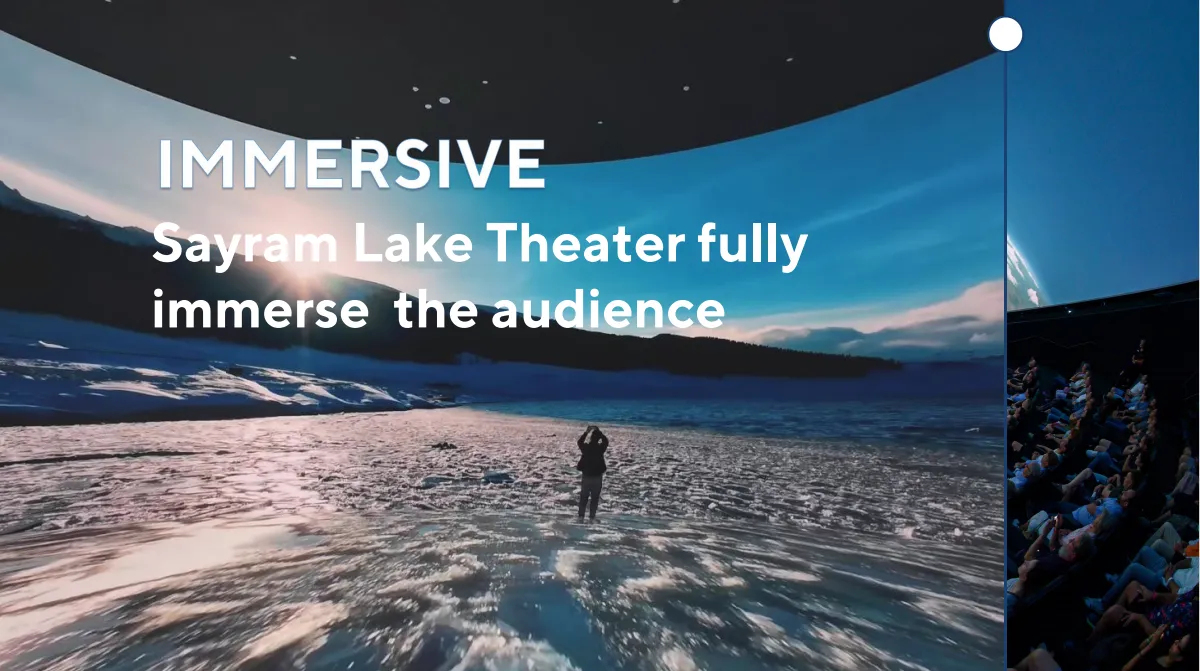
Brand Objective: Transform the natural landscape and cultural heritage of Sayram Lake into a perceptible immersive narrative experience, allowing audiences to "enter the story of the scenery" rather than "watch a video about the scenery."
How the Technical Foundation Supports Brand Narrative:
Imaging Chain Architecture:
The project uses a distributed receiving card architecture, dividing the 428㎡ dome into multiple independent load-bearing zones to ensure uniform distribution of 8K video data across the curved surface. Each zone is independently driven while hardware-level Genlock provides global frame synchronization, ensuring seamless flow of imagery across all dome areas.
3D Mapping Pre-distortion Processing:
For the dome's curved structure, the system applies reverse geometric deformation to video content—pre-stretching or pre-compressing the image at corresponding coordinate positions in software according to the dome's physical curvature. When the pre-distorted image is projected onto the curved screen, the physical curvature precisely cancels the software deformation, and viewers see a complete image with no stretching or distortion. Brand visual elements—whether the rippling lake surface or cultural motifs—maintain their original proportions and lines on the curved surface.
Multi-Screen Frame Synchronization:
Hardware-level Genlock achieves microsecond-level synchronization between the curved acoustic-transparent screen and the floor tile screen. When imagery transitions from the dome to the floor (such as water flowing from all directions toward the viewer's feet), viewers perceive a single "continuous flow" rather than "two spliced segments." This synchronization precision allows the brand narrative to flow seamlessly through the space.
Per-Pixel Color Calibration:
Given the varying viewing angles across the dome (areas directly facing the screen versus those at oblique angles), the system performs independent brightness and color calibration for each LED. Viewers in any position—whether seated centrally or standing at the edge—perceive consistent colors. The emotional colors of the brand narrative (the blue of the lake, the green of the grassland) remain true regardless of viewing angle.
Acoustic Integration:
A specially designed micro-perforated acoustic-transparent structure allows sound to penetrate the screen while maintaining visual pixel density, where it is absorbed by acoustic materials behind. After eliminating spatial reverberation, the brand narrative's narration, music, and ambient sounds are delivered clearly to every viewer—unobstructed by echoes.
Commercial Results:
The space has become a landmark visual attraction for Xinjiang cultural tourism. Average visitor dwell time increased from 3–5 minutes in traditional exhibitions to 15–20 minutes. Organic social media exposure exceeded one million impressions in the first month of operation. These figures demonstrate how the technical foundation directly supports brand narrative and commercial conversion—when the brand story moves people, consumers not only stay but actively share.
The Hong Kong University of Science and Technology Immersive Interactive Center is a benchmark project by Spectrum Creative in the research and education sector. The space features P1.9 high-density pixels with a total display area of 84.5㎡, constructing a five-sided fully enclosed CAVE system, achieving 7680Hz ultra-high refresh rate and DCI-P3 wide color gamut, with active 3D technology.
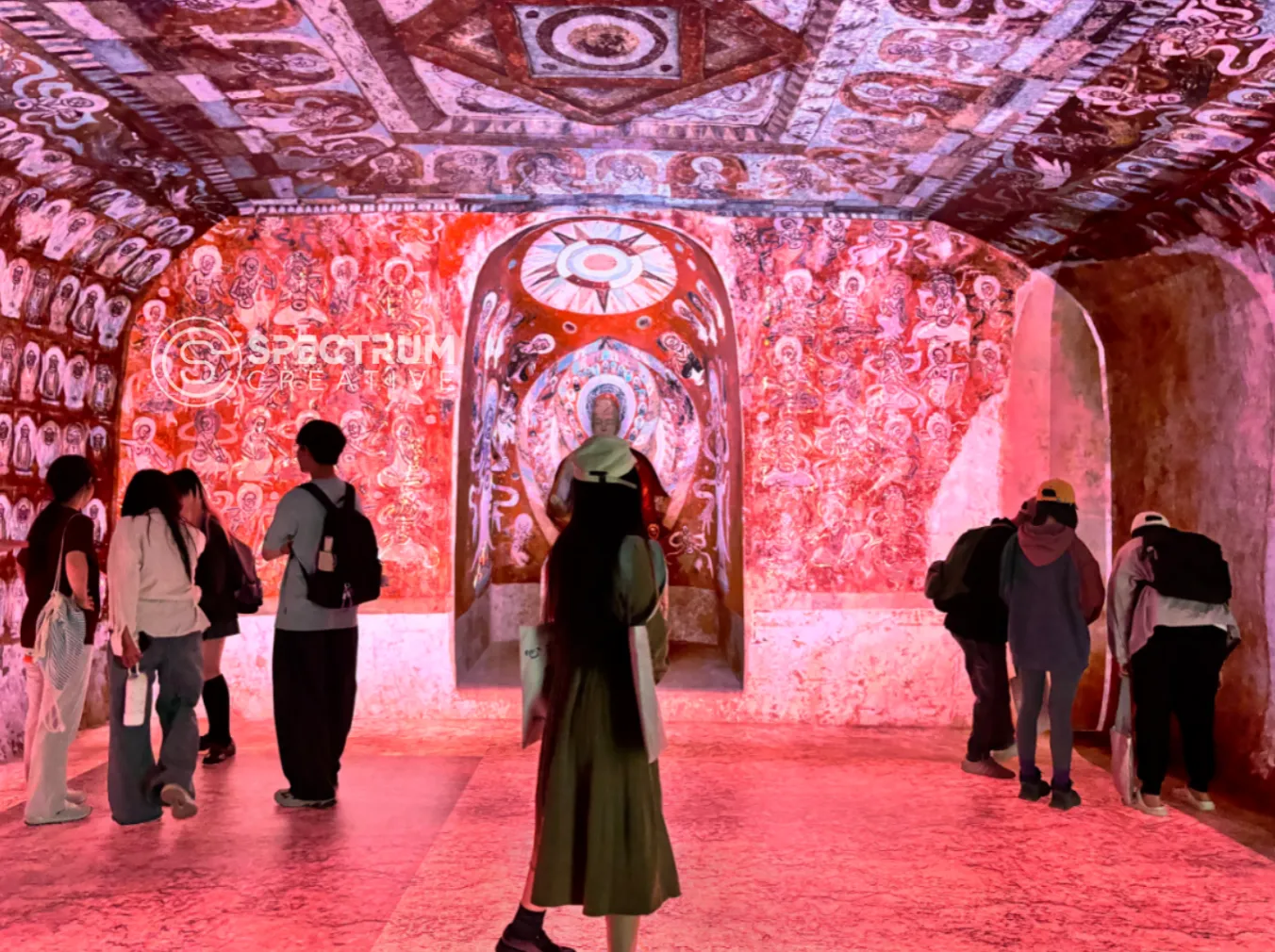
Brand Objective: Establish the CAVE space as a reusable, switchable "digital asset"—capable of supporting both research data visualization and cultural art curation, avoiding the waste of "single-use, single-scenario" investment.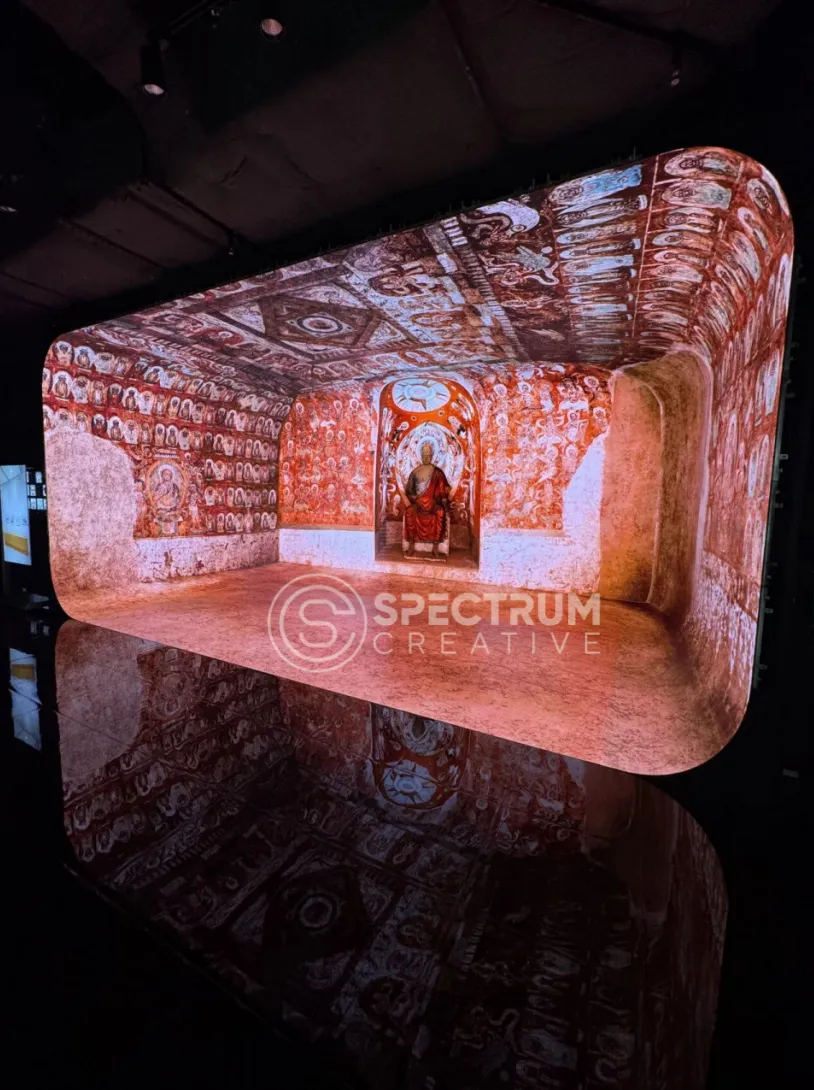
How the Technical Foundation Supports "Reconfigurable" Value:
UE5 Rendering Engine + 3D Mapping:
Leveraging UE5's real-time rendering capabilities and 3D Mapping spatial projection algorithms, the system can instantly switch between academic and art curation modes.
l In Academic Mode, the system loads research data models and maps data visualization imagery onto the five-sided space via 3D Mapping, enabling researchers to observe data from any angle.
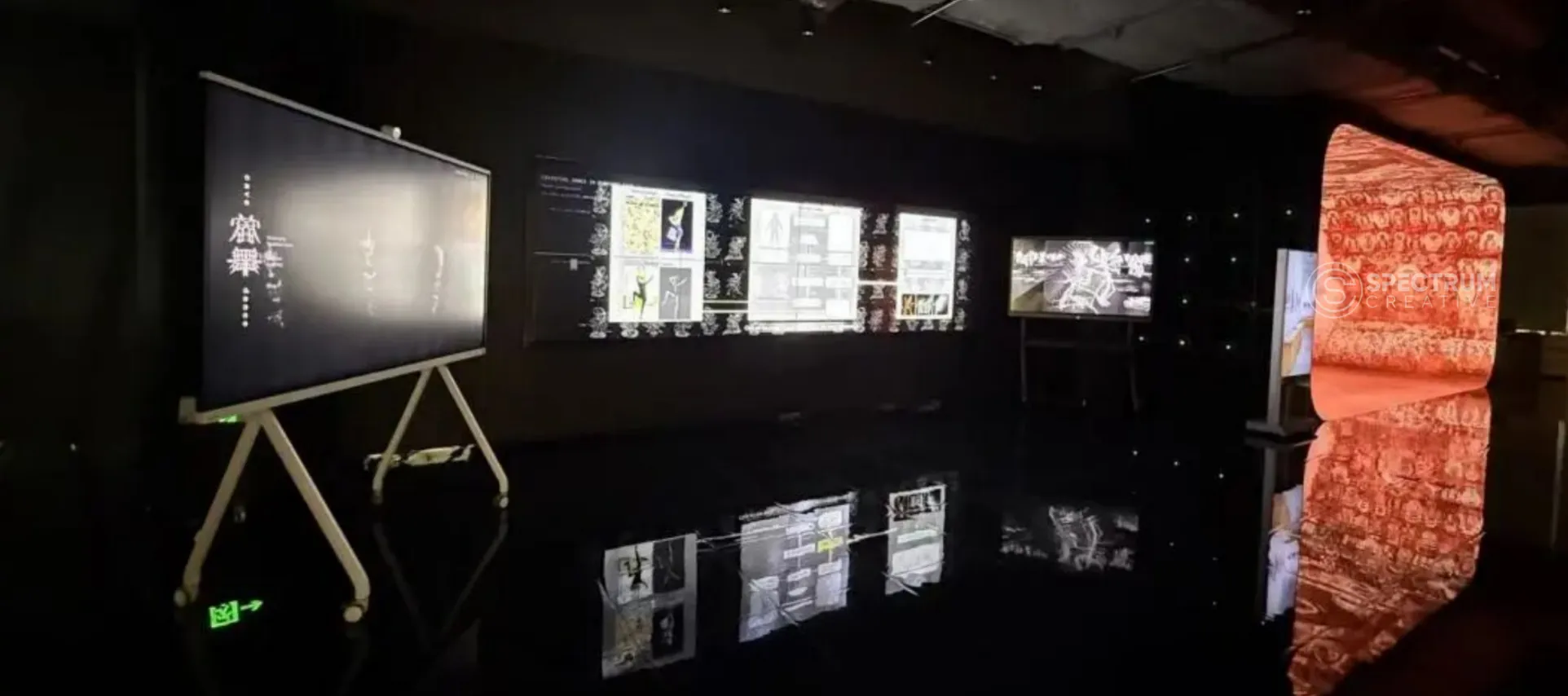
l In Art Curation Mode, the system loads panoramic video content (such as the digital restoration of the "Cave Dance" Dunhuang exhibition) and adapts it to the five-sided space through the same 3D Mapping algorithm.
During switching, no re-creation of distortion-adjusted assets is required—standard panoramic video adapts to the space through real-time mapping. Single content switching costs drop from tens of thousands of yuan for "re-creating assets" to thousands for "loading new content."
FSD Frame Synchronization Technology:
The proprietary frame synchronization solution achieves microsecond-level synchronization across five screens. In Academic Mode, continuous rotation of data models shows no "model tearing"; in Art Curation Mode, Dunhuang murals unfolding across screens show no "breaks at the seams." This synchronization precision delivers seamless experiences to viewers in both modes.
Per-Pixel Calibration and Color Management:
For art curation mode (such as the "Cave Dance" Dunhuang exhibition), the system uses per-pixel calibration to ensure precise reproduction of Dunhuang mural colors across the five-sided space. Color difference is controlled within ΔE<2—a museum-grade exhibition standard that meets the stringent requirements of art exhibitions.
Commercial Implications:
The HKUST case demonstrates that the core brand value of immersive LED spaces lies not in "one-time visual impact," but in "continuous content iteration capability." For commercial brands, this means an immersive space is not a one-time marketing expense, but a "digital asset" that can be continuously updated alongside brand campaigns.
The space has become a scarce digital practice and academic outcome showcase platform at HKUST, supporting cross-disciplinary applications from fluid dynamics simulation to Dunhuang art exhibitions. The "reconfigurable" capability of the imaging system is the core of its long-term operational value.
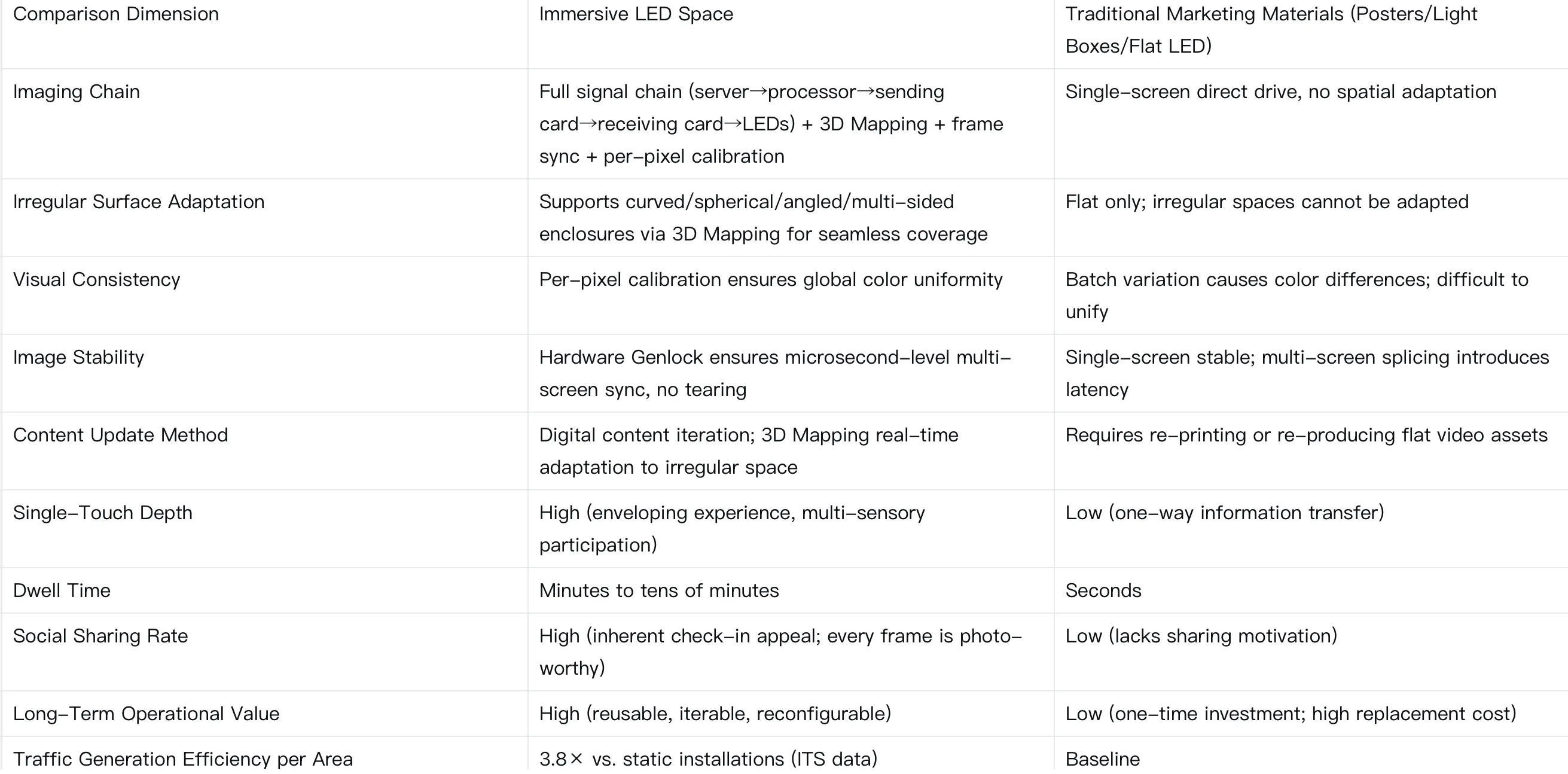
ROI Quantification Framework:
The ROI of immersive LED projects can be measured across three dimensions, each directly related to imaging technology:
1. Direct Revenue: Ticket sales, on-site sales conversion.
l Depends on the experience premium generated by image quality (refresh rate, color gamut, brightness). Consumers are willing to pay more for "superior visuals." The smoothness of 7680Hz refresh rate, the color depth of DCI-P3 wide gamut, the all-day usability of high brightness—each technical specification directly impacts consumer experience perception and willingness to pay.
2. Indirect Revenue: Consumption increase from extended dwell time (commercial complex scenarios).
l Depends on the smoothness and comfort of the imaging system. No flicker (high refresh rate), no tearing (frame sync), color comfort (per-pixel calibration)—these technical details determine how long consumers are willing to stay. Longer dwell means higher conversion probability.
3. Communication Revenue: Organic social media impressions × CPM equivalent.
l Depends on the visual impact of the imagery. The spatial depth created by 3D Mapping gives every frame a "three-dimensional" quality; the color depth of DCI-P3 makes mobile photos stand out on social platforms—these technical capabilities directly translate into the "shareability" of social communication.
Step 1: Define Experience Objectives and Content Strategy
What core message does the brand want to convey? What should consumers remember when they leave? This objective will determine the content narrative direction of the entire space. The content narrative direction, in turn, directly impacts the technical selection of the imaging system.
For example: If the brand wants to convey "technology," content will have faster dynamic rhythm and more saturated colors—requiring higher refresh rate and wider color gamut. If the brand wants to convey "nature," content will have softer colors and gentler transitions—requiring higher per-pixel calibration precision.
Step 2: Spatial Concept Design and Form Selection
How can LED forms match the spatial narrative?
l Curved screens create envelopment—suitable for "surround" narratives, making consumers feel embraced by the brand
l Floor tile screens add interactivity—suitable for "participatory" narratives, letting consumers walk on brand imagery
l Ceiling screens create upward-gazing perspectives—suitable for "grand narratives," conveying brand scale
l Multi-sided enclosures (CAVE) create complete immersion—suitable for "deep narratives," fully entering the brand world
Different forms determine 3D Mapping complexity—greater curvature and more angles mean higher pre-distortion processing difficulty, requiring more technical planning time in the early project phase.
Step 3: Imaging System Planning (Core Phase)
This is the critical phase that determines final visual quality—and Spectrum Creative's core technical value. The following planning must be completed early in the project:
l Signal Chain Architecture Design: Determine the selection and topology of playback servers, video processors, sending cards, and receiving cards. Large projects may require multiple servers in cascade, with redundant signal backup paths planned.
l 3D Mapping Solution: Determine geometric correction approach based on spatial form (curved/spherical/angled). Clarify: equirectangular projection or cube mapping? What pre-distortion precision is required?
l Frame Synchronization Solution: Determine sync mechanism across multiple screens—hardware Genlock or software sync? What microsecond-level precision is required?
l Color Calibration Standards: Determine target values for brand color calibration (e.g., ΔE<2). Clarify calibration precision levels and acceptance criteria.
Step 4: Content Creative Production and Pre-visualization
Complete pre-distortion processing and effect pre-visualization in the digital twin environment:
l Preview content presentation on irregular space in the 1:1 digital model
l Verify 3D Mapping parameter accuracy
l Confirm brand color visual consistency across different screens
l Adjust content based on pre-visualization results to avoid extended on-site debugging
Step 5: On-Site Deployment and Operational Iteration
After on-site installation and commissioning, establish a continuous content update mechanism:
l Update content quarterly, aligned with brand campaign rhythms and seasonal themes
l Optimize content design based on consumer feedback (dwell data, interaction data)
l Leverage 3D Mapping capabilities for rapid new content adaptation—no need to re-create distortion assets
l Regularly check per-pixel calibration status to ensure long-term brand color consistency
Q1: What is the approximate investment threshold for an immersive LED brand experience project?
A: Depends on project scale and technical complexity. Small to medium-sized brand experience spaces (50–100㎡) typically cost millions; large cultural tourism or commercial complex projects (300㎡+) require higher investment. The imaging system (video processors, sending/receiving cards, synchronization solutions, calibration services) accounts for approximately 15%–25% of total hardware investment. It is recommended to clarify budget range at the project initiation stage, with the technical team providing targeted solutions.
Q2: Are immersive LED experiences suitable for smaller brands?
A: Yes. Immersive experiences don't have to be "large"—they need to be "precise." Smaller brands can achieve high-impact brand narratives within limited budgets through boutique immersive pop-up spaces or window installations. The modular design of the imaging system supports flexible scaling—starting with small curved screens and gradually upgrading to multi-sided enclosures as the brand develops. The key is to plan signal chain scalability early, ensuring future upgrades don't require complete rebuilds.
Q3: How often should immersive LED content be updated? What are the update costs?
A: Quarterly updates are recommended, aligned with brand campaign rhythms. Technically, playback systems with 3D Mapping capabilities can switch content quickly—standard panoramic video adapts to irregular space through real-time mapping, without re-creating distortion assets. Single content update costs can be reduced by 30%–50% (compared to traditional irregular screen content production). The core logic: once 3D Mapping parameters are established, subsequent updates only require replacing the video source—no repeated geometry mapping processing.
Q4: How can the ROI of an immersive LED project be measured?
A: Measure across three dimensions:
l Direct Revenue: Ticket sales, on-site sales conversion—requires establishing ticketing/sales data collection mechanisms before project launch
l Indirect Revenue: Dwell time × per-customer spending increase—requires visitor counting equipment at space entrance and exit, comparing entry and exit data
l Communication Revenue: Social media impressions × CPM equivalent—requires social media monitoring keywords to track organic post impressions and engagement
It is recommended to establish complete data collection mechanisms before project launch to enable quantitative evaluation.
Q5: Can immersive LED experiences integrate with social media (e.g., check-in photo sharing)?
A: Yes. Specific approaches include:
l Reserve "best photo spots" in spatial design—clearly mark where photos turn out best
l Design visually striking moments in content suitable for photo-sharing—such as high-saturation color scenes, dynamic lighting peaks, and perfect brand logo presentations
l Combine with social media check-in mechanisms—such as QR code scanning for exclusive filters or interactive participation
l DCI-P3 wide color gamut and high brightness ensure that mobile photos and videos remain color-accurate and clear on social platforms
Q6: Is post-deployment maintenance of the imaging system complex?
A: Not complex. Immersive LED uses front-maintenance design—modules can be removed and replaced from the front. Maintenance focuses on:
l Regular per-pixel calibration status checks: Recommend semi-annual color calibration reviews to ensure brand color consistency
l Signal chain stability monitoring: Real-time monitoring of receiving card status through the playback system dashboard
l Spare parts inventory: Recommend stocking 3%–5% of total modules as spares
Spectrum Creative provides comprehensive training and technical support services to help clients establish independent maintenance capabilities.