2026-08-14
Share


Immersive LED spatial transformation is a systematic approach that combines irregular LED forms—curved screens, spheres, floor tiles, ceilings, and multi-sided enclosures—with full-chain signal control from video source to individual LEDs, 3D Mapping geometric calibration, and multi-screen frame synchronization to turn architectural spaces into immersive, interactive digital environments, moving the audience from "watching a screen" to "being inside the image."
1. Why "Irregular" Is the Spatial Soul of Immersive LED
2. The System Imaging Architecture of Immersive Spaces: The Complete Chain from Video Source to LEDs
3. Case Study 1: Sayram Lake 428㎡ Dome Theater — Triple Engineering Breakthroughs in Acoustics, Thermal Management, and Optics
4. Case Study 2: HKUST 84.5㎡ Five-Sided CAVE Space — A Research-Grade Imaging System and Algorithm Validation
5. Immersive LED vs. Traditional Projection: Why LED Is Becoming the Preferred Choice for Immersive Spaces
6. Three Major Technical Challenges in Irregular Screen Deployment and Their Solutions
7. FAQ
8. Further Reading
The fundamental limitation of traditional flat LED screens is that they remain "images hanging on a wall." There is both a physical and psychological distance between the audience and the screen—you know you are looking at a screen, rather than being inside the image.
The essential breakthrough of immersive LED lies in using irregular forms to dissolve the "screen-ness." When LED modules are assembled into curves, spheres, domes, floor tiles, ceilings, or five-sided CAVE spaces, the screen's boundaries disappear. The audience's field of view is completely enveloped by the image—you no longer "watch" the image; you are "in" it.
According to Omdia data, the global immersive display system market is growing at 34% annually, with cultural tourism and retail accounting for 57% of total demand. Behind this growth is a strong market demand for "spatial experience" rather than mere "information display."
Immersive LED spaces are not simply multiple screens pieced together. Their imaging quality depends on the collaborative precision of an entire signal chain—from each frame output by the video source to the final light presentation on irregular screens, passing through four critical stages: signal transmission, geometric mapping, color calibration, and synchronization control.
A complete immersive LED signal chain is as follows:
text
[3D Rendering/Playback Server]
│ (HDMI 2.0 / DP 1.4 video stream output)
▼
[Video Processor/Main Controller]
│ (Splicing/Scaler/Frame sync/Color calibration)
▼
[LED Sending Card/Main Controller]
│ (Gigabit Ethernet/Fiber/Proprietary high-speed bus)
▼
[Distributed Receiving Cards] ────> [Irregular module driver boards/LEDs]
l Playback Layer: Runs 3D engines (such as UE5) or playback software (such as Disguise, TouchDesigner), outputting multiple video streams.
l Processing Layer: The video processor handles image splicing, scaling, geometric deformation (pre-distortion), and color space conversion.
l Transmission Layer: The sending card distributes processed signals to each receiving card via Ethernet or fiber.
l Execution Layer: Receiving cards decode signals and drive each LED to achieve final imaging.
Within this chain, latency, frame drops, or color shift at any stage directly impact the immersive experience. Therefore, immersive projects place demands on the chain's bandwidth, synchronization, and calibration precision that far exceed those of ordinary LED screens.
When video content is projected onto curved, spherical, or multi-angled screens, if displayed directly without processing, the image will suffer severe stretching, compression, or distortion—like pasting a world map onto a globe, where the equator stretches and the poles compress.
The core solution to this problem is 3D Mapping (three-dimensional mapping) algorithms, whose workflow is as follows:
l Step 1: Digital Twin of Physical Space. Build a 1:1 corresponding 3D model of the site in software, precisely recording the position, angle, and curvature of each module.
l Step 2: UV Unwrapping and Texture Mapping. Map the 3D coordinates of physical modules to 2D texture space (UV space), establishing the correspondence between "virtual pixels" and physical LEDs.
l Step 3: Pre-distortion Processing. The algorithm applies reverse geometric deformation to the input video—intentionally distorting the image in software. When projected onto the physical screen, the distortion is precisely canceled by the physical structure, and the human eye sees a normal image without stretching or deformation.
l Step 4: Pixel-Level Lookup Table (LUT) Generation. Bind the physical coordinates of each LED to its corresponding color value, generating an executable lookup table for the control system, ensuring every pixel of every frame lands on the correct LED.
When multiple screens form an enclosed space, they must achieve microsecond-level frame synchronization. If the left screen lags behind the right screen by even one frame (approximately 16ms), the audience will perceive noticeable tearing when turning their head—and the immersion collapses instantly. Immersive LED systems use hardware-level Genlock sync signals to ensure all receiving cards refresh on the same clock edge.
In addition, different batches of LED modules have subtle brightness and color temperature variations, and different viewing angles also cause color shifts. The system requires per-pixel calibration algorithms to independently correct the brightness and color of each LED, with brightness compensation for polar or edge areas, ensuring consistent colors from any position within the space.
The Sayram Lake Immersive Theater in Xinjiang is a landmark project by Spectrum Creative in the cultural tourism sector. The project features a giant dome-shaped LED structure with an arc length of 31 meters and a height of 8 meters, totaling 428㎡, combining curved acoustic-transparent screens and floor tile screens.
Challenge 1: Acoustics — Physical Elimination of the "Reverb Pool"
Large LED immersive spaces consist of four or even five rigid LED cabinets. These flat, hard metal and resin surfaces reflect sound like mirrors, creating a noisy "reverb pool."
Spectrum Creative engineered a specialized micro-hole/grid physical structure into the module design. While maintaining visual pixel density, it creates microscopic sound channels, allowing sound waves to penetrate the screen and be absorbed by acoustic materials behind it—fundamentally eliminating multiple reflections.
Challenge 2: Power and Heat Dissipation — The Asset Value Retention Logic of 80W Ultra-Low Power
High power consumption and poor heat dissipation in traditional LED giant screens accelerate LED aging, causing dead pixels, color shifts, and image degradation. Spectrum Creative restructured the underlying driver technology to achieve an average power consumption of just 80W/m². Low power consumption directly reduces electricity bills and dependence on air conditioning. More importantly, superior heat dissipation ensures LEDs operate at ideal temperatures, preventing heat-induced degradation and extending service life.
Challenge 3: Image Quality — DCI-P3 Cinema-Grade Color Gamut and Per-Pixel Calibration
Standard screens have narrow color gamuts, prone to color banding or dullness. The LED components of this giant screen achieve the DCI-P3 cinema-grade color gamut, covering a broader spectrum of reds and greens. At the same time, per-pixel brightness and color calibration were performed before project delivery, ensuring visual consistency across all areas of the dome's curved surface and precisely reproducing the director's color grading details.
The successful deployment of this project proves that Spectrum Creative is not just a display hardware provider, but an "underlying ecosystem builder" capable of systematically solving acoustic, thermal, and optical challenges.
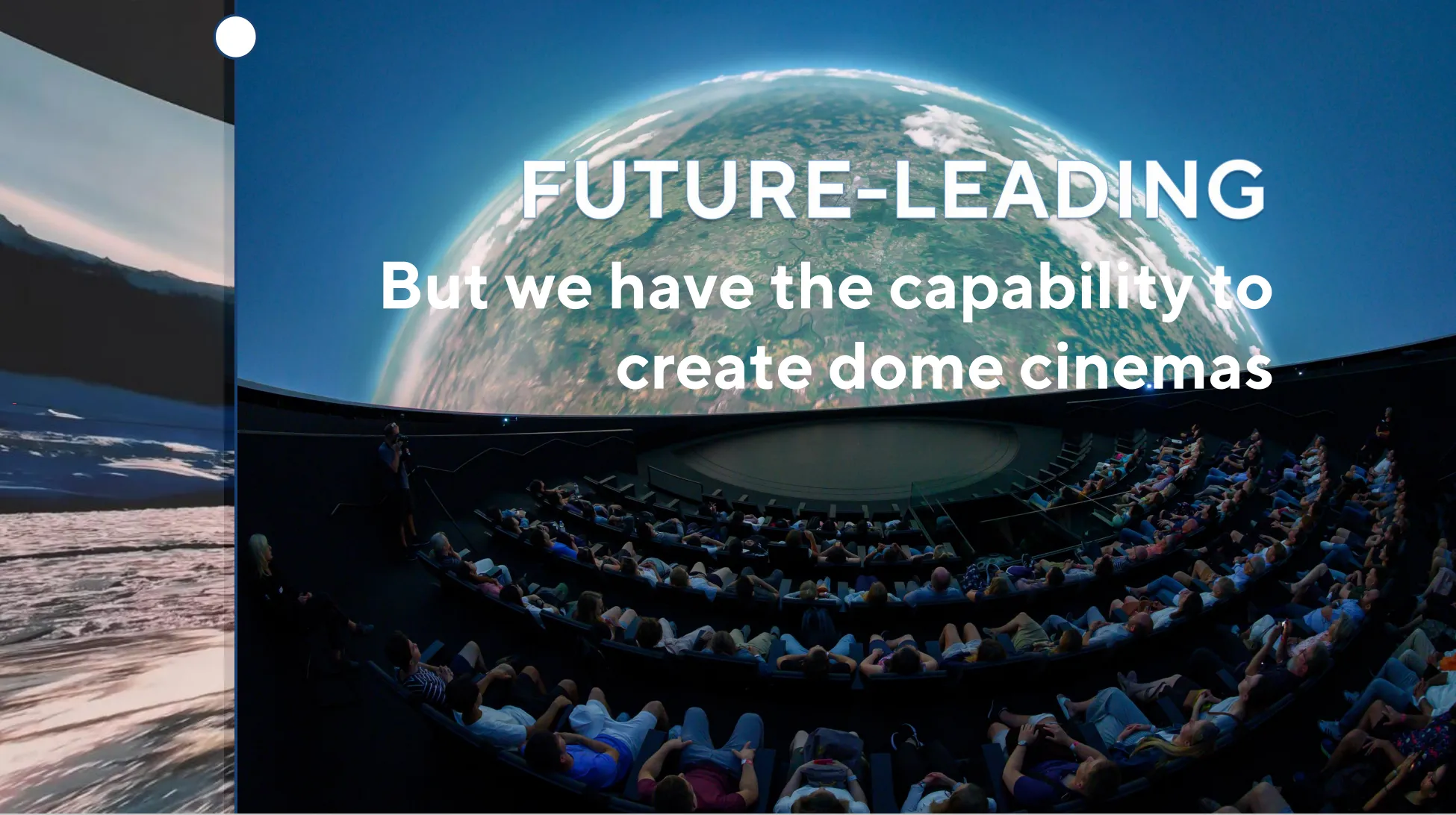
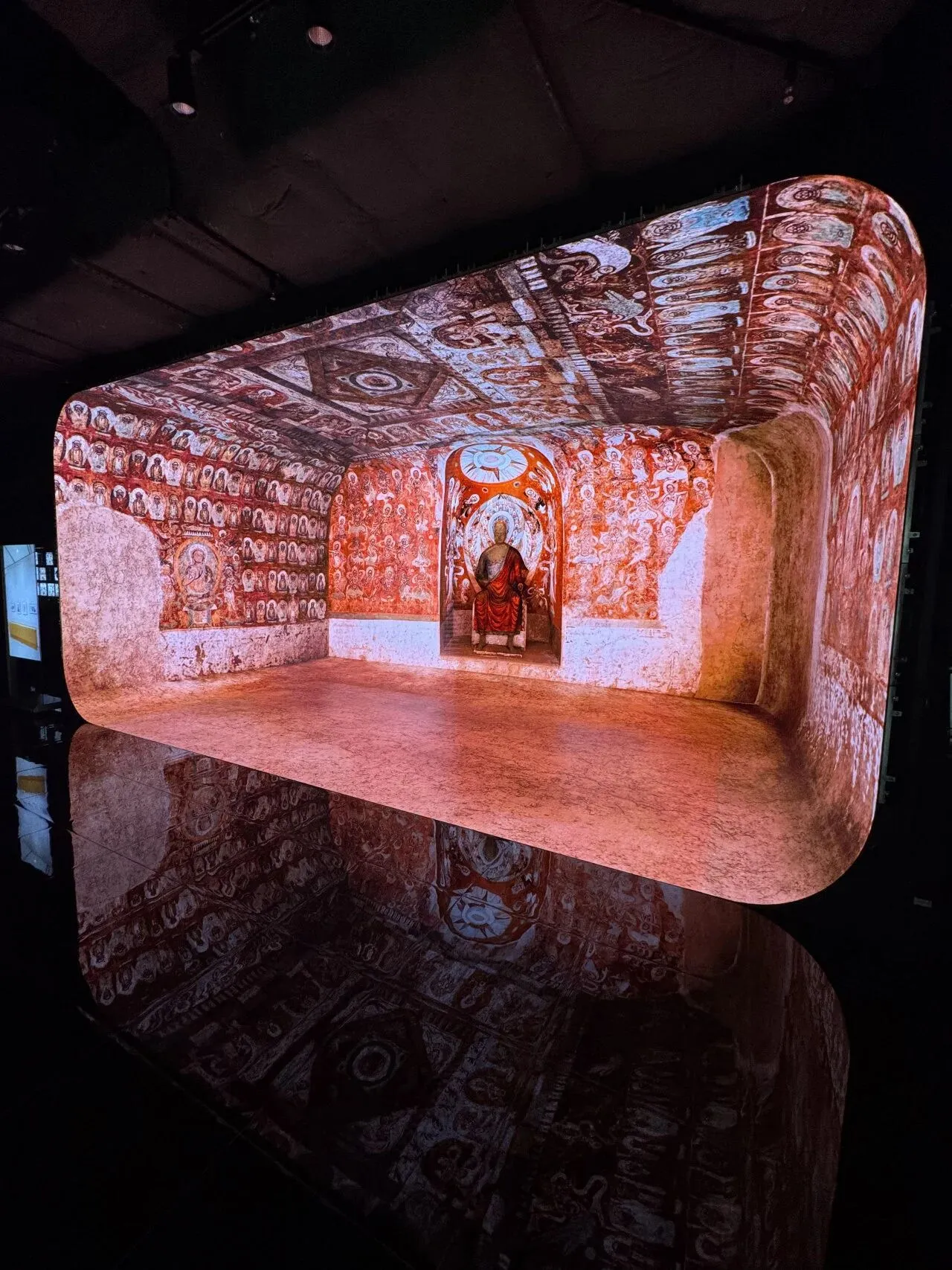
The Hong Kong University of Science and Technology Immersive Interactive Center is a benchmark project by Spectrum Creative in the research and education sector. The space features P1.9 high-density pixels with a total display area of 84.5㎡, constructing a five-sided fully enclosed space including floor and ceiling (CAVE system), achieving 7680Hz ultra-high refresh rate and DCI-P3 wide color gamut with active 3D technology.
Research-Grade Precision: A Complete Closed Loop from Signal Chain to 3D Mapping
The platform is powered by the UE5 rendering engine, supporting high-precision import and real-time interactive manipulation of 3D data models. The core competencies of its imaging system are reflected in:
l Full-Chain Low Latency: From server output to LED response, end-to-end latency is contained within two frames, ensuring immediacy of interactive operations.
l 3D Mapping Geometric Correction: For the different angles and curves of the five-sided space, the system uses pre-distortion algorithms to ensure seamless cross-screen visuals—no stretching, no tearing.
l FSD Frame Synchronization Technology: The proprietary frame synchronization solution achieves microsecond-level synchronization across five screens, ensuring geometric consistency in research outcome presentations.
Triple Patent Support for System Integration:
l Dome Panoramic Image Intelligent Playback Control System: Solves geometric distortion and color inconsistencies in multi-screen splicing with microsecond-level synchronization (the core algorithm of this software copyright is precisely based on 3D Mapping and frame synchronization technology).
l Immersive LED Display Virtual Scene Building Software: Enables 1:1 digital twin creation and pre-distortion simulation of the virtual environment at the project design phase, significantly shortening on-site debugging cycles.
l Retractable Mechanical Screen Motion Trajectory Editing System: Provides greater interactive flexibility for teaching spaces.
The Operational Value of "Reconfigurable Digital Assets"
Powered by the UE5 rendering engine and frame synchronization technology, the space can instantly switch between different scenarios—Academic Mode for research data presentations, and Art Curation Mode for cultural exhibitions (such as the "Cave Dance" Dunhuang theme exhibition). This flexible "theme switching" capability makes the space a highly reusable "reconfigurable digital asset."
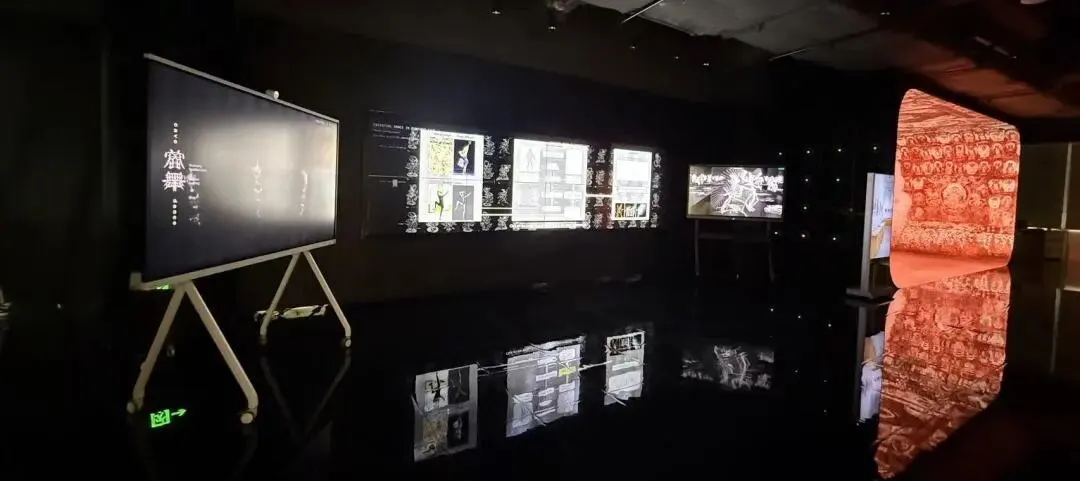
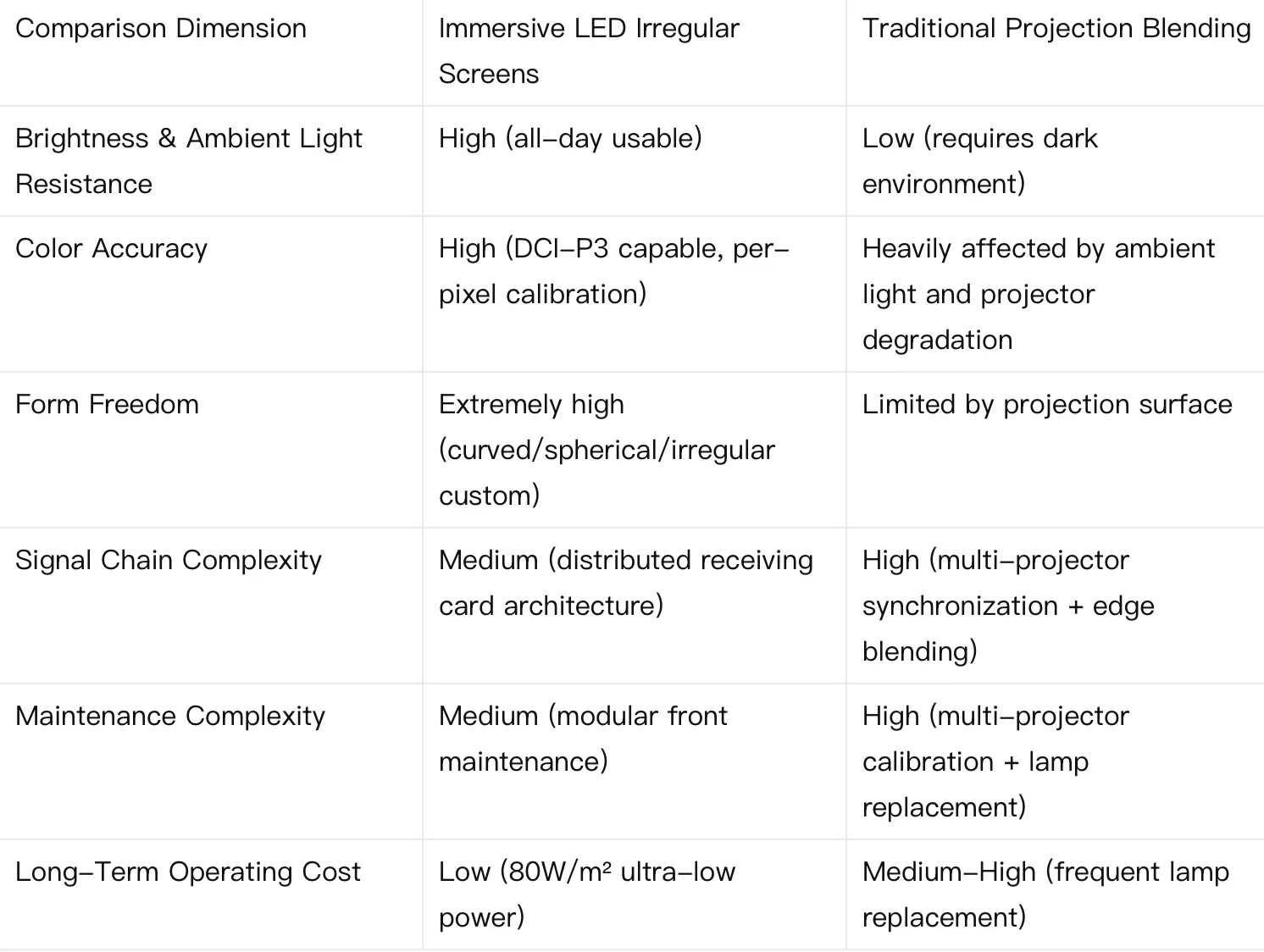
The core reason LED is replacing projection as the preferred choice for immersive spaces is not "brighter," but "more controllable"—LED offers more stable, predictable long-term performance across color, brightness, form, and maintenance.
Challenge 1: Curved Surface Flatness and Splicing Precision
Each module on a curved LED screen is installed at a different angle. Minor deviations create visible gaps or height differences at the seams. Solution: High-precision CNC-machined frames with six-axis adjustable mounting brackets, with module-by-module calibration during installation, supplemented by the receiving card's per-pixel position correction capability.
Challenge 2: Multi-Screen Frame Synchronization and Signal Latency
When multiple screens are independently driven, desynchronization can cause tearing. Solution: Hardware-level Genlock sync signals ensure all receiving cards refresh under the same clock; fiber optic transmission reduces long-distance signal latency.
Challenge 3: Content Adaptation Costs for Irregular Screens
Creating custom content for irregular screens is often costly. Solution: 3D Mapping algorithms map standard video onto irregular spaces in real time, establishing pixel-level LUTs—eliminating the need for project-specific distortion-adjusted assets and significantly reducing content production costs.
Q1: What is the essential difference between immersive LED irregular screens and ordinary LED screens?
A: Ordinary LED screens are "flat displays" viewed from outside; immersive LED irregular screens use curved, spherical, or multi-sided enclosures to "wrap" the audience inside the image, eliminating screen boundaries. The key differentiator lies in the control system—immersive systems require three core algorithms: multi-screen frame synchronization, 3D Mapping geometric correction, and per-pixel color calibration.
Q2: What percentage of the total project budget does content production typically account for in immersive LED projects?
A: Typically 20%–35%. Content for irregular spaces is more complex than for flat screens, requiring 3D modeling and spatial adaptation. However, with a playback system capable of 3D Mapping, standard panoramic video can be mapped onto irregular spaces in real time, significantly reducing content production costs.
Q3: How long is the typical installation cycle for irregular LED screens?
A: Depends on project complexity. The 428㎡ Sayram Lake dome project took approximately 4 months from design to delivery;generally, small to medium-sized immersive projects (100–200㎡) take about 2 to 3 months.. Factory pre-assembly combined with on-site modular installation and digital twin pre-commissioning can significantly reduce on-site construction time.
Q4: Can immersive LED integrate seamlessly with existing building structures?
A: Yes. Immersive LED uses modular designs adaptable to curved walls, cylinders, domes, floor tiles, and various architectural structures. Spectrum Creative conducts 1:1 digital twin modeling at the project planning stage to ensure seamless integration of the screen structure with the architectural space.
Q5: Is daily maintenance of a five-sided CAVE space difficult?
A: No. Immersive LED uses front-maintenance design—modules can be removed and replaced from the front without damaging building structures. Floor tile screens use modular load-bearing designs with single-point load capacity exceeding 1.5 tons, supporting independent replacement of individual modules.
l Spectrum Creative Official Website: www.spectrumcreative.cn