
2026-09-02
Share


Mlxos series model selection means choosing the right mechanical display model based on viewing distance, content type, installation scale, lighting requirements, video needs, power consumption, and interaction design.
Choosing a model is not simply about selecting a larger or smaller unit.
It is about matching the product logic with the project scenario.
For example:
l If the viewer stands close to the installation, the project needs higher density.
l If the project covers a large wall and is viewed from far away, lower density may be more efficient.
l If the space needs nighttime atmosphere, lighting capability becomes important.
l If the project needs video playback, a P10 LED screen version is required.
l If interaction is needed, the control system and content workflow must be considered from the beginning.
This guide explains how to choose between Mlxos 100, Mlxos 168, Mlxos 138L, and Mlxos 138P.
The first question is not “Which model is the best?”
The first question is:
What kind of content does the project need to present?
Different content types require different model choices.
If the main content is based on color blocks, logo patterns, abstract graphics, mechanical waves, or simple image-like effects, Mlxos 100 and Mlxos 168 are usually the first options.
These two models focus on mechanical flipping and color surface changes.
They are suitable for:
l brand logos
l pattern walls
l commercial facades
l storefront signs
l exhibition backdrops
l decorative mechanical surfaces
Mlxos 100 is better for refined close-range effects.
Mlxos 168 is better for large-area, long-distance installations.
If the project needs lighting atmosphere, especially in nighttime commercial spaces, Mlxos 138L is more suitable.
It combines mechanical flipping with RGB full-color light, making it suitable for:
l bars
l clubs
l nightlife districts
l art installations
l stage atmosphere
l interactive lighting walls
The source material describes the RGB full-color lighting version as suitable for light-and-shadow atmosphere, nighttime visuals, and artistic decoration.
If the project needs video content, moving images, product videos, brand films, or launch visuals, Mlxos 138P is the right direction.
Mlxos 138P integrates P10 LED screen capability. It combines mechanical movement with video expression and is suitable for high-end exhibition halls, product launches, interactive installations, and video display backdrops.
If the project needs interactive content triggered by people, cameras, LiDAR, or real-time sensors, the selection should consider not only the physical model, but also the control system.
The source material states that the product can support TouchDesigner, cameras, and LiDAR, allowing audience movement to trigger screen variations.
In general, all models can be considered for interactive design, but the final choice depends on whether the interaction should be based on color blocks, lighting, or video playback.
The following table uses the final Mlxos series naming while preserving the technical parameter logic from the source material.
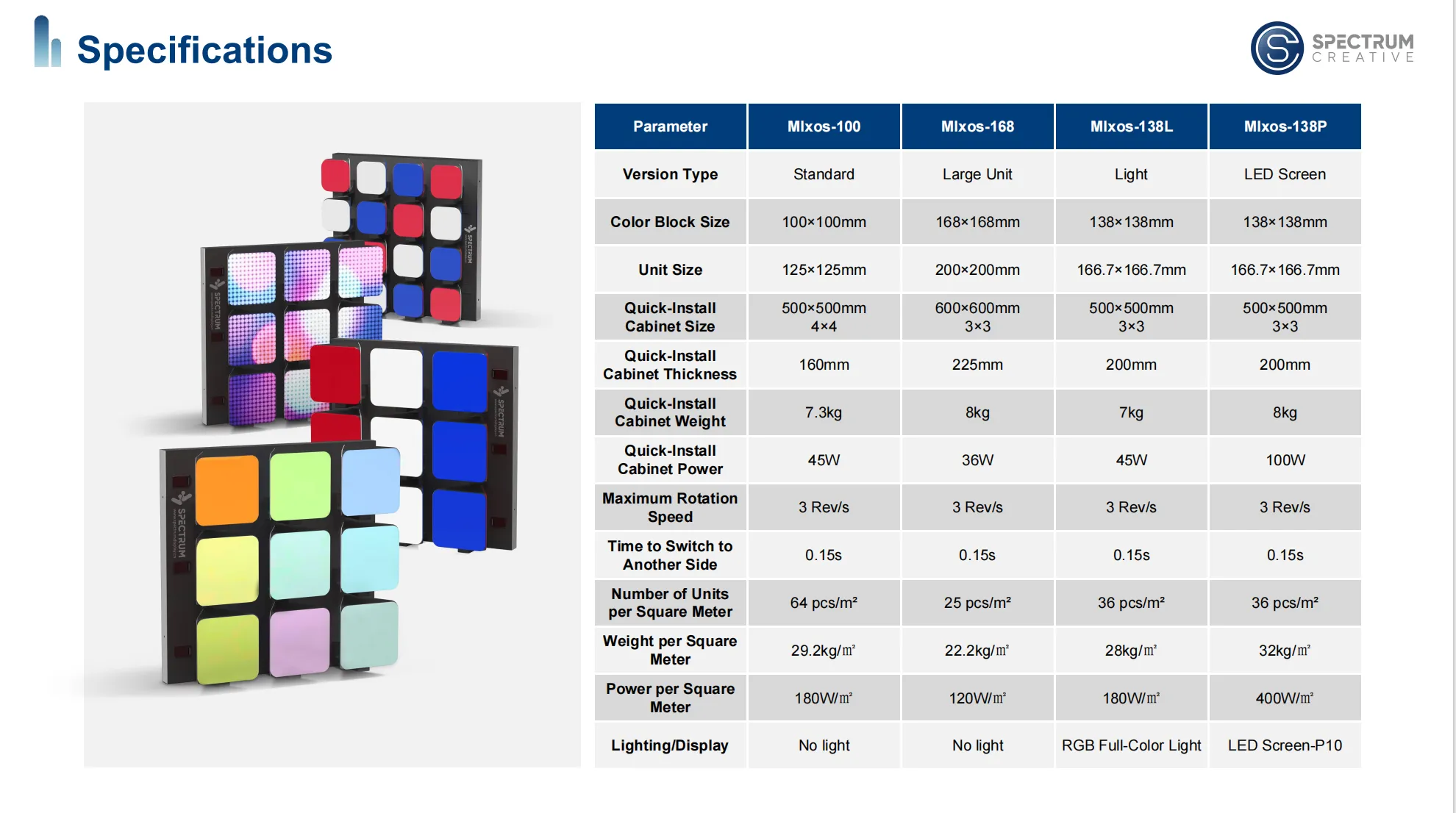
The source specifications provide the technical foundation for these parameters, including unit size, cabinet size, cabinet thickness, rotation speed, unit density, weight, power consumption, and lighting/display type.
Mlxos 100 is the high-density option in the series.
It uses 64 pcs/㎡, making it suitable for projects where viewers stand close to the display. In practical selection, it is recommended for viewing distances under 5 meters.
Because of its higher density, Mlxos 100 can create more refined matrix effects than lower-density models. It is suitable for spaces where detail matters.
Recommended applications include:
l storefront signs
l premium brand windows
l exhibition hall backdrops
l brand showrooms
l close-range display walls
l high-end commercial entrances
Mlxos 100 is especially useful when the product is seen at human scale.
For example, a visitor walking past a flagship store window may only be one or two meters away from the surface. In this case, unit density matters. A lower-density system may look too rough at close range, while Mlxos 100 can deliver a more delicate mechanical visual experience.
Choose Mlxos 100 when the project needs:
l higher visual density
l close-range viewing
l refined logo or pattern expression
l premium spatial quality
l small to medium area installation
However, if the project is very large and mainly viewed from far away, Mlxos 100 may not be the most cost-efficient choice.
Mlxos 168 is designed for large-area projects.
It uses 25 pcs/㎡, making it less dense than Mlxos 100, but more efficient for large surfaces. It is recommended for viewing distances over 8 meters.
This model is especially useful when the project needs visual scale rather than close-range detail.
Recommended applications include:
l large commercial walls
l airport corridors
l pedestrian streets
l shopping mall atriums
l public art walls
l large building interior or exterior surfaces
The key value of Mlxos 168 is balance.
It reduces unit density while maintaining strong mechanical movement. This makes it suitable for projects that require large visual coverage, controlled cost, and lower energy consumption.
According to the source specifications, the large-unit version uses 120W/㎡, making it the lowest power option among the four models.
Choose Mlxos 168 when the project needs:
l large-area installation
l long-distance viewing
l lower power consumption
l strong decorative impact
l better project cost control
For many commercial spaces, Mlxos 168 will be the practical choice when the goal is to build a visual landmark rather than show detailed images.
Mlxos 138L is designed for atmosphere.
It uses 36 pcs/㎡ and integrates RGB full-color lighting capability. This makes it suitable for spaces where lighting effects are more important than pure graphic detail.
Recommended applications include:
l nighttime commercial spaces
l bars and clubs
l entertainment venues
l stage atmosphere
l art installations
l interactive light walls
l immersive commercial interiors
The strength of Mlxos 138L is its ability to combine mechanical movement with light-and-shadow expression.
In a daytime retail space, the mechanical surface may be the main attraction.
In a nighttime venue, lighting becomes the emotional layer.
Mlxos 138L can create color changes, rhythm effects, and atmospheric movement, especially when connected with lighting control systems such as DMX512, Art-Net, or MADRIX. The source material confirms that the system supports DMX512, Art-Net, MADRIX, and TouchDesigner workflows.
Choose Mlxos 138L when the project needs:
l RGB full-color lighting
l nighttime visual impact
l music or stage rhythm linkage
l artistic light installation
l strong commercial atmosphere
If the project does not need video playback but needs a vivid nighttime identity, Mlxos 138L is usually more suitable than Mlxos 138P.
Mlxos 138P is the video-capable model.
It uses 36 pcs/㎡ and integrates a P10 LED screen. This allows the product to combine mechanical movement with video display.
Recommended applications include:
l high-end exhibition halls
l product launches
l interactive installations
l video display backdrops
l technology showrooms
l immersive brand presentations
Mlxos 138P is suitable when the project needs more than color blocks or lighting.
It can show video content, brand films, product visuals, animated graphics, and other digital media while still preserving the physical impact of mechanical flipping.
This makes it a good choice for projects where video content and mechanical movement need to work together.
However, Mlxos 138P also has higher power consumption. According to the source specifications, the LED screen version reaches 400W/㎡, higher than the other three models.
Choose Mlxos 138P when the project needs:
l video playback
l brand films
l product launch content
l high-end exhibition storytelling
l mechanical movement plus digital content
If the project does not require video, Mlxos 100, Mlxos 168, or Mlxos 138L may be more cost-effective.
Use the following text-based decision tree.
If yes, choose Mlxos 138P.
If no, go to Step 2.
If yes, choose Mlxos 138L.
If no, go to Step 3.
If the audience is within 5 meters, choose Mlxos 100.
If the audience is over 8 meters, choose Mlxos 168.
If the viewing distance is between 5 and 8 meters, choose based on project priority:
l choose Mlxos 100 for better detail
l choose Mlxos 168 for larger area and better cost control
If yes, Mlxos 168 is usually more practical.
If no, Mlxos 100 can create a more refined close-range experience.
If yes, confirm the control system early.
Depending on the interaction content:
l color and motion interaction: Mlxos 100 or Mlxos 168
l lighting interaction: Mlxos 138L
l video interaction: Mlxos 138P
Yes, different models can be mixed in one project, but the logic must be clear.
Mixed-use design should not be random. It should follow spatial hierarchy.
A common strategy is to use Mlxos 100 in close-range areas and Mlxos 168 in large-area background zones.
For example:
l Mlxos 100 for the entrance logo wall
l Mlxos 168 for a large atrium wall
This allows the project to maintain detail where people stand close, while controlling cost and power consumption on large surfaces.
Another strategy is to combine Mlxos 168 with Mlxos 138L.
For example:
l Mlxos 168 for a large mechanical facade
l Mlxos 138L for nighttime lighting zones
This is suitable for commercial spaces that operate both during the day and night.
Mlxos 138P can be used as a video focal area, while Mlxos 100 or Mlxos 168 can form the surrounding mechanical pattern surface.
For example:
l Mlxos 138P for a central video zone
l Mlxos 168 for surrounding movement effects
This works well for exhibition halls, product launches, and immersive brand spaces.
When mixing models, the project team should consider:
l visual transition between different unit sizes
l control protocol compatibility
l content production logic
l maintenance zoning
l spare parts strategy
l power and structural load differences
Mixed use can create stronger design effects, but it also requires more careful planning.
Choosing Mlxos series is not only about product price.
A good selection plan should also consider long-term operating cost, structural cost, maintenance, spare parts, and content production.
Power consumption can significantly affect long-term project cost, especially for large-area installations.
The source material lists the following power consumption per square meter:
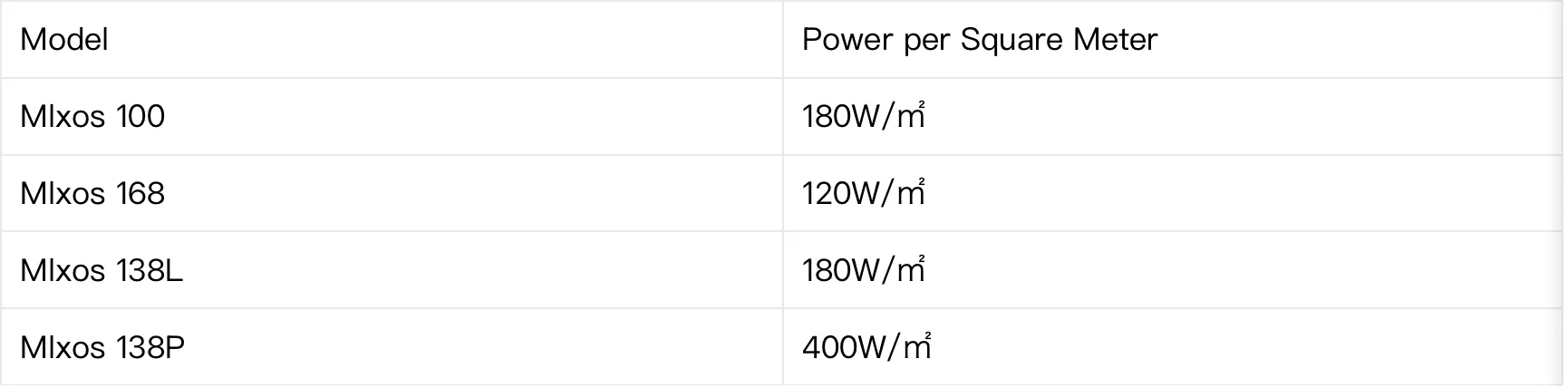
These values are based on the source specifications for the four corresponding product types.
Assume:
l project area: 100㎡
l operation time: 10 hours per day
l operation days: 365 days per year
l electricity price: USD 0.15 per kWh
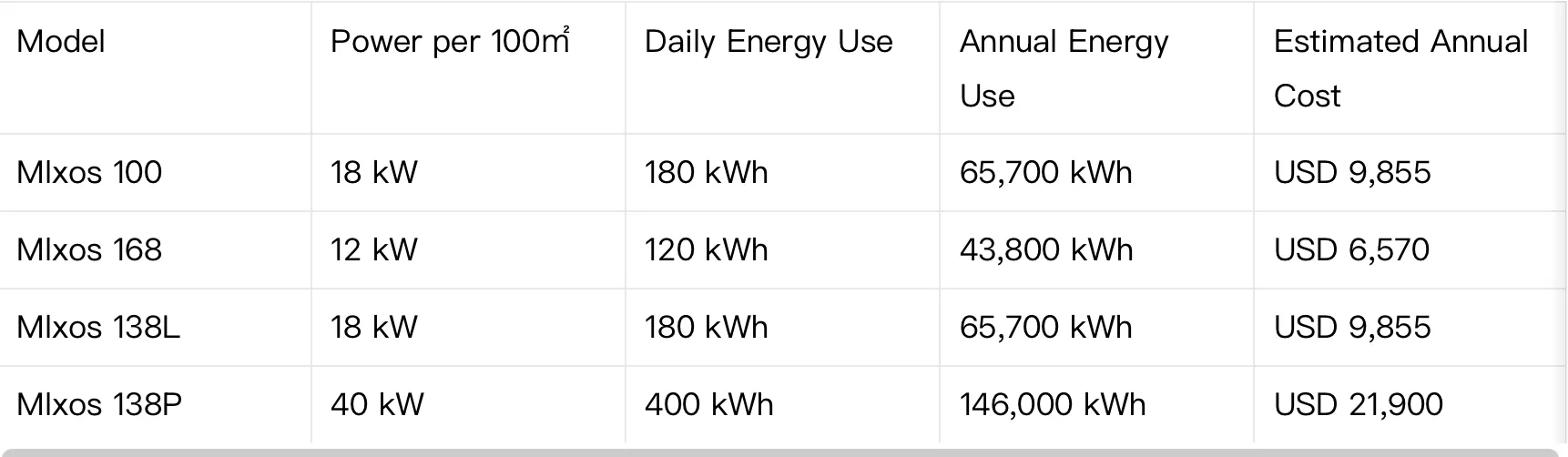
This estimate shows why Mlxos 168 is often the energy-saving choice for large-area projects.
Mlxos 138P should be selected when video playback is truly necessary, because its LED screen capability also brings higher power requirements.
Weight is another hidden cost.
The source specifications list the following weights per square meter:
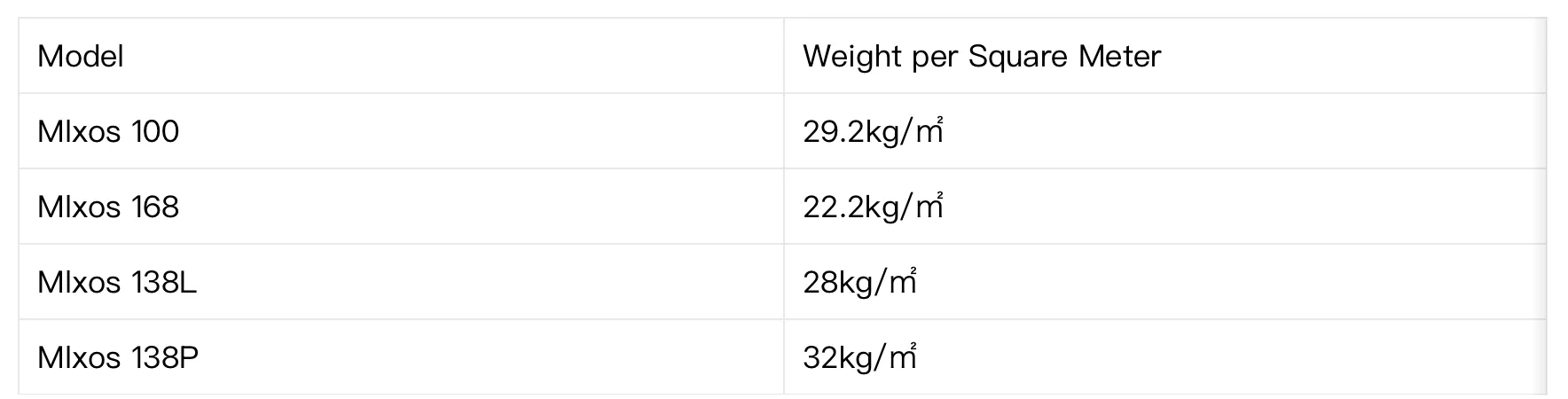
These values affect steel structure, wall reinforcement, ceiling suspension, transportation, and installation planning.
For wall-mounted projects, the load-bearing structure must be reviewed early.
For ceiling installations, suspension safety is even more important.
For temporary exhibitions, transport weight and installation efficiency should also be included in project budgeting.
For large projects, spare parts should be planned in advance.
A recommended reserve is usually 5%–8% of the total unit quantity, depending on project scale, maintenance requirements, installation difficulty, and operating environment.
For example:
l small showroom projects may use 5%
l large public space projects may use 8%
l touring or rental projects may require more frequent spare replacement planning
Spare parts planning can reduce future maintenance delays and avoid long downtime.
Different models also create different content production needs.
Mlxos 100 and Mlxos 168 mainly require:
l pattern design
l color block logic
l motion sequence design
l mechanical wave programming
Mlxos 138L additionally requires:
l lighting design
l RGB effect programming
l music or stage rhythm linkage
Mlxos 138P requires:
l video content production
l pixel mapping
l LED video adaptation
l motion and video synchronization
Therefore, Mlxos 138P may involve higher creative and technical content costs than standard mechanical versions.
Control protocol selection affects system design, response logic, and integration with other systems.
The source material states that the product supports both DMX512 and Art-Net, allowing integration with stage lighting, content production, and interactive control systems.
DMX512 is widely used in stage lighting control.
It is suitable for:
l lighting effects
l rhythm changes
l stage control
l simple programmed sequences
l stable device-level control
For projects that mainly require predictable lighting or movement sequences, DMX512 is practical and reliable.
Art-Net is a network-based protocol that transmits DMX data over Ethernet.
It is suitable for:
l larger systems
l complex control networks
l integration with digital content systems
l real-time interactive workflows
For projects involving TouchDesigner, sensors, cameras, LiDAR, or large-scale interactive content, Art-Net can provide a more flexible control architecture.
Choose DMX512 when the project needs:
l simple lighting control
l stable stage effects
l smaller control systems
l traditional lighting console workflow
Choose Art-Net when the project needs:
l larger installation scale
l network control
l real-time content
l third-party system integration
l interactive design
For many commercial projects, the final control system may combine both.
Art-Net can handle network-level control, while DMX512 can execute device-level instructions.
The source control diagram also shows Art-Net to DMX512 conversion as part of the control link, making third-party system integration easier.
Mlxos 100 is recommended for close-range viewing under 5 meters. It uses 64 pcs/㎡ and is suitable for refined display effects, storefronts, brand windows, showrooms, and premium display walls.
Mlxos 168 is recommended for large-area commercial walls. It uses 25 pcs/㎡, is suitable for viewing distances over 8 meters, and offers lower power consumption at 120W/㎡.
Mlxos 138L is recommended for nighttime atmosphere. It integrates RGB full-color lighting and is suitable for bars, clubs, art installations, stage environments, and commercial lighting effects.
Mlxos 138P supports video playback. It integrates a P10 LED screen and is suitable for product launches, high-end exhibition halls, video display backdrops, and interactive digital installations.
Yes. Mlxos series can be connected with TouchDesigner, cameras, LiDAR, DMX512, Art-Net, and MADRIX workflows to create sensor-based interaction, human-machine response, lighting linkage, and real-time content changes.