
2026-09-22
Share


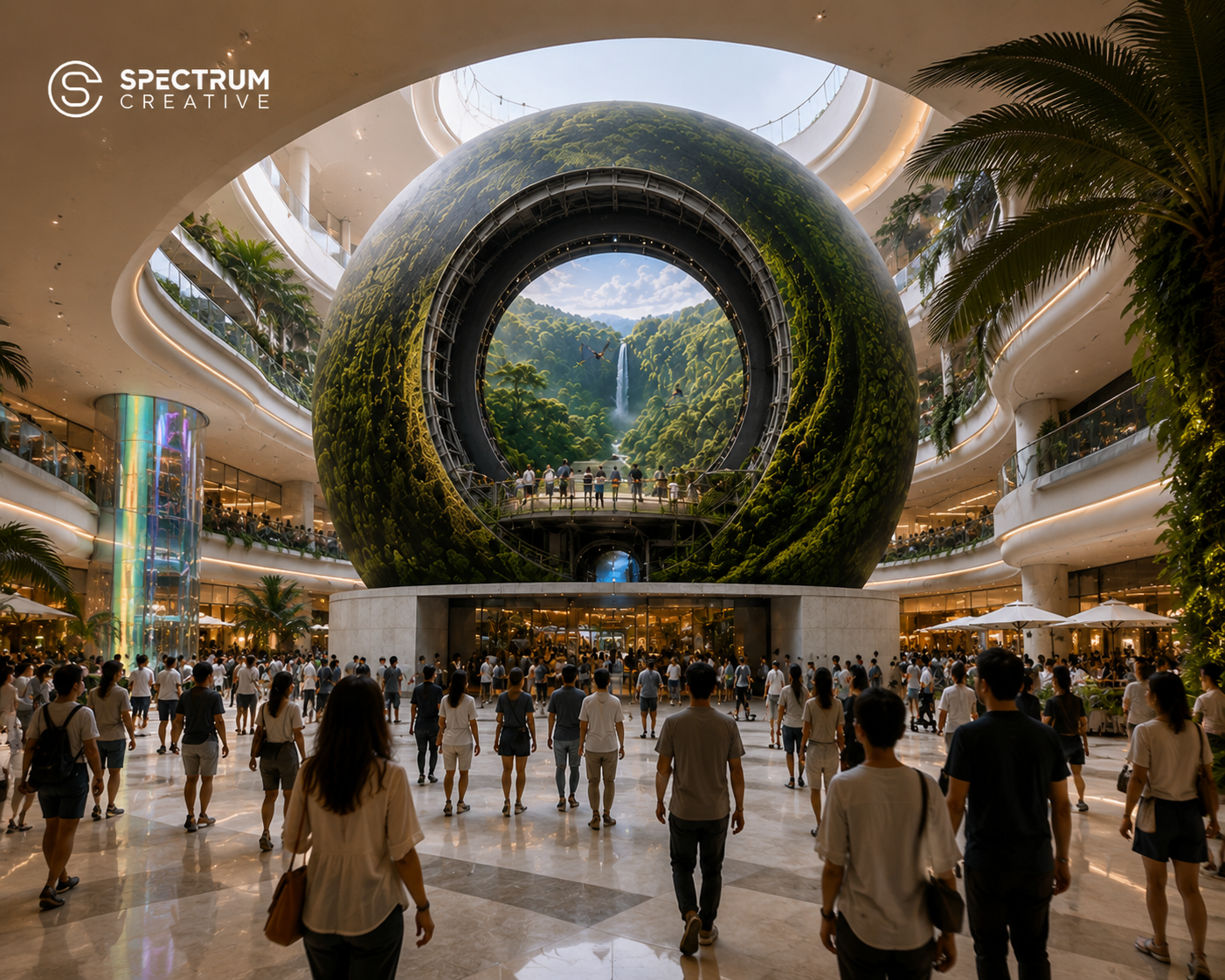
When a client asks:
“We want to install an LED sphere in our shopping mall atrium. The diameter is around 10 meters. Can you provide a quotation?”
This is one of the most common questions received by Spectrum Creative.
However, a professional answer cannot be a simple number.
A large-scale LED sphere project is not priced by multiplying the display area by a fixed unit cost. Unlike conventional LED walls, a spherical LED installation is a customized engineering system that combines architectural evaluation, structural design, display technology, content adaptation, control systems, installation planning, and long-term operation.
Before a reliable quotation can be provided, the project must go through a complete technical confirmation process — from understanding the client’s objectives to validating whether the proposed solution can actually be built.
This is not a limitation of the quotation process. It is a necessary engineering approach.
A large LED sphere is fundamentally different from a standard commercial display. A television can be manufactured, packaged, delivered, and powered on immediately. A spherical LED system, however, needs to be designed around each specific environment.
The sphere diameter is only the beginning.
The final solution depends on where the sphere will be installed, how audiences will experience it, what content will be displayed, how the structure will be supported, and how the system will operate over years of use.
One of the biggest misunderstandings about LED sphere projects is treating them as a traditional display product.
For a flat LED wall, many basic parameters can be standardized. Pixel pitch, cabinet size, brightness level, and installation method can often be selected from existing product systems.
A spherical LED display is different.
The curved surface changes everything.
Each module needs to follow the geometry of the sphere. The supporting structure must match the building environment. The control system needs to handle curved image mapping. The content itself needs to be adapted to avoid visual distortion.
A successful LED sphere project requires cooperation between multiple disciplines:
Display engineering
Mechanical and structural engineering
Electrical planning
Software and control systems
Content production
Installation and maintenance
This is why two projects with the same diameter can still have completely different budgets.
For example, a 5-meter sphere installed in a shopping mall atrium may require customized structural integration, while another 5-meter sphere built inside an exhibition hall may have a completely different engineering approach.
The physical size may be similar, but the project requirements are not.
The diameter of an LED sphere is an important factor, but it does not determine the entire project cost.
As sphere size increases, the complexity of the project grows faster than the physical dimensions.
A larger sphere requires more LED modules, but it also creates additional engineering challenges. The supporting structure becomes more complex, installation becomes more demanding, and transportation requirements become more difficult.
For example, increasing a sphere from a medium-sized installation to a large architectural landmark does not simply mean adding more LED panels. Engineers must reconsider:
structural stability
module segmentation
maintenance access
installation sequence
signal transmission
power distribution
Large spherical displays are therefore closer to architectural projects than traditional display projects.
Pixel pitch is another major factor affecting both visual quality and project investment.
A smaller pixel pitch provides higher image density and better viewing quality, especially when audiences stand close to the display.
This makes fine-pitch solutions suitable for environments such as:
museums
exhibition spaces
interactive experiences
premium commercial installations
For larger venues where audiences view the sphere from a distance, a larger pixel pitch may already provide sufficient visual performance while maintaining better cost efficiency.
The correct choice is not simply the smallest pixel pitch available.
It depends on the relationship between:
viewing distance
sphere size
content type
expected visual experience
A well-designed project balances image quality and investment rather than maximizing specifications without considering the actual environment.
Not every spherical LED project uses the same structure.
Some projects require a complete 360-degree sphere, while others may use a dome structure or a customized spherical form integrated into an architectural space.
Each structure creates different engineering requirements.
A full sphere installed in a public plaza needs to consider visibility from every direction, weather protection, and structural stability.
A dome installed inside a museum may focus more on immersive viewing experience, audience circulation, and content presentation.
The geometry of the structure directly affects:
module arrangement
supporting framework
installation method
maintenance strategy
Therefore, the first engineering question is not simply:
“How large is the sphere?”
The more important question is:
“What experience does this sphere need to create, and how will it exist within the surrounding space?”
The installation environment has a direct influence on the engineering solution.
Indoor LED spheres usually have more controlled conditions. The design can focus primarily on image quality, audience experience, and integration with the surrounding architecture.
Outdoor installations require a more comprehensive engineering approach.
Compared with indoor environments, outdoor spherical LED projects need to address challenges such as higher brightness requirements, weather protection, waterproof performance, thermal management, wind resistance, and long-term durability.
These factors directly influence material selection, structural design, and manufacturing processes.
An outdoor sphere is not simply an indoor display placed outside. It is a system designed to operate reliably under changing environmental conditions.
The supporting structure is often one of the most underestimated parts of an LED sphere project.
Before production begins, engineers need to understand how the sphere interacts with the building.
Important considerations include whether the installation is:
ground-supported
suspended from above
integrated into an existing structure
installed as an independent architectural feature
A project inside a shopping mall may require lightweight structural solutions because of building load limitations.
A large outdoor installation may require a completely independent steel framework designed for long-term stability.
The structural solution affects not only cost but also safety, installation time, and future maintenance.
This is why engineering evaluation must happen before final pricing.
An LED sphere is not only a physical display surface.
It is also a digital visual system.
Unlike flat screens, spherical displays require specialized content adaptation. Standard videos cannot simply be uploaded and expected to display correctly.
Without proper mapping, images may appear stretched around certain areas of the sphere or compressed near curved sections.
A complete spherical display solution may involve:
spherical image mapping
synchronization systems
real-time content processing
interactive technologies
remote operation
The display hardware creates the canvas, but the control system determines how that canvas becomes an experience.
For this reason, professional LED sphere projects evaluate both hardware and software from the beginning.
A successful LED sphere project is not completed by simply manufacturing LED modules and installing them on site.
From the first discussion with the client to the final system operation, the project usually goes through a series of engineering validation stages.
Each stage reduces uncertainty and ensures that the final installation can achieve the intended visual experience.
Every LED sphere project begins with understanding the purpose behind the installation.
Before discussing specifications or pricing, the project team needs to understand what role the sphere will play within the space.
A sphere designed for a shopping mall may focus on attracting visitors and creating a memorable brand experience.
A sphere installed in a science museum may prioritize education, visualization, and immersive storytelling.
A project for an entertainment venue may require advanced content synchronization and interactive features.
Therefore, the first step is defining the application scenario.
The engineering team needs to understand:
Where will the sphere be installed?
How will visitors experience it?
What is the expected viewing distance?
Will the audience view the sphere from a fixed position or walk around it?
What type of content will be displayed?
These questions directly influence the technical solution.
The installation environment determines factors such as brightness requirements, pixel pitch selection, structural design, and content workflow.
Without a clear understanding of the application, even a technically impressive display may fail to deliver the expected experience.
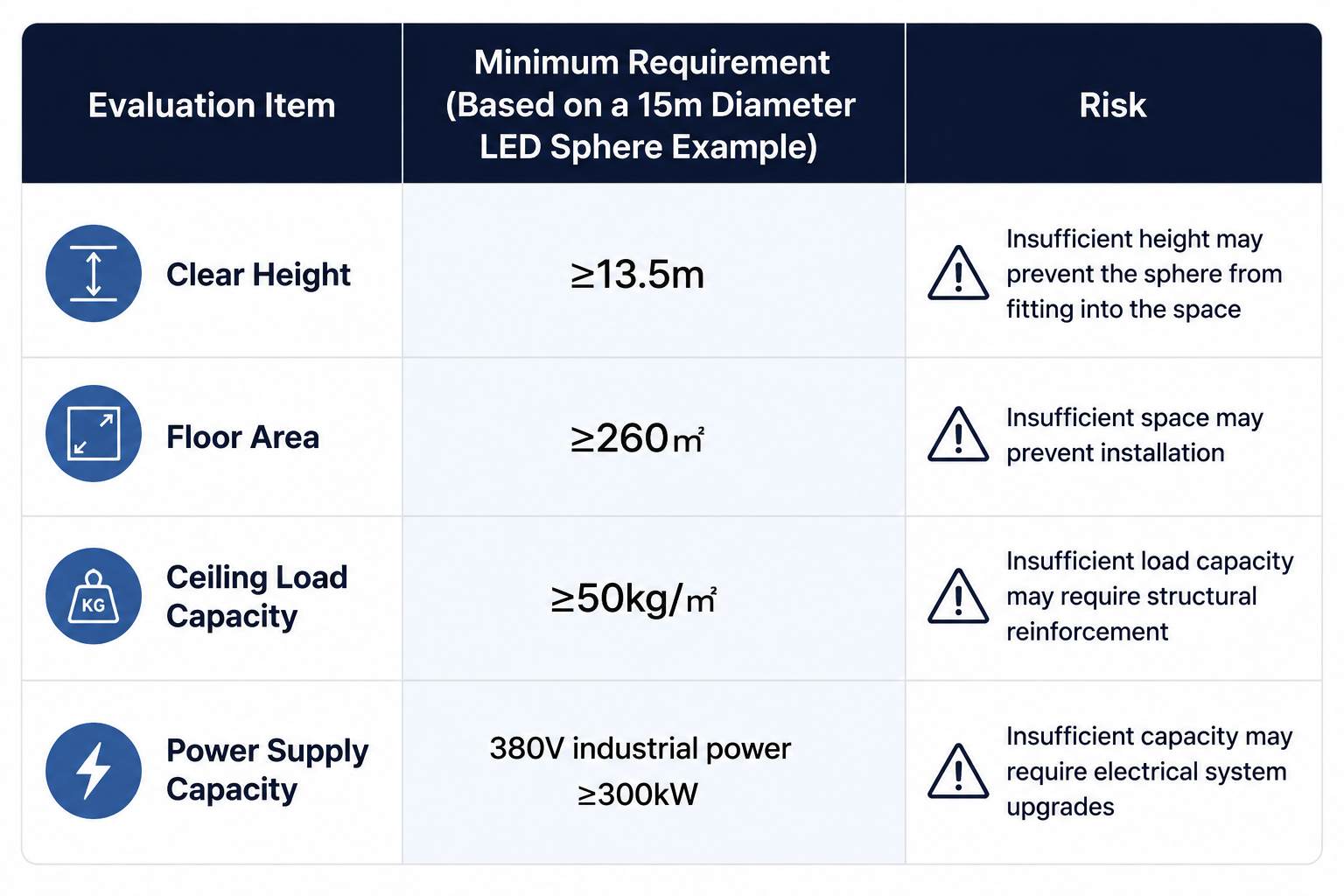
After defining the project requirements, the next step is verifying whether the installation environment can support the proposed solution.
This is one of the most important stages before quotation.
Engineers need to evaluate the actual site conditions, including available installation space, ceiling height, structural load capacity, power supply, ventilation, and maintenance access.
For example, a large sphere installed inside a commercial atrium may require a detailed assessment of the building structure.
The project team needs to confirm whether the existing architecture can support the additional load and whether reinforcement is necessary.
Electrical capacity is another critical factor.
Large LED sphere installations require stable power distribution and carefully planned electrical systems to ensure reliable operation.
Maintenance planning must also be considered at this stage.
A visually impressive installation is only successful when it can be safely maintained after completion.
This is why Spectrum Creative does not provide a simple quotation based only on diameter.
The purpose of technical evaluation is to ensure that the proposed solution is realistic, safe, and achievable.
Once the site conditions are confirmed, the project moves into solution design.
For complex spherical LED projects, digital simulation plays an important role before manufacturing begins.
Spectrum Creative uses engineering simulation methods to verify the relationship between the display system and the installation environment.
The process includes creating a digital model of the project, testing the spherical module arrangement, validating structural concepts, and preparing detailed installation documentation.
This stage answers some of the most important engineering questions:
How should the sphere be divided into modules?
How should the supporting structure carry the load?
How can signal transmission remain stable across the curved surface?
How can content be displayed without distortion?
By solving these problems before production, digital validation reduces risks during manufacturing and installation.
For large-scale custom displays, simulation is not only a design tool. It is a method for controlling project uncertainty.
After the technical solution is approved, the project enters the manufacturing phase.
Unlike standard LED products, large spherical displays require customized production planning.
A professional workflow includes module preparation, structural assembly, signal testing, and system verification before shipment.
Factory pre-assembly is especially important for large projects because it allows engineers to identify potential problems before the equipment reaches the installation site.
During this stage, the team can verify:
whether the modules fit correctly
whether the structure performs as expected
whether the control system operates properly
whether installation procedures are practical
For the 4.8-meter LED sphere project at Siam Paragon in Bangkok, factory preparation helped significantly reduce on-site installation time.
For large immersive display projects, factory pre-assembly is not simply an additional service.
It is an essential part of project risk management.
After the modular components arrive at the project location, the installation phase begins.
The process requires coordination between structural teams, electrical engineers, display technicians, and content specialists.
The installation is not only about assembling hardware.
The team must ensure that every part of the system works together.
This includes:
Structural framework installation
LED module assembly
Signal and power connection
Control system configuration
Image calibration
Content testing
Because the display surface is curved, calibration is especially important.
Even small installation deviations can affect visual consistency across the sphere.
After hardware installation is completed, engineers conduct system testing to ensure:
image accuracy
color consistency
brightness performance
stable signal transmission
reliable operation
The goal is not simply to turn on the screen.The goal is to create a seamless visual experience.
The moment an LED sphere is powered on is not the end of the project.
It is the beginning of long-term operation.
During the acceptance stage, the project team verifies whether the system meets the original design requirements.
This includes checking visual performance, system stability, maintenance accessibility, and operational reliability.
Long-term success also depends on continuous management.
A spherical LED installation requires:
regular inspection
spare module planning
software maintenance
content updates
Content is often overlooked in large display projects.
However, an LED sphere is ultimately a storytelling platform.
Without continuous content updates, even the most advanced hardware may gradually lose audience attraction.
The most successful immersive installations are not only engineering achievements.They are continuously evolving experiences.
One of the most common questions from clients is:
“If our sphere is only slightly larger than another project, shouldn’t the price be similar?”
The answer is usually no.
Diameter is only one variable among many.
Two spheres with similar dimensions can have completely different budgets depending on their application, environment, and technical requirements.
A project requiring a lightweight customized structure may cost significantly more than a ground-supported installation.
A sphere requiring advanced real-time interaction and 8K content processing may require a more sophisticated control system.
A project designed for close viewing may require a finer pixel pitch compared with a large outdoor installation viewed from a distance.
The final investment is determined by the complete engineering solution, not by size alone.
A reliable budget begins with accurate information.
Before discussing final investment, project owners should confirm essential conditions such as installation space, structural capacity, and electrical availability.
A quotation without technical validation may create unrealistic expectations.
Pixel pitch should be selected according to how audiences experience the sphere.
Close viewing environments require higher image density.
Large venues with longer viewing distances may achieve excellent results with different specifications.
The best solution is not always the one with the smallest pixel pitch.
It is the one that matches the actual application.
Hardware creates the physical platform, but content creates the experience.
Spherical displays require specially adapted content because traditional flat videos cannot fully utilize the curved surface.
Professional content production and continuous updates should be considered part of the overall project investment.
A successful LED sphere project requires cooperation across multiple fields.
A supplier that only provides display hardware may leave the client responsible for coordinating structural engineers, software teams, and content providers.
Working with a partner that understands display technology, engineering integration, and immersive experience design can significantly reduce project risks.
Because an LED sphere is not a standardized product.
Pixel pitch, sphere geometry, installation conditions, structural requirements, control systems, and content requirements all influence the final solution.
A simple square-meter quotation cannot accurately represent the real engineering requirements.
The cost depends on many project-specific factors, including display specifications, structure, installation environment, and system requirements.
A reliable quotation can only be provided after completing requirement analysis and technical evaluation.
The timeline depends on project complexity.
Projects using factory pre-assembly and modular installation methods can significantly reduce on-site construction time.
A medium-sized customized LED sphere project may take several weeks, while larger architectural installations may require several months.
The selection depends mainly on viewing distance and application purpose.
Closer viewing requires higher pixel density, while larger venues may prioritize overall visual impact and cost efficiency.
A well-designed LED sphere should include maintenance planning from the beginning.
Modular design, accessibility, spare parts preparation, and regular inspection help ensure stable long-term operation.
Compared with traditional projection-based immersive systems, LED-based solutions can provide more consistent brightness and require less frequent calibration.
A large-scale LED sphere is not simply a curved screen.
It is a combination of architecture, engineering, display technology, software, and creative storytelling.
The most successful projects begin long before manufacturing starts.
They begin with understanding the space, defining the experience, validating the engineering, and building a solution that can operate reliably for years.
For clients planning an immersive LED sphere project, the right first step is not asking:
“How much does a sphere cost?”
The better question is:
“What engineering solution can turn this idea into a successful experience?”