
2026-09-29
Share


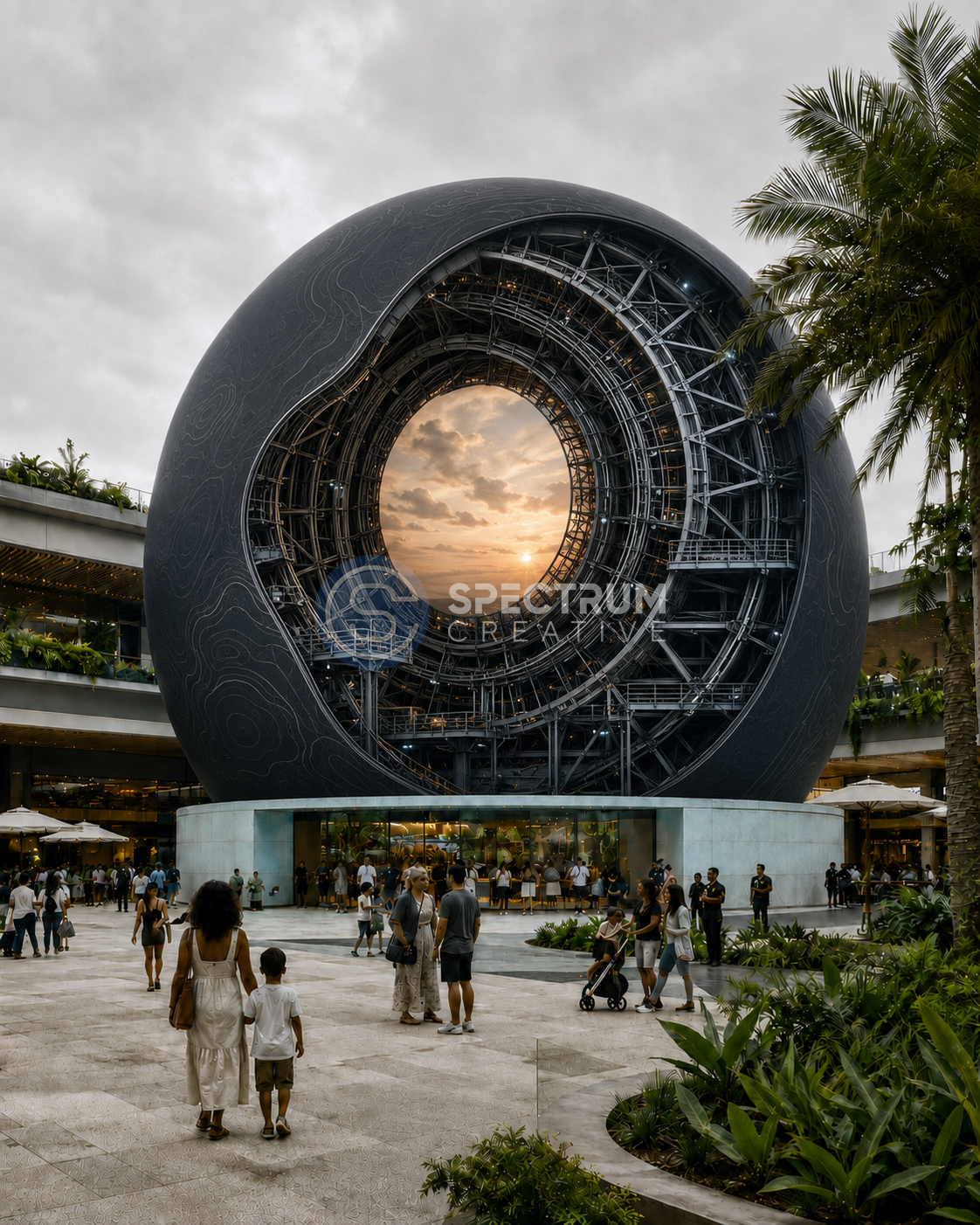
One-sentence definition:
The cross-border delivery of an overseas immersive LED project is a standardized engineering system covering factory pre-assembly, modular ocean shipping, localized installation, and system commissioning. It requires the supplier to have manufacturing capability, project management capability, and cross-border coordination capability at the same time.
A client may ask: “We want to install this LED sphere in Bangkok. Can you do it?”
The answer is yes. But before saying yes, the Spectrum Creative project team first needs answers to three questions.
First, what are the site conditions?
Is the clear height sufficient? What is the load-bearing capacity of the floor? Is there a night construction window? Has the mall opening date already been fixed?
When the project team entered the Bangkok Siam Paragon site, they found that the atrium structure required a secondary load-bearing review, night construction time was highly restricted, and the mall opening date had already been locked. These conditions directly determined the delivery strategy.
Second, what are the local regulations and standards?
Different countries have different requirements for building structures, fire safety, and electrical standards. The Jakarta project in Indonesia, for example, is located in a tropical environment with high temperature, high humidity, and annual rainfall exceeding 2,000mm, so outdoor equipment must meet IP65 or higher protection requirements. European projects usually require CE certification, while US projects may require UL certification. If the certification is not approved, the equipment cannot pass customs.
Third, who will coordinate the site?
Overseas projects involve the owner, local construction teams, property management departments, and sometimes local approval authorities. Language, time zones, and construction habits can all affect the delivery schedule.
Only after these three questions are answered can the delivery plan truly begin.
The biggest difference between overseas projects and domestic projects is this: once something goes wrong overseas, you cannot always send people to fix it immediately.
Ocean shipping can take 20–45 days. Engineers need visas, travel arrangements, time zone adjustment, and coordination with local teams. Any small oversight can push the entire project into a delivery bottleneck.
That is why Spectrum Creative’s approach is simple: solve every possible problem inside the factory first.
At the Shenzhen or Huizhou production base, the engineering team builds a physical simulation according to the actual site dimensions. Module segmentation, steel structure assembly, cable routing, and media control system debugging are all tested in the factory before shipment.
For the Bangkok Siam Paragon project, the team completed full 1:1 simulation assembly and system pre-commissioning in Shenzhen. For the Austria indoor LED sphere project, the team also completed pre-commissioning before shipment, including sphere segmentation logic, module cabling, and playback software configuration.
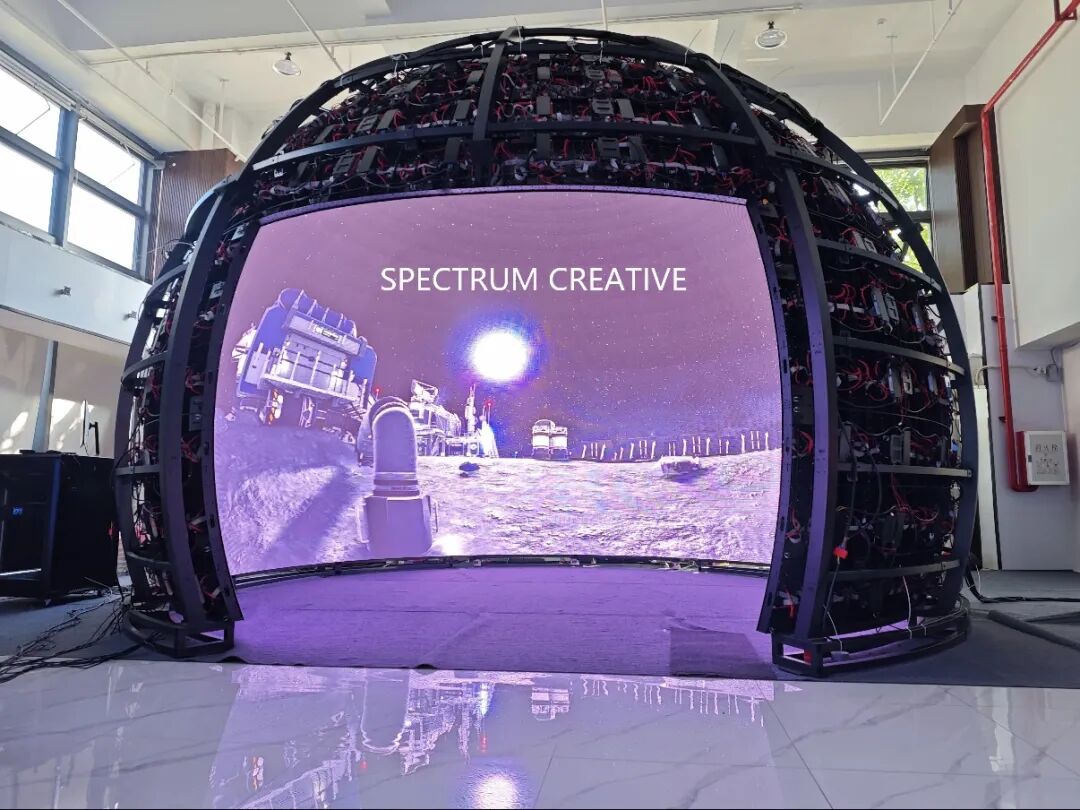
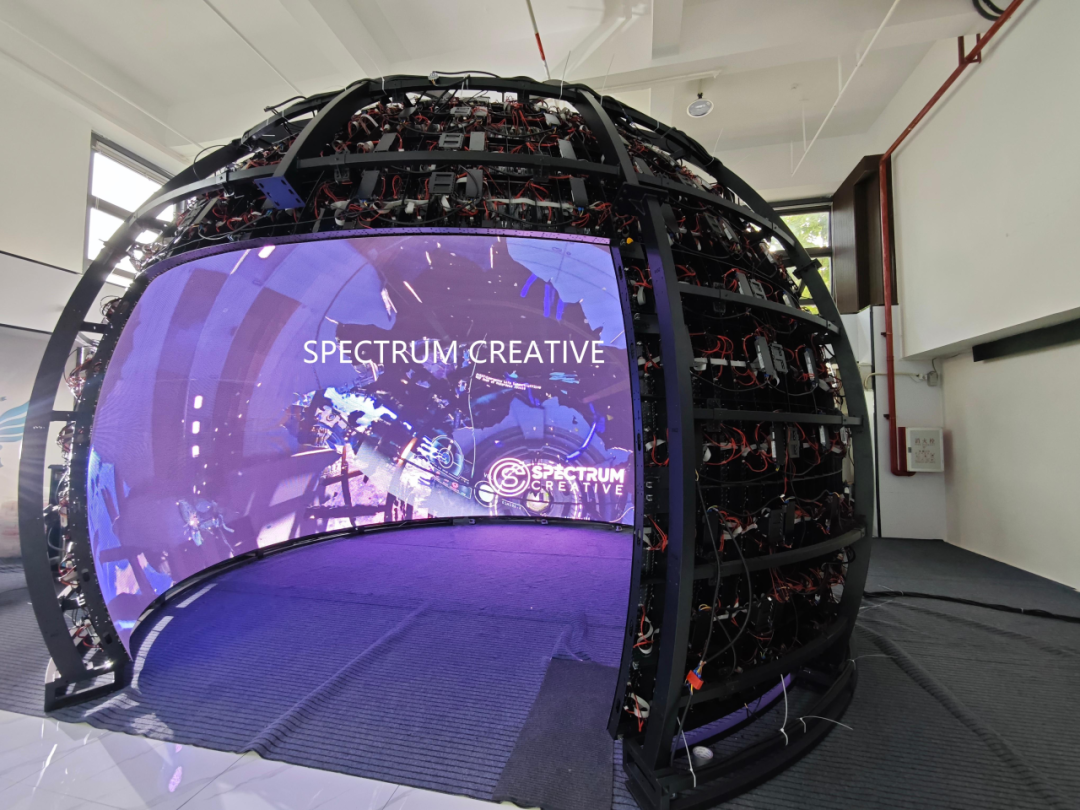
Beyond physical pre-assembly, software-level verification is also required.
Through Immersive LED Display Virtual Scene Construction Software V1.0, the engineering team completes pre-distortion processing and 3D Mapping parameter setup in a digital environment.
Through Spherical Panoramic Image Intelligent Playback Control System V1.0, the team verifies the spherical mapping algorithm and frame synchronization accuracy.
The first step is module lighting testing. Each module is powered on individually to check for dead pixels, color deviation, and brightness consistency.
The second step is system integration testing. After all modules are assembled, standard test visuals are played to verify that the image has no tearing, no color inconsistency, and no delay.
The third step is aging testing. The system runs continuously for more than 72 hours to simulate 24/7 working conditions and eliminate early-stage failure risks.
Shipment means delivery readiness.
An LED sphere is not a single machine. It is a highly modular component system.
Each cabinet is packaged independently, with single-package weight controlled between 7kg and 30kg. The steel structure is divided into standardized components and assembled on site according to drawings. Cables, power supplies, control cards, and accessories are packed separately with clear labels and complete packing lists.
This design serves three purposes.
First, it reduces the weight and volume of individual packages and optimizes shipping cost. Second, it lowers the difficulty of on-site installation because modular assembly does not require large lifting equipment in many cases. Third, it reduces transportation risk. If one cabinet is damaged, only the corresponding module needs to be replaced, without affecting the entire project schedule.
For the Bangkok project in Thailand, ocean shipping from Shenzhen to Bangkok took around 7 days. For the Jakarta project in Indonesia, the shipping period was around 10 days. For projects in Europe or the Middle East, shipping time usually ranges from 20 to 45 days.
Customs clearance documents should be prepared in advance, including product specifications, certification documents such as CE, UL, or FCC, certificate of origin, packing list, and invoice.
Spectrum Creative’s business already covers markets including the United States, the United Kingdom, Australia, Saudi Arabia, Israel, Indonesia, and Thailand, giving the team practical experience in international logistics and customs clearance.
Once the modules arrive on site, the installation stage begins.
Overseas projects usually adopt a model of Chinese technical supervision + local construction team.
Chinese engineers are responsible for technical briefing, key-stage inspection, and system commissioning. Local construction teams handle repetitive work such as steel structure installation, module assembly, and cable laying.
For the Bangkok Siam Paragon project, Spectrum Creative’s engineering team completed the entire process from design confirmation to final activation within 8 weeks. On-site construction time was reduced by more than 60%.
This efficiency came from the combination of factory pre-assembly and modular design. Once the equipment arrived on site, workers mainly needed to assemble it according to the standard plan, rather than solve unknown technical problems on site.
Steel structure installation: The curved keel structure is positioned with millimeter-level accuracy.
Module assembly: Modules are installed according to numbered sequences to ensure even seams and a smooth surface.
Cable deployment: Signal cables and power cables are laid separately to reduce electromagnetic interference.
Power connection: LED spheres are recommended to use an independent circuit and UPS power backup.
Unexpected conditions always appear on site.
In the Bangkok project, the atrium structure required additional load-bearing consideration, so the team redesigned a lightweight aluminum alloy frame. In the Jakarta project, the tropical environment created long-term challenges including high temperature, high humidity, strong UV exposure, and salty sea wind. The SPKO-500 series adopted industrial-grade die-casting technology, a semi-enclosed self-cooling system, and strict waterproof and anti-corrosion treatment.
Safety standards for overseas projects are often stricter than domestic projects. High-altitude work requires safety ropes and safety nets. Lifting operations must be carried out by certified operators. Night construction requires sufficient lighting and clear access routes.
In the Beijing Sanlitun project, the team also designed a Level-5 wind-resistant structure and GOB surface protection process for an outdoor pop-up scenario.
Commissioning after installation is the key step that determines the final experience.
Every module of an LED sphere or irregular display needs point-by-point calibration.
Engineers place a high-resolution calibration camera at the center of the sphere to capture the actual display position of each module, generate a correction matrix, and eliminate color difference and brightness inconsistency.
For the Bangkok project, Spherical Panoramic Image Intelligent Playback Control System V1.0 enabled microsecond-level synchronization of 8K video data across hundreds or thousands of irregular modules.
For the Beijing Sanlitun project, Immersive LED Display Virtual Scene Construction Software V1.0 completed 3D Mapping spatial calculation and eliminated geometric distortion at physical corners.
Video signal, audio system, control system, and power system must all be tested together.
The test includes verifying that the image has no tearing, no delay, and no color difference; that audio and video are synchronized; that the control system responds correctly; and that the cooling system operates stably.
After commissioning is completed, the owner or system integrator carries out final acceptance.
Acceptance criteria usually include core parameters such as brightness, refresh rate, and color temperature; image performance with no distortion, no dead pixels, and no color inconsistency; verification of full front-maintenance functions; and completion of operation training.
Factory production, modular transportation, on-site installation, and system commissioning are four visible stages. But there is also a fifth stage running through the entire project: project management.
The timeline of an overseas project is often shaped by fixed dates that cannot be delayed, such as a mall opening, exhibition opening, or event launch.
Spectrum Creative uses reverse scheduling. Starting from the final activation date, the team works backward to define each milestone: factory pre-assembly deadline, shipping date, on-site installation start date, and commissioning completion date.
The 8-week delivery of the Bangkok project and the on-time activation of the Indonesia project both demonstrate the effectiveness of this timeline control system.
Overseas projects require coordination among the Shenzhen headquarters, Huizhou factory, and project site. Time zones, language, and cultural differences must be handled through a clear communication mechanism from the beginning.
Weekly progress meetings, daily construction logs, and immediate issue-response channels may seem small, but they often determine whether a project can be delivered on time.
Overseas projects have more uncontrollable factors than domestic projects: shipping delays, customs clearance issues, site condition changes, and differences in local worker skills.
Every stage requires a backup plan.
From system design and product customization to manufacturing and global project delivery, Spectrum Creative provides a one-stop solution.
This is not about selling a screen. It is about delivering a complete immersive space.
Spectrum Creative’s business covers the United States, the United Kingdom, Australia, Saudi Arabia, Israel, Indonesia, Thailand, and other markets. Its creative LED solutions have already been successfully delivered in multiple overseas projects.
Supported by the Huizhou manufacturing base, Spectrum Creative applies standardized quality control from raw material procurement to final factory inspection.
The factory pre-assembly and modular design model can reduce on-site construction time by more than 60%.
Three core software copyrights support the complete workflow:
Spherical Panoramic Image Intelligent Playback Control System V1.0
Immersive LED Display Virtual Scene Construction Software V1.0
Retractable Mechanical Screen Motion Trajectory Editing System V1.0
These systems ensure a closed-loop capability from hardware to algorithm.
The delivery timeline cannot be judged simply by “a few weeks.” It mainly depends on the project scale and site conditions.
For a medium-sized project such as the 4.8-meter LED sphere at Siam Paragon in Bangkok, if the design is clearly confirmed and the site coordination goes smoothly, the project can take around 8 weeks from design confirmation to final activation.
However, for large-scale LED spheres, irregular immersive spaces, dual-layer structures, or projects involving multiple integrated systems, it is generally recommended to reserve 4–8 months. This includes design development, structural evaluation, factory production, international shipping, customs clearance, on-site installation and commissioning, as well as content adaptation and system integration.
The earlier the client provides architectural drawings, clear height, load-bearing conditions, power supply information, and installation access details, the more controllable the project timeline will be.
Yes. In the Bangkok project, 1:1 factory pre-assembly reduced on-site construction time by more than 60%. The Beijing Sanlitun project also completed full pre-commissioning before shipment.
The core value of factory pre-assembly is to eliminate unknown variables in a controllable environment, so that the on-site stage becomes standardized assembly rather than problem solving.
Spectrum Creative has complete overseas project delivery experience. Product certification, such as CE, UL, and FCC, customs clearance documents, and local construction requirements are evaluated at the project launch stage to ensure smooth customs clearance and compliant installation.
The common model is Chinese technical supervision + local construction team.
Chinese engineers are responsible for technical briefing, key-stage inspection, and system commissioning. Local construction teams handle repetitive work such as steel structure installation and module assembly. This model balances technical accuracy with localized efficiency.
The core guarantees are modular design and full front maintenance.
If a single module fails, it can be replaced quickly on site without being returned to the factory. Spectrum Creative also provides remote technical support, spare parts planning, and local service team coordination for overseas projects.