
2026-10-01
Share


Structural engineering determines whether an LED sphere can be safely built, accurately installed, and reliably operated over the long term.
An LED sphere project is not simply a collection of display modules assembled into a curved surface.
Behind every successful spherical LED installation is a complete engineering system involving load analysis, customized module arrangement, millimeter-level assembly accuracy, installation safety, and long-term maintenance planning.
The display modules determine how the audience sees the content.
The structural design determines whether the entire sphere can exist.
There is a saying in the LED industry:
“The hardest part of building a spherical LED display is not making it light up. It is keeping it working reliably for years.”
This statement reflects a fundamental reality of large-scale spherical displays.
If a display module fails, replacing a single module may solve the problem.
If the structure fails, the entire system may need to be dismantled.
Unlike flat LED walls, LED spheres combine complex geometry, heavy loads, customized components, and strict installation requirements. A small structural error can eventually become a visible surface deformation or an operational failure.
For large commercial projects, structural design is the hidden foundation that determines everything above it.
The weight challenge of an LED sphere begins with basic geometry.
The surface area of a sphere increases according to:
S = πD²
This means that as diameter increases, every additional meter adds significantly more surface area, modules, structural components, and installation requirements.
For example, using a standard outdoor load estimation of 35kg/㎡:
Increasing diameter from 10m to 11m adds approximately 66㎡ of surface area
Increasing diameter from 11m to 12m adds approximately 72㎡
Increasing diameter from 12m to 13m adds approximately 78.5㎡
The increase is not linear.
Larger spheres require not only more LED modules, but also stronger supporting structures, more complex installation methods, and higher safety margins.
The actual structural calculation must consider:
LED module weight
Control system weight
Power supply and cable weight
Supporting framework weight
Wind load for outdoor projects
Seismic requirements where applicable
A famous example is the Las Vegas Sphere project, where the massive structure relies on complex steel and concrete systems designed specifically to support the building envelope and display infrastructure.
For commercial LED sphere projects, engineers need to answer several fundamental questions before production begins.
Whether the sphere is installed on the ground or suspended from a building structure, the supporting conditions determine whether the concept is feasible.
Engineers must evaluate:
Floor loading capacity
Roof loading conditions
Foundation strength
Load distribution
A beautiful design cannot become reality without a reliable structural foundation.
Traditional steel structures provide strength but can add significant weight.
For the 4.8m LED sphere project at Siam Paragon Bangkok, Spectrum Creative adopted a lightweight aluminum alloy framework design, reducing structural weight by more than 30% compared with traditional steel solutions.
A lighter structure can simplify transportation, installation, and building integration.
A spherical framework works similarly to longitude and latitude lines on a globe.
The structure distributes weight through multiple support paths instead of concentrating stress in one area.
Poor load distribution can create deformation, uneven module pressure, and long-term reliability issues.
One of the biggest challenges in spherical LED engineering is transforming flat modules into a curved surface.
This is a problem that has existed for centuries — from map projection to global modeling.
A sphere cannot be perfectly covered with standard rectangular panels without distortion.
Using traditional rectangular modules creates several problems:
Raised corners
Uneven surfaces
Visible gaps between modules
Image distortion
The solution is customized curved or trapezoidal module design.
Engineers divide the sphere into curved sections, similar to cutting a watermelon into slices. Each section gradually changes shape so that the modules can follow the natural curvature of the sphere.
However, this approach introduces additional engineering requirements:
Multiple customized module sizes
Precision manufacturing
Special edge design
High-accuracy structural alignment
For large spherical displays, the challenge is not only producing LED modules.
It is creating thousands of individual components that work together as one continuous surface.
This is why very large LED spheres remain difficult for many manufacturers.
The limitation is not simply display technology.
The real challenge is structural engineering and precision manufacturing.
On a traditional flat LED wall, small installation errors may not immediately attract attention.
On a spherical display, curved geometry amplifies every mistake.
Large LED spheres require extremely high installation accuracy.
Typical requirements include:
Curvature alignment within strict tolerance
Controlled module gaps
High structural roundness accuracy
The error chain is simple:
A 1mm structural deviation
→ creates module positioning errors
→ increases surface unevenness
→ creates visible image distortion
A small mistake at the beginning can become a major visual defect after the entire sphere is assembled.
The difficulty increases further during real installation.
Engineers must simultaneously manage:
High-altitude work
Module positioning
Cable routing
Cooling systems
Electrical safety
Final image calibration
Without structural simulation capability, experienced engineering teams, and professional installation experience, large spherical projects carry significant risks.
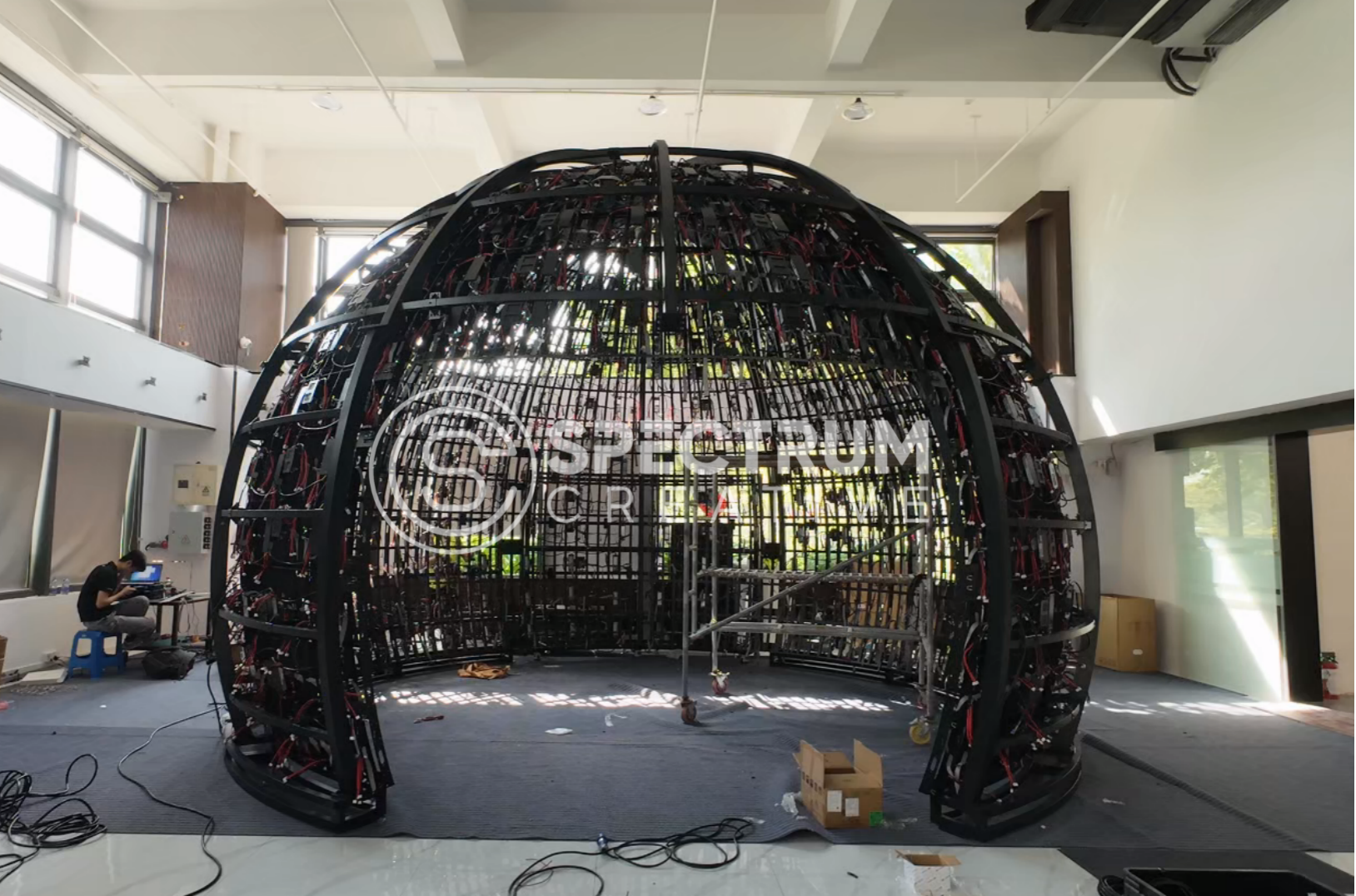
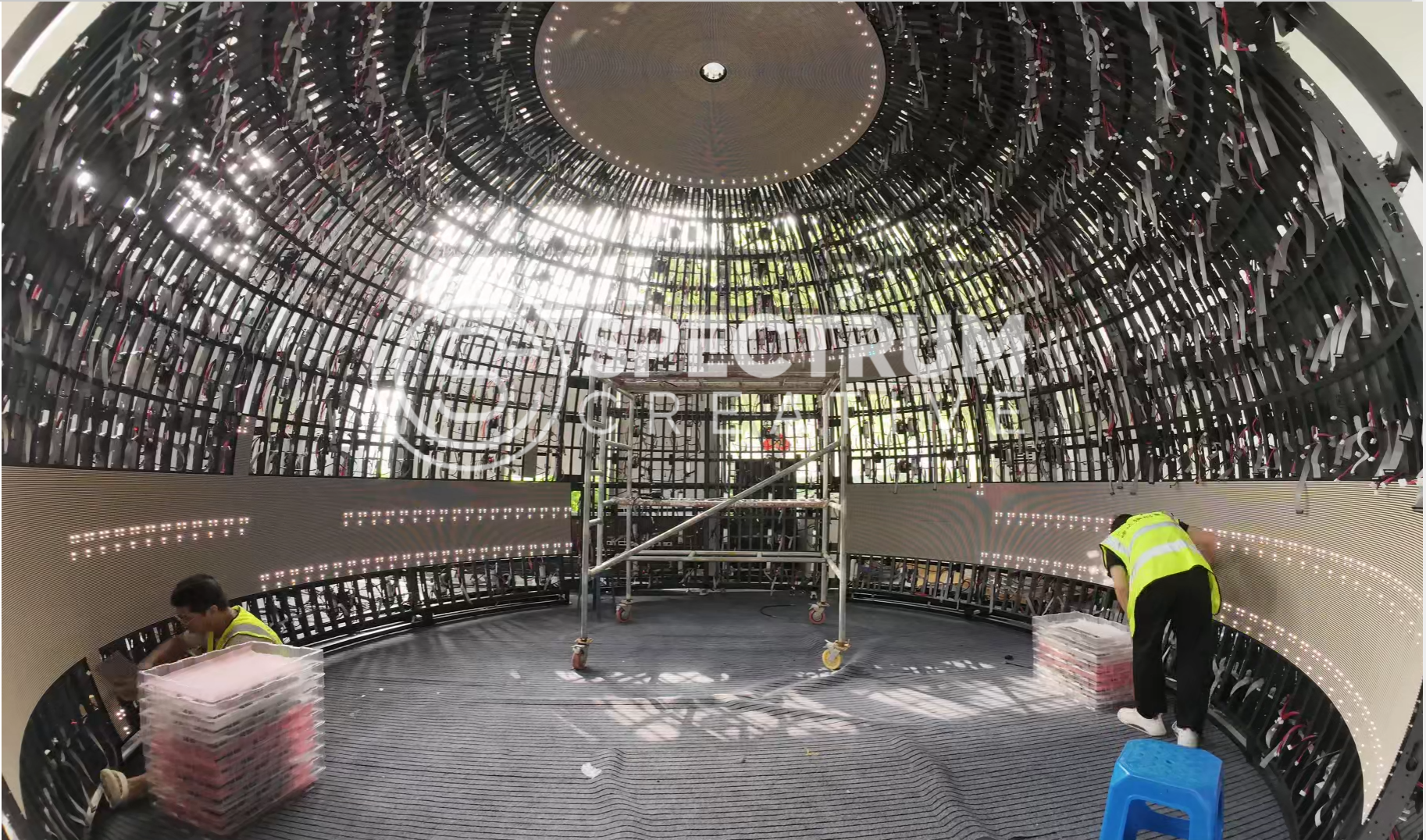
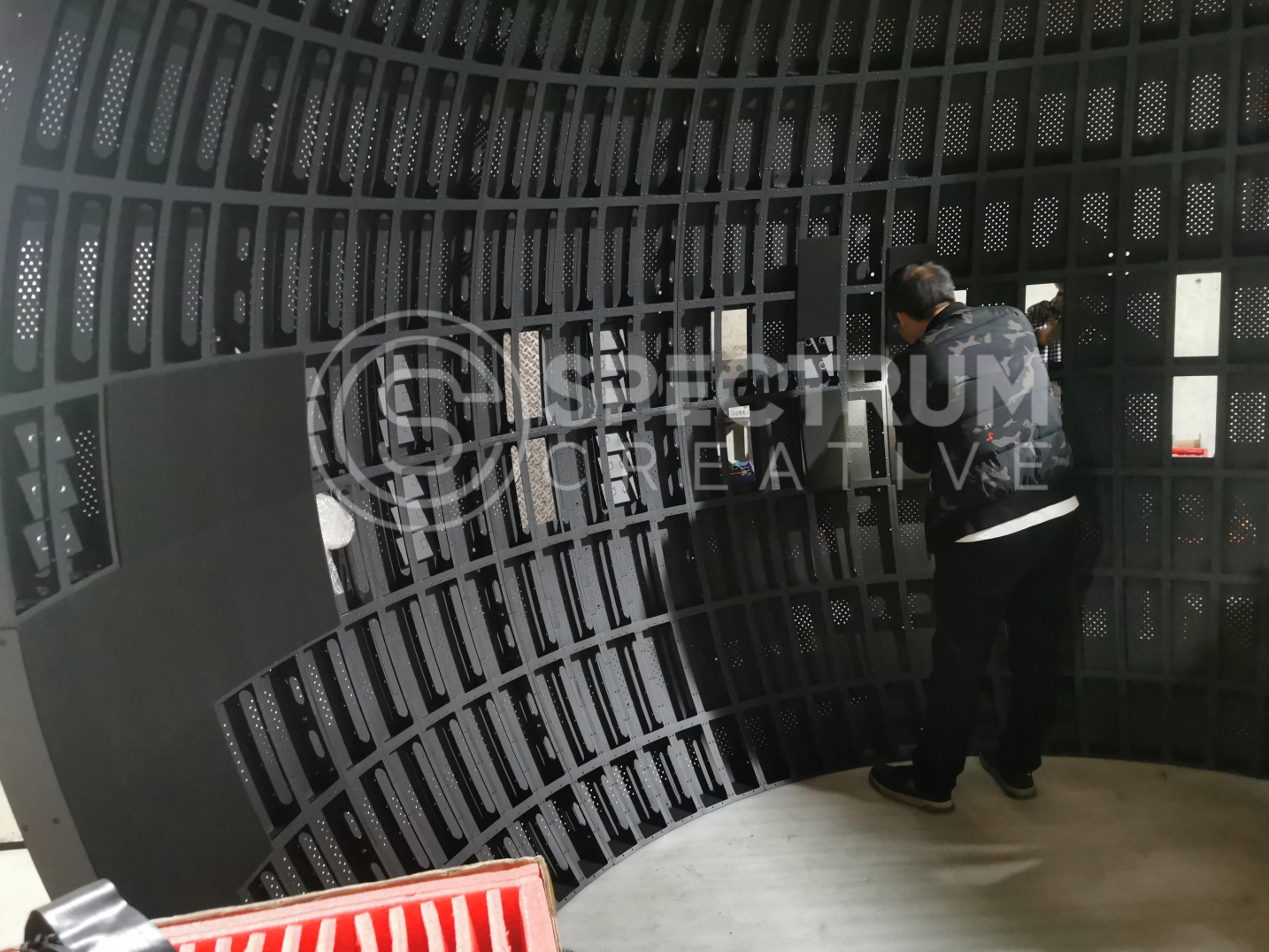
LED sphere installation involves complex construction conditions, especially for large outdoor or elevated projects.
Safety risks include:
Installation above several meters requires professional safety equipment, including fall protection systems and controlled access procedures.
Large spherical components require specialized lifting equipment and qualified operators.
Incorrect load calculations, poor welding quality, or insufficient structural design can create serious safety risks.
The inside of a sphere is a confined space with dense electronic components.
Without proper ventilation and thermal design, localized overheating can reduce LED lifespan and affect system stability.
Safety is not an additional feature.
It is a requirement that determines whether a project can move forward.
For LED spheres, installation is only the first step.
Long-term operation depends heavily on maintenance planning.
Traditional rear maintenance requires internal access space, which increases structural complexity and occupied space.
Front maintenance allows engineers to replace modules from outside the sphere without entering the internal structure.
The Siam Paragon 4.8m LED sphere project adopted a front-maintenance design, allowing individual module replacement without interrupting normal commercial operations.
A spherical display contains a large number of tightly arranged electronic components.
Without effective airflow design, heat accumulation can cause:
Faster LED aging
Color inconsistency
System instability
Proper ventilation channels and thermal management are essential for long-term reliability.
Because spherical displays use customized modules, spare parts planning is more complicated than traditional LED walls.
Different module shapes may require dedicated inventory.
A low initial construction cost can become expensive if future maintenance is not considered.
The best structural design is not only about building the sphere.
It is about keeping the sphere operating efficiently for years.
Display modules determine what audiences see.
Structural engineering determines whether the experience can exist.
The lifespan of an LED sphere is not decided by the brightest LED chip.
It is determined by every structural connection, every support point, and every maintenance decision behind the display surface.
Structural design is not just one part of an LED sphere project.
Structural design is the foundation of the entire sphere.
Larger spheres create rapidly increasing challenges in structural load, wind resistance, installation accuracy, and engineering complexity. Beyond a certain scale, manufacturers need stronger simulation capability, structural expertise, and installation experience.
Because flat rectangular modules cannot naturally follow spherical geometry. Customized module shapes and precise arrangement are required to achieve a smooth curved surface.
Because internal access inside a sphere is limited. Front maintenance allows engineers to replace modules externally, reducing downtime and simplifying long-term operation.
Engineers must consider display module weight, control systems, power components, cables, supporting structures, wind loads, and other environmental factors.
Large spherical displays require strict control of curvature, module alignment, and surface accuracy. Small structural errors can become visible image defects after assembly.