
2026-10-02
Share


One-sentence definition:
Content production for immersive LED spaces is a complete digital asset workflow that covers physical space measurement, 3D modeling, pixel mapping, real-time rendering, and final signal output. It determines what visual experiences the hardware can deliver and what audiences ultimately see.
This is one of the most overlooked questions in immersive LED projects.
A client may invest millions in an LED sphere, curved LED wall, or CAVE immersive environment. After installation and system testing, the demo content looks perfect — galaxies, oceans, flames, and abstract visuals all running smoothly.
Then comes the real question:
“How do we display our own brand content on this system?”
A standard 16:9 video cannot simply be placed onto a spherical LED display. The result is stretched images around the equator, compressed visuals near the poles, and distorted perspectives.
The same problem appears on curved walls and CAVE spaces. Flat content does not automatically become immersive content. It must be redesigned according to the physical geometry of the display.
Hardware is only the physical carrier. Content is what creates the actual experience.
When the shape of the display changes, the logic of content production must change with it.
The first step in immersive LED content production is not opening a software program.
It begins with measurement.
Engineers first collect accurate data from the physical installation:
Radius and curvature of curved LED surfaces
Diameter and segmentation of LED spheres
Width, height, and angles of each wall in a CAVE environment
Pixel distribution and module positions
These measurements become the foundation of the digital production environment.
For example, a 4.8-meter LED sphere contains a curved surface made of hundreds of customized modules. Content creators need to understand the exact position, angle, and pixel density of every module before creating visual assets.
Without accurate spatial data, even high-quality content can appear distorted after playback.
Pixel density is not always identical across immersive displays.
On spherical LED systems, different areas have different pixel structures. The equator normally contains more modules and higher pixel density, while the polar areas have different pixel distribution.
Therefore, content planning needs to consider:
Where detailed visual information should appear
Where simpler patterns are more suitable
How camera movement should follow the geometry of the surface
Spectrum Creative’s Immersive LED Display Virtual Scene Construction Software V1.0 is designed to support 1:1 digital twin creation and pre-distortion simulation during the early design stage, allowing physical dimensions, module positions, and spatial parameters to be converted into accurate digital production data.
After collecting spatial data, the next step is creating a digital replica.
Immersive LED content workflows commonly combine several software platforms:
Blender
3ds Max
Cinema 4D
Unreal Engine
TouchDesigner
For large-scale immersive environments, real-time rendering engines are increasingly important because they allow interactive content, live data visualization, and dynamic experiences.
Unreal Engine, especially with its nDisplay workflow, is widely used for multi-screen synchronization, virtual production, immersive exhibitions, and large-scale visual installations.
The production team rebuilds the physical environment inside a 3D platform.
A complete digital twin includes:
The curvature of spherical surfaces
The geometry of curved walls
The corner angles of CAVE environments
The exact relationship between pixels and physical modules
This digital environment becomes the testing platform before any content reaches the actual LED system.
One of the most important steps is converting a 3D surface into a usable content format.
UV mapping allows a curved surface to be represented digitally so that video and textures can be correctly placed.
For spherical displays, common approaches include:
Equirectangular projection
Cube mapping
Custom spherical mapping solutions
Without proper mapping, content may look correct on a computer screen but become distorted when displayed on the physical structure.
For Spectrum Creative’s immersive LED projects, virtual simulation and pre-distortion verification are completed before final production to reduce unexpected issues during installation.
Immersive LED spaces often contain far more pixels than traditional displays.
A 4.8-meter LED sphere with fine pixel pitch can contain tens of millions of pixels. A large CAVE installation can also exceed the resolution capability of standard 4K or even 8K workflows.
Content resolution should be determined based on:
Actual module arrangement
Screen surface area
Pixel density
Viewing distance
The goal is not simply creating an “8K video”.
The correct approach is calculating the actual pixel requirements of each display area and rendering content accordingly.
Different areas of an immersive display may require different levels of detail.
High-density areas can support:
Fine textures
Complex objects
Detailed animation
Lower-density areas should avoid unnecessary visual complexity that increases rendering costs without improving audience experience.
Rendering transforms digital scenes into actual LED signals.
For immersive environments, this process involves multiple systems working together.
There are two main approaches.
Real-time engines such as Unreal Engine and TouchDesigner are suitable for:
Interactive experiences
Real-time data visualization
Dynamic environments
Sensor-based interaction
For example, immersive LED environments can respond to audience movement, camera tracking, or external data sources.
Traditional rendering tools such as Blender and 3ds Max are suitable for fixed experiences where maximum visual quality is the priority.
The choice depends on whether the experience requires interaction or stable playback.
Large immersive LED systems consist of multiple display areas.
The rendering system needs to distribute content across different channels while maintaining synchronization.
The typical workflow includes:
Rendering Engine → Media Server → Video Processor → LED Controller → Display Modules
The biggest challenge is synchronization.
Even a small frame delay between different display surfaces can create:
Visual tearing
Misalignment
Motion inconsistency
For spherical and curved displays, additional pre-distortion processing is required.
The content is intentionally adjusted during rendering so that after being displayed on the physical curved surface, the audience sees a correctly proportioned image.
After rendering, content needs a reliable playback system.
The playback system manages:
Content storage
Video decoding
Multi-channel output
Synchronization
Real-time interaction
Common platforms include:
Disguise for large-scale performances and virtual production
TouchDesigner for interactive LED mapping
MADRIX for LED pixel control and real-time effects
A complete signal chain usually includes:
Media Server → Video Processor → Sending Card → Receiving Card → LED Modules
Every stage affects:
Latency
Stability
Synchronization accuracy
Immersive LED environments require significantly higher system reliability compared with conventional LED screens.
LED modules from different production batches may have slight variations in brightness and color.
Professional systems use calibration processes to ensure:
Consistent brightness
Accurate color reproduction
Uniform visual quality across the entire installation
Hardware provides the structure.
Content creates the experience.
Spectrum Creative combines display engineering with digital content workflow to deliver immersive LED solutions from concept to operation.
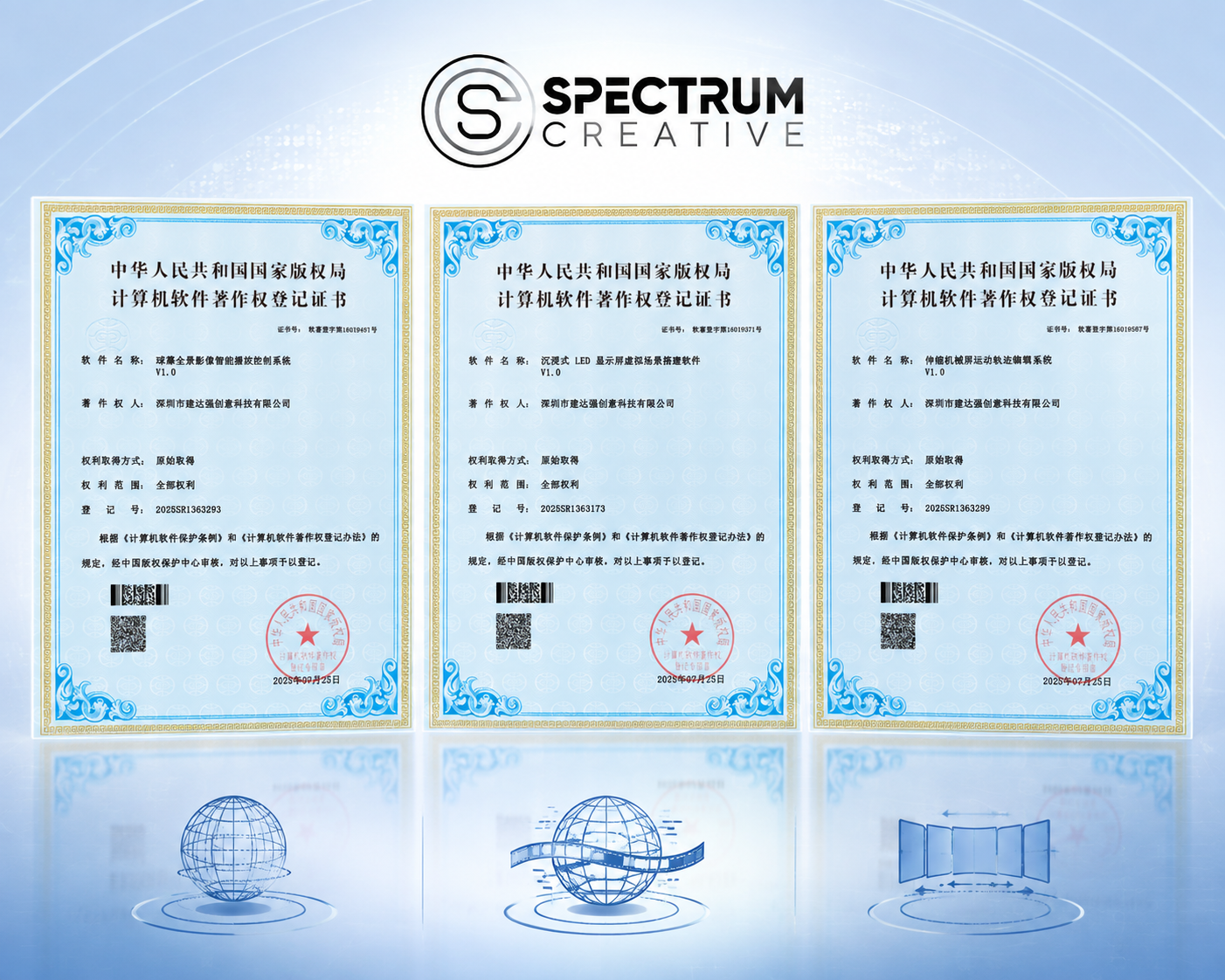
Spectrum Creative has developed proprietary software systems supporting immersive display projects:
Immersive LED Display Virtual Scene Construction Software V1.0
Supports digital twin creation and pre-distortion simulation during early project planning.
Spherical Image Intelligent Playback Control System V1.0
Addresses geometric distortion and color inconsistency across multi-screen spherical environments.
Retractable Mechanical Screen Motion Editing System V1.0
Enables frame-level synchronization between mechanical movement and video content.
Immersive LED projects require coordination between:
Hardware manufacturing
Content production
Rendering systems
Playback control
On-site commissioning
Without integration between these areas, even advanced hardware cannot achieve the intended experience.
Spectrum Creative provides a complete workflow from display engineering to content integration, reducing coordination complexity for customers.
The timeline depends on project complexity.
Simple curved LED content may require several weeks, while complex spherical or CAVE environments involving 3D modeling, rendering, and pre-distortion can require several months.
Early content planning is essential to avoid delays after hardware installation.
No.
Flat videos are not designed for curved or spherical surfaces. They require 3D mapping, spatial adjustment, and pre-distortion processing before playback.
A: For 3D modeling, commonly used tools include Blender, 3ds Max, and Cinema 4D. For real-time rendering, Unreal Engine with the nDisplay module and TouchDesigner are often used. For media playback and show control, common platforms include Disguise and MADRIX. In addition, video footage captured with 360° cameras can also be used as immersive LED content material.
Resolution is calculated based on the physical pixel structure of the LED installation.
The production team needs to understand the actual pixel distribution before deciding rendering resolution.
For complex immersive projects, content production is often a significant part of the total investment because it requires 3D modeling, rendering, mapping, and optimization.
Planning content together with hardware from the beginning usually leads to better results.