
2026-10-05
Share


One-sentence definition:
A robotic screen safety system is a complete engineering protection framework covering anti-pinch protection, motion range limitation, hardware and software collision prevention, and emergency stop control. Its goal is not simply to make the screen move, but to ensure that the system can stop safely under any condition.
A wall composed of thousands of independent moving units expands, contracts, and creates wave-like movements in front of an audience. Visitors can reach out and interact with the physical motion, creating a unique combination of digital content and mechanical experience.
The visual effect is impressive.
But if the safety system is not properly designed, the same interaction can become a risk.
As robotic screens become increasingly common in science museums, commercial spaces, exhibitions, and public installations, audiences naturally want to touch and experience the movement. However, many traditional mechanical systems focus primarily on visual performance and overlook the safety boundaries required for physical interaction.
A conventional motor-driven system follows commands directly. If an object enters the gap between two moving modules, the motor may continue applying force without recognizing the resistance.
This is why safety cannot be treated as an additional feature after the design is completed.
For robotic screen projects, safety must be built into the mechanical structure, control system, and software architecture from the beginning.
The first safety layer is giving the robotic screen the ability to sense abnormal resistance.
When a moving module encounters a person or foreign object, the system should immediately recognize the change and stop instead of continuing the movement.
Spectrum Creative equips its indoor Robotic product series, including Robotic-128, Robotic-160, and Robotic-250, with a 3kg-level anti-pinch protection system.
This is not simply a software function. It is a physical safety mechanism built through sensor feedback and control algorithms.
Each motion axis integrates a high-sensitivity torque feedback system. During movement, the controller continuously monitors the physical resistance experienced by the mechanical structure.
Through engineering tests and safety evaluation, the indoor system uses a 3kg resistance threshold as the protection limit.
When abnormal resistance exceeds the preset value, the system identifies a potential collision or obstruction.
Once the system detects excessive resistance, the control system immediately cuts power to the corresponding drive unit within milliseconds.
The mechanical module loses its rigid driving force, allowing the object or person to be released safely.
For outdoor models with heavier moving units, the safety threshold is adjusted according to the increased mechanical load. For example, the SPKO-500 uses a higher anti-pinch threshold to match its larger module weight.
Every robotic screen movement must operate within a defined range.
Exceeding that range can damage the mechanical structure or create safety risks.
Robotic screen projects usually require two levels of motion limitation.
Hardware limits are physical safety mechanisms installed at the end positions of the mechanical movement.
Examples include:
Limit switches
Mechanical stoppers
Physical travel restrictions
Even if the software system fails, hardware limits can still stop the movement.
Software limits define the maximum and minimum movement range inside the control system.
They allow the system to control movement accurately and prevent unnecessary impact on mechanical components.
A reliable robotic screen requires both systems:
Software limits handle normal operation.
Hardware limits provide final protection in extreme situations.
Collision risks in robotic screens mainly come from two situations:
Collision between moving modules
Collision between modules and external objects
To prevent module-to-module collisions, Spectrum Creative integrates intelligent collision prevention algorithms into its Motion Track Editing System V1.0.
The system continuously monitors the spatial position of multiple motion units. During trajectory design, it can predict possible mechanical interference and automatically adjust movement paths.
This prevents potential collisions before the movement is executed.
For external objects, the anti-pinch system acts as the primary protection layer.
The principle is simple:
When the system detects abnormal resistance, it interprets the situation as a possible collision and immediately releases motor force.
This combination of software prediction and hardware feedback creates a safer operating environment.
Even with advanced protection systems, unexpected situations can still occur.
The emergency stop system (E-Stop) is the final safety protection layer.
A professional robotic screen emergency stop system should include:
The emergency stop circuit should operate independently from the main control system.
Even if the control system freezes, the emergency stop function must remain available.
Industrial safety architecture usually includes redundant safety channels and monitoring components to reduce the possibility of failure.
Once triggered, the emergency stop should immediately disconnect the motion drive power.
Emergency buttons should be clearly visible and easy to operate without complex training.
Safety systems are not designed for normal operation.
They exist to protect users when unexpected situations happen.
Safety is not something that can simply be added after a robotic screen has been manufactured.
It must be considered during the earliest engineering stages.
The structure design decides:
Where sensors can be installed
How limit systems are arranged
Where emergency buttons should be located
How moving units interact with surrounding space
A safety system designed too late often requires expensive modifications.
Engineers must define:
How resistance thresholds are calculated
How collision algorithms interact with motion control
How the system recovers after an emergency stop
These decisions must be built into the control system architecture.
Different projects may have different requirements from:
Brand owners
Commercial properties
Museums
Public institutions
Safety testing and documentation should be considered before project execution begins.
Planning safety early does not increase project complexity.
It reduces long-term risks, including:
Installation delays
Maintenance problems
Safety incidents
Brand reputation damage
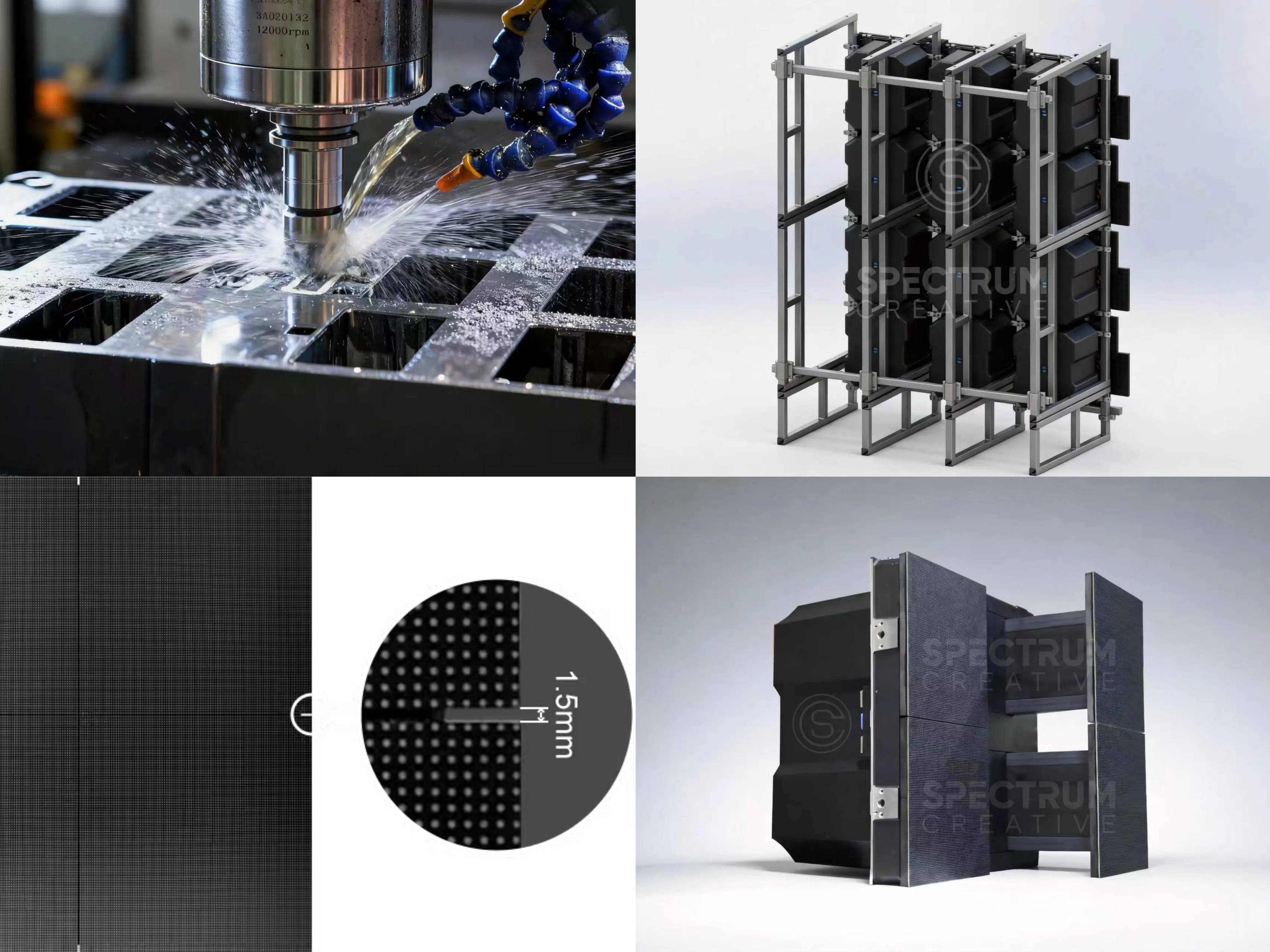
A robotic screen is not simply an LED display combined with motors.
It is a complex engineering system integrating:
Solving structural load, motion accuracy, and long-term durability challenges.
Ensuring stable image quality during physical movement.
Controlling thousands of moving units with precise trajectories.
Connecting mechanical systems, display technology, software control, and content management into one complete solution.
The final experience depends on how well these systems work together.
A robotic screen is successful not because it can move.
It is successful because it can move safely, repeatedly, and reliably for years.
A:
The system uses torque feedback sensors inside the motion mechanism to monitor resistance in real time. When resistance exceeds the safety threshold, the control system immediately releases the driving force, allowing the object or person to be removed safely.
A:
The threshold is determined through engineering evaluation and safety testing. It provides enough sensitivity to detect abnormal resistance while maintaining stable operation during normal movement.
A:
Robotic screens use a combination of software limits and hardware limits. Software limits control normal operation, while physical limit switches provide additional protection if abnormal conditions occur.
A:
It is a control algorithm that monitors the position of multiple moving units and predicts possible interference during trajectory planning. The system can automatically adjust movement paths before collisions happen.
A:
Emergency stop provides an independent safety mechanism that can immediately interrupt movement power during unexpected situations. It is an essential requirement for robotic systems installed in public environments.