
2026-10-09
Share


A Beginner-Friendly Guide to a New Spatial Visual Trend
A wall is no longer just a wall. It can breathe, ripple, and respond.
A ceiling is no longer simply a ceiling. It can move, transform, and become an expression of the space itself.
This is not a scene from a science-fiction film. It is a real shift taking place in commercial spaces in 2026. More and more brands are asking the same question:
“What else can we do besides hanging another screen?”
For the past decade, the solution was simple: wherever a brand needed visual impact, it installed a screen.
One in the shopping mall atrium. One in the showroom. Another around the product-launch stage. The digital signage industry expanded rapidly as a result. In 2025, the global creative LED display market reached approximately RMB 50.21 billion and is projected to approach RMB 101.28 billion by 2032.
There is nothing inherently wrong with screens. LED display technology has made enormous progress over the past decade, with higher brightness, finer pixel pitches, and lower power consumption.
The problem is how screens are being used.
When every shopping mall atrium has another rectangular LED wall, every showroom plays the same type of promotional video, and every launch event uses a similar screen layout, even excellent display technology begins to disappear into visual sameness.
According to Sony’s 2025 Retail Technology Index, despite significant investment in AI systems, digital signage, and smart-store infrastructure, consumer engagement with innovative technologies in European markets fell by 11%. Consumers are becoming increasingly tired of empty promises of “innovation.”
Homogeneous screen applications without thoughtful spatial design or content strategy are finding it increasingly difficult to capture attention.
The screen itself has not failed. Poorly designed, repetitive applications are preventing screens from delivering their real value.
That is why leading brands are beginning to explore “screen-free” approaches—not because screens are bad, but because good creative design is what allows both the display and the space to reach their full potential.
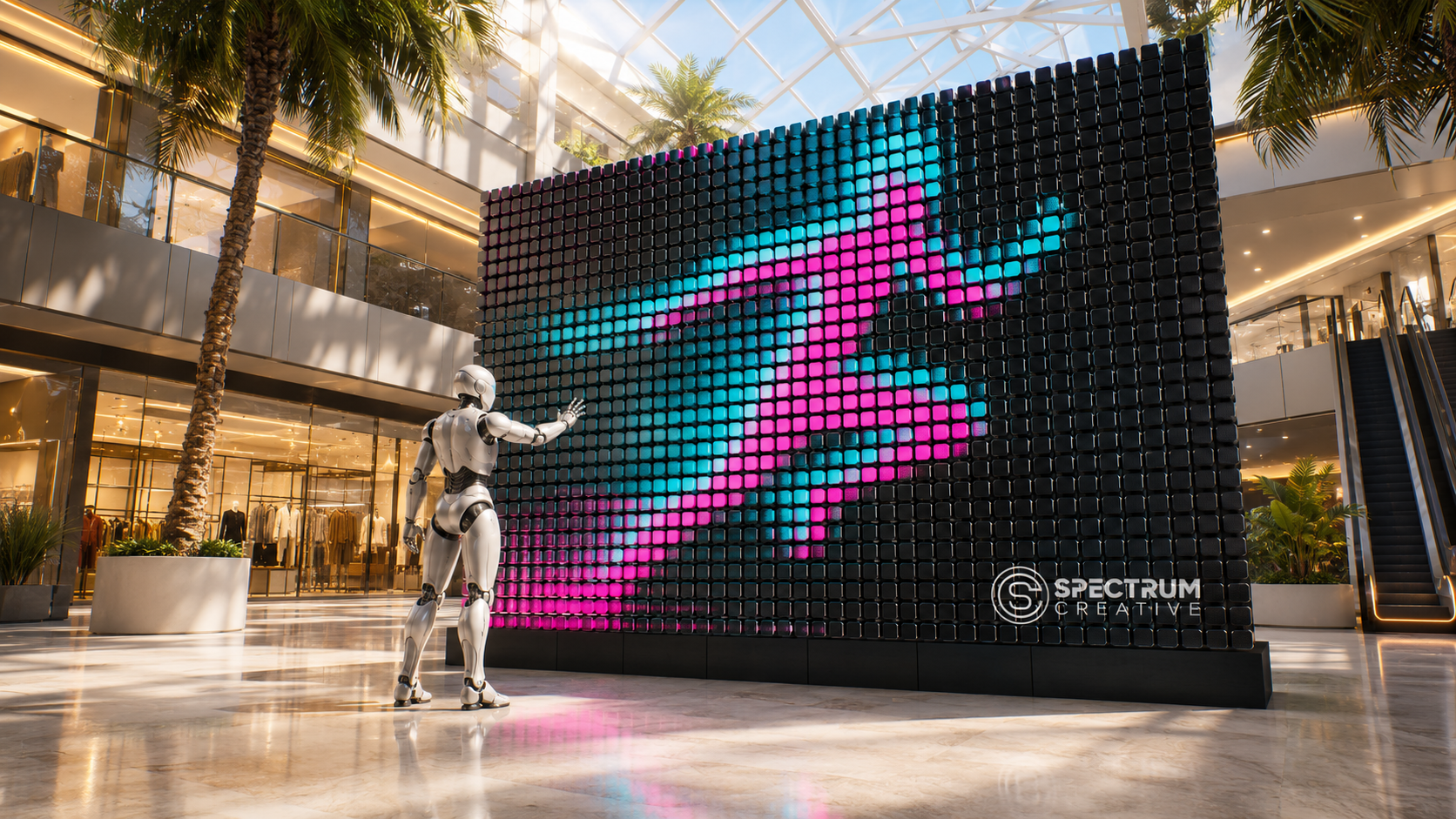
The global experiential retail market was valued at approximately USD 118.16 billion in 2025 and is projected to reach USD 315.37 billion by 2034. China’s experience economy has reached RMB 18.4 trillion, representing year-on-year growth of 22.6%.
These figures point in the same direction: consumers are willing to pay for experiences, not for screens.
A brand may invest in a display, but what consumers remember is the experience around it. That raises an important question:
If the goal is to create a memorable experience, is a conventional screen always the best solution?
The limitation of screens is not the technology itself. It is the increasing similarity of how that technology is applied. When every space hangs a display in the same way and plays similar content, visual fatigue is inevitable.
High-end commercial spaces are therefore beginning to take a different approach.
At the intersection of contemporary architecture and digital media, the concept of the “digital skin” is emerging as a new direction. Digital media is no longer simply attached to a building as an additional screen. Instead, creative design allows it to become organically integrated into the architectural surface.
During the day, it may function as a textured architectural façade. At night, it can transform into a dynamic visual layer.
The same trend is becoming increasingly visible in Shenzhen. According to HC LED Screen Network and industry research cited in the source material, the global creative LED display market exceeded RMB 50 billion in 2025. Custom-shaped and transparent LED displays are becoming two important categories, reshaping the spatial aesthetics and interactive experiences of commercial complexes, cultural-tourism destinations, and brand showrooms.
The screen is being “dissolved” into the space.
And creative design is what makes that possible.
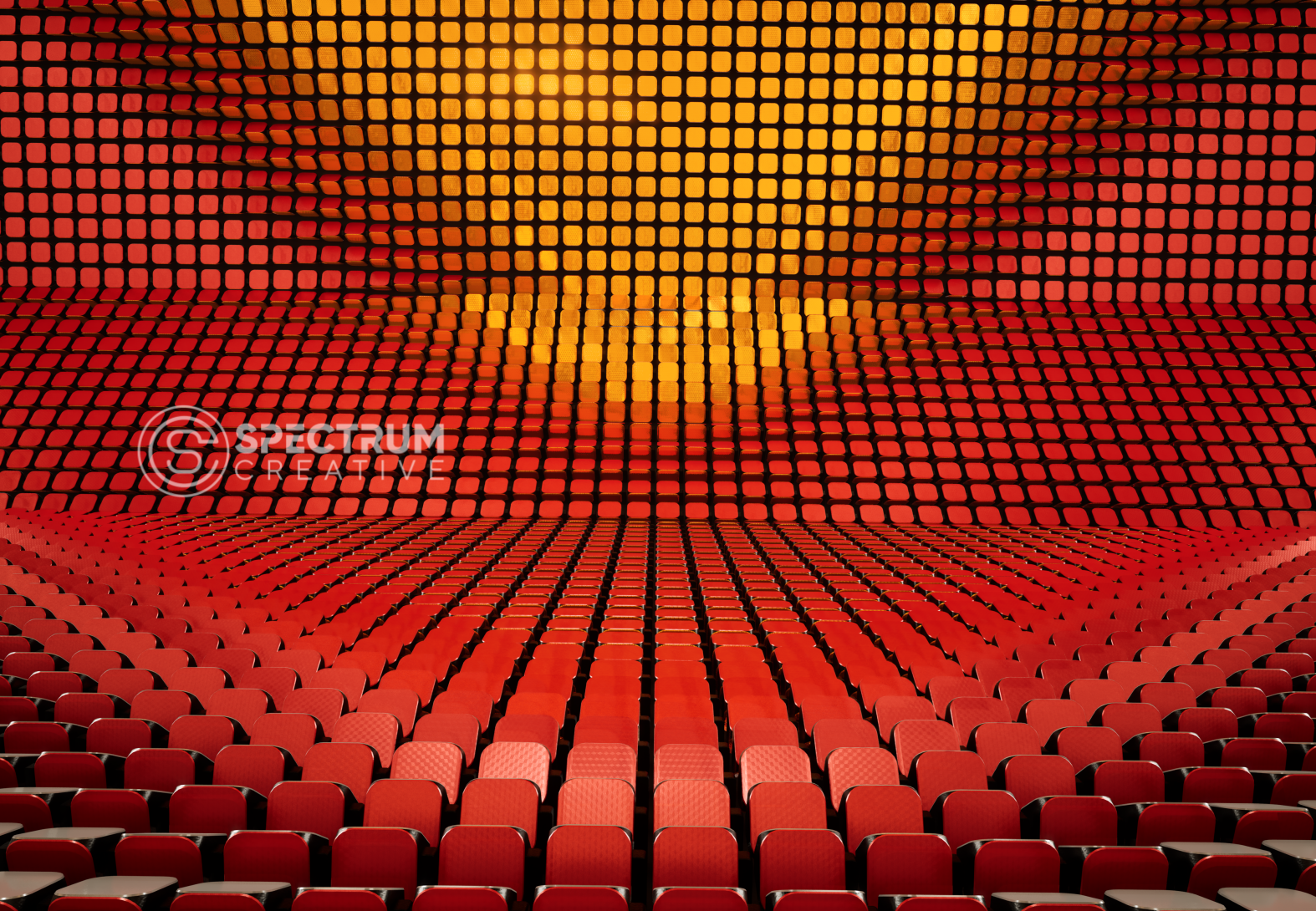
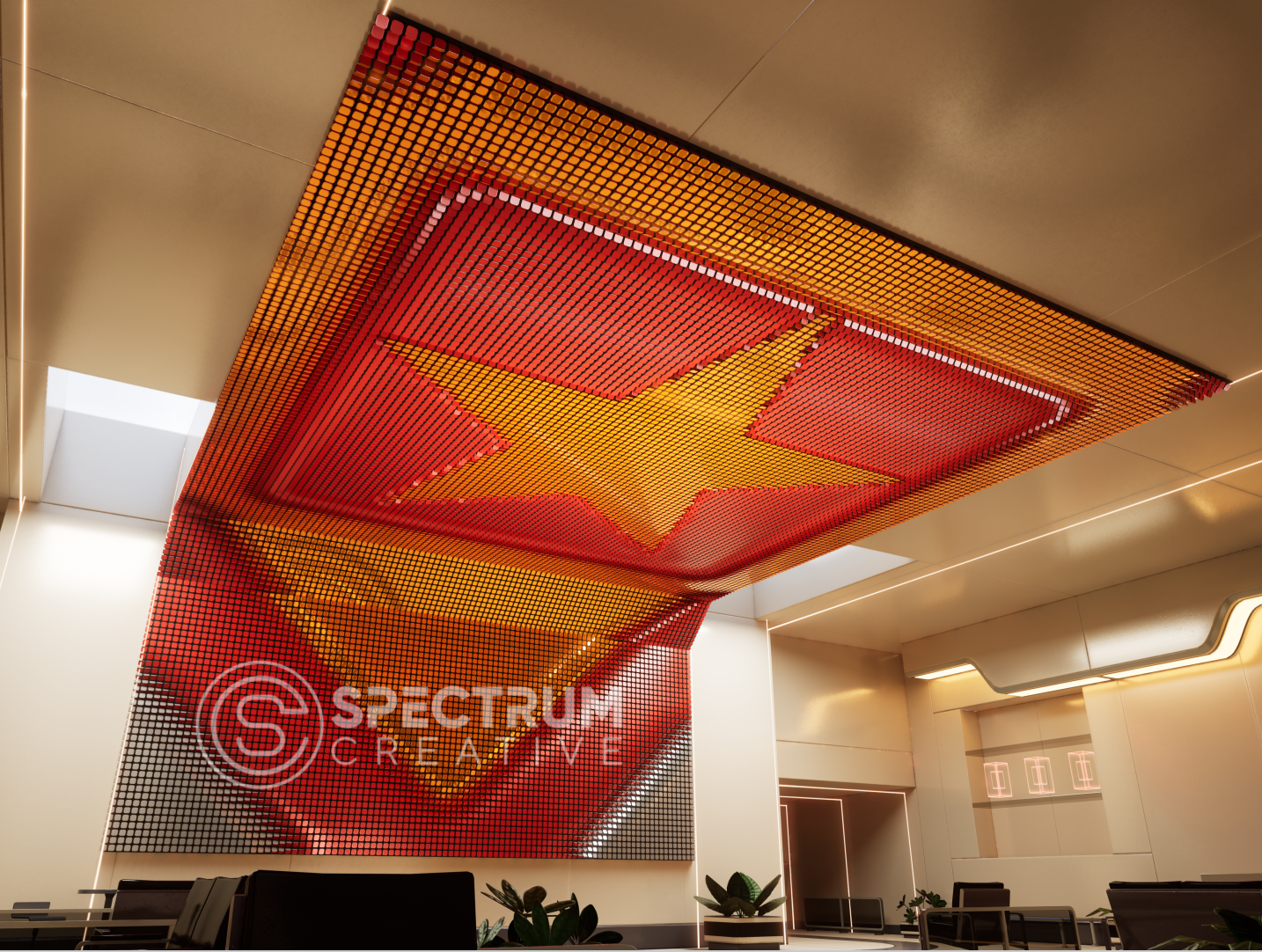
The essence of a “screen-free” visual approach is to transform display technology from something attached to the space into something that appears to grow out of the space itself.
Spectrum Creative’s Mlxos Series follows this logic.
Rather than functioning as a conventional screen mounted on a wall, Mlxos Series is a mechanical dynamic display system composed of thousands of rotating triangular-prism units. Each unit can rotate independently, creating dynamic visual patterns through physical movement rather than relying solely on illuminated pixels.
It offers three practical advantages.
First, lower power consumption. Mlxos 168 requires only 120 W/㎡, compared with approximately 600–1,000 W/㎡ for conventional LED displays. Based on a 100㎡ installation, the difference in annual electricity costs can reach RMB 60,000–110,000.
Second, no self-emitted blue light or conventional screen glare. The mechanical surface creates visual effects by reflecting ambient light rather than relying on a continuously illuminated display surface. This makes it particularly suitable for museums, showrooms, premium commercial spaces, and other environments where lighting quality matters.
Third, lower long-term operating and maintenance costs. Beyond energy consumption, the modular structure simplifies maintenance. Individual cabinets weigh only 7–8 kg and support both front and rear maintenance, allowing localized servicing without dismantling large sections of the installation. The mechanical structure is designed for a service life of more than 10 years, while applicable LED modules are rated for more than 50,000 hours.
Its role within a space is also fundamentally different.
A conventional LED display acts as a player: content plays on the screen, and the audience watches it.
Mlxos Series can act as part of the space itself. When a wall begins to breathe, ripple, and respond, it is no longer perceived simply as a display device. It becomes part of the emotional language of the environment.
At Berczy Square in Toronto, a 90-foot LED installation is blurring the boundary between digital signage and architecture. Rather than behaving like conventional signage, it was designed as a living architectural element embedded within the spatial experience.
The façade is no longer simply an exterior boundary. It is becoming a programmable visual layer.
Philips Professional Display Solutions has taken a similar approach in a project for SDIC Intelligence, creating a three-dimensional “breathing” display that combines mechanical screen transformation with glasses-free 3D visuals. Abstract corporate concepts are translated into a tangible spatial language, turning the lobby into the visitor’s first interface with the brand.
These examples point to a broader principle:
Whether the medium is LED or Mlxos Series, the real question is not “screen or no screen?” It is whether the project has strong creative design.
Good creative design allows display technology to become part of the architecture.
Without it, even an advanced screen can become little more than background noise.
Mlxos Series can be integrated with TouchDesigner, cameras, LiDAR, and other sensor systems.
When someone approaches the installation, the system can change rotation speed, generate wave-like movements, or shift visual patterns in response.
The space is no longer simply showing something to the audience.
It is responding to the audience.
This is where creative spatial systems create a different kind of value.
Traditional digital signage is fundamentally about broadcasting: the brand communicates, and the consumer watches. It is a one-way relationship.
A responsive mechanical installation is about sensing: the space detects the audience and reacts in real time. It becomes a two-way relationship.
The visitor is no longer simply watching a video.
They are participating in a physical dialogue with the space.
Physical Presence: The visual effect does not come only from pixels switching on and off. It comes from real materials physically moving. Light reflects across edges, while shadows shift across surfaces—creating a sense of physical reality that digital rendering alone cannot reproduce.
Architectural Integration: Instead of appearing as equipment mounted onto a finished space, the modular system can be integrated into walls, ceilings, columns, and other architectural surfaces, allowing the installation to become part of the architecture itself.
Interactive Responsiveness: The experience is no longer one-way playback. Through sensors and control systems, the installation can detect human presence and respond in real time.
Long-Term Adaptability: The hardware does not have to remain visually static. Movement patterns and content can continue evolving for seasonal campaigns, brand collaborations, special events, and other applications—allowing one physical system to support continuously changing experiences.
The global creative LED display market reached approximately USD 1.921 billion in 2025 and is projected to reach USD 3.662 billion by 2032. The market continues to grow, but the direction of that growth is changing, with custom-shaped display formats accounting for an increasing share.
Brands and spatial designers are no longer simply looking for a brighter screen.
They are looking for creative ways to make a space feel alive—visual languages that are not limited to another rectangular illuminated surface.
Mlxos Series is one possible answer.
It is not simply a screen. It can become a wall that appears to breathe.
It is not merely playing content. It is becoming part of the space itself.
That is the deeper meaning of this shift:
Free visual experiences from the device and bring them back into the space. Let creativity—not hardware—become the protagonist.
Q1: What is the fundamental difference between a “screen-free” visual solution and a conventional LED display?
A: A conventional LED display usually functions as a visible display device: the audience looks at a screen. A “screen-free” approach aims to integrate the visual system into the space itself, using physical movement, material texture, ambient-light reflection, and architectural integration to create an experience. The two are not replacements for one another; they are different creative directions for different spatial requirements.
Q2: Is Mlxos Series a “screen-free” solution?
A: It can be considered part of this design direction. Mlxos Series uses physically rotating triangular-prism modules to create dynamic visual effects rather than relying on a conventional self-emissive screen surface. The visual experience comes from physical movement, reflected ambient light, material texture, and changing shadows, reducing the impression of “looking at a screen.”
Q3: Why are some screen installations becoming less effective at attracting consumers?
A: The problem is not the screen itself. It is repetitive applications that lack spatial design and content strategy. When every environment uses similar rectangular displays and similar video content, audiences naturally experience visual fatigue. Strong creative design is what allows display technology to regain its impact.
Q4: Where are “screen-free” visual solutions most suitable?
A: They can be used in flagship stores, commercial complexes, showrooms, art installations, hotel lobbies, and public spaces—particularly where the objective is to create a distinctive spatial identity rather than simply add another information display. They are especially relevant when a brand wants the installation itself to become part of the visitor experience.
Q5: Does Mlxos Series really consume much less power than a conventional LED display?
A: According to the specifications used in this article, Mlxos 168 consumes approximately 120 W/㎡, compared with approximately 600–1,000 W/㎡ for conventional LED displays. Because its visual effects rely heavily on physical movement and ambient-light reflection, its operating logic differs significantly from that of a continuously illuminated LED display surface.