
2026-10-13
Share


A Comparison of Two Visual Approaches for Procurement Decision-Makers
When planning a visual solution for a commercial space, you are essentially making one fundamental choice:
Should the space use static decoration or dynamic display?
Both approaches can attract attention, but they play very different roles within a space and differ significantly in cost structure, maintenance requirements, and long-term value. Choosing the wrong direction can mean more than wasted budget—it can compromise the entire spatial experience.
The global digital signage market is valued at approximately USD 24.6–28.7 billion in 2026, while the creative LED display market continues to expand at a compound annual growth rate of approximately 9.4%–11%.
This growth is not simply about market size. It reflects a broader shift: brands are allocating more and more budget to visual experiences.
But investing in visual experiences is not the same as investing in screens. And investing in screens is not the same as choosing the right dynamic display solution.
In one sentence: Choosing a dynamic display solution means first deciding between static decoration and dynamic display based on project objectives, spatial conditions, content requirements, viewing behavior, and long-term operating costs—and then matching the project with the appropriate dynamic display technology, such as LED Display, Robotic Screen, or Mlxos Series.
Simply put: first decide whether it should move; then decide how it should move.
Traditional materials such as stone, wood, metal panels, glass curtain walls, and decorative coatings contain no electronic components and offer no content-update capability. Once installed, they remain essentially unchanged.
Advantages: Authentic material texture, stable aesthetics, and long-term use after a one-time installation.
Limitations: They do not change. Seasonal campaigns, brand updates, holiday promotions, and other evolving commercial needs cannot easily be reflected in the space.
Dynamic display is a broad category that includes multiple technical approaches. What they share is the ability to change content, update visual effects, and give a space a sense of movement and responsiveness.
The main dynamic display approaches include:
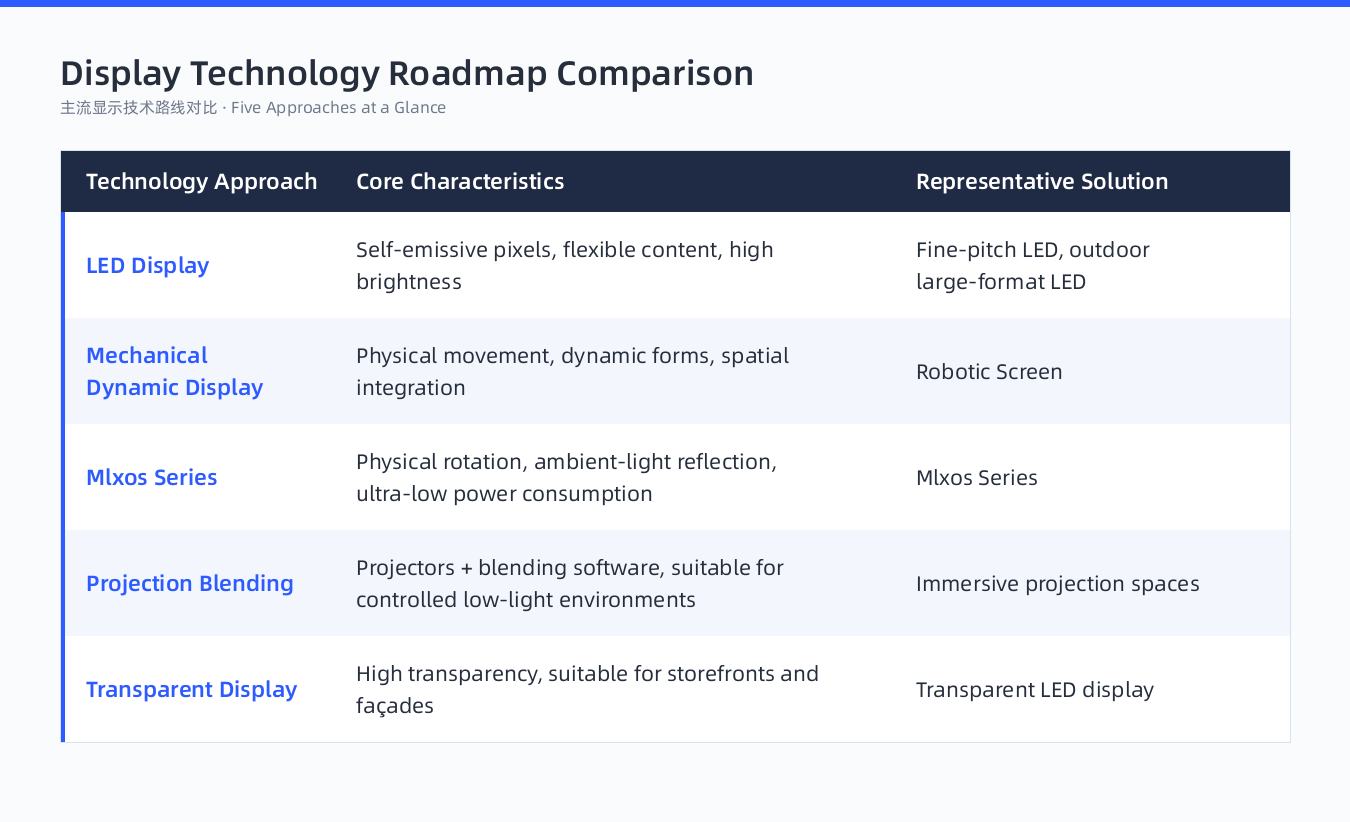
The essence of dynamic display is to give a space the ability to change.
Which technology should be used depends on the project objective, spatial conditions, and content requirements.
LED displays use self-emissive pixels to present video, images, and real-time data, with content that can be updated at any time. From indoor fine-pitch displays to massive outdoor screens, LED technology covers almost every commercial application.
Advantages: Flexible content, high brightness, saturated colors, mature technology, and a broad product range.
Best suited for: Video playback, advertising, real-time information, large-format displays viewed from a distance, and retail environments requiring frequent content updates.
Limitations: Self-emissive displays generally consume more power. Conventional LED displays typically have rated power consumption of approximately 400–600 W/㎡. Visually, they also remain recognizable as a “screen,” with the display surface and framing often making the installation feel like equipment added to the space.
A Robotic Screen adds a mechanical motion system to an LED display, allowing the display surface to extend, retract, rise, or rotate.
This transforms the display from a two-dimensional visual plane into a three-dimensional spatial experience.
Advantages: Physical movement itself becomes part of the visual language. Mechanical motion can be synchronized with digital content to create a physical 3D experience.
Best suited for: Stage productions, exhibitions, brand events, commercial spaces, and projects requiring dynamic form and strong spatial impact.
Mlxos Series creates dynamic visuals through physical rotation rather than relying on pixel-based illumination. Each triangular-prism unit can rotate independently, using ambient-light reflection to create changing patterns and visual effects.
It does not rely on a conventional self-emissive screen surface, reducing glare and avoiding the blue-light characteristics associated with illuminated displays.
Its key advantages include:
Physical Presence: The audience sees real materials physically moving rather than pixels simply switching on and off.
Ultra-Low Power Consumption: Mlxos 168 requires only 120 W/㎡, approximately 20% of the power consumption of a conventional LED display.
No Conventional Screen Light Pollution: Visual effects are created through ambient-light reflection rather than a continuously illuminated screen surface, reducing glare and avoiding blue-light emission from the display surface.
Architectural Integration: The modular system can be integrated into walls, ceilings, and columns, allowing it to become part of the architectural environment rather than appearing as an added screen.
Lower Long-Term Operating Costs: The mechanical structure is designed for a service life of more than 10 years, while modular construction simplifies maintenance.
Best suited for: Brand environments that need to be remembered rather than simply seen; spaces emphasizing design and spatial experience; premium commercial projects where the display should visually “disappear” into the architecture; and projects sensitive to energy consumption and long-term operating costs.
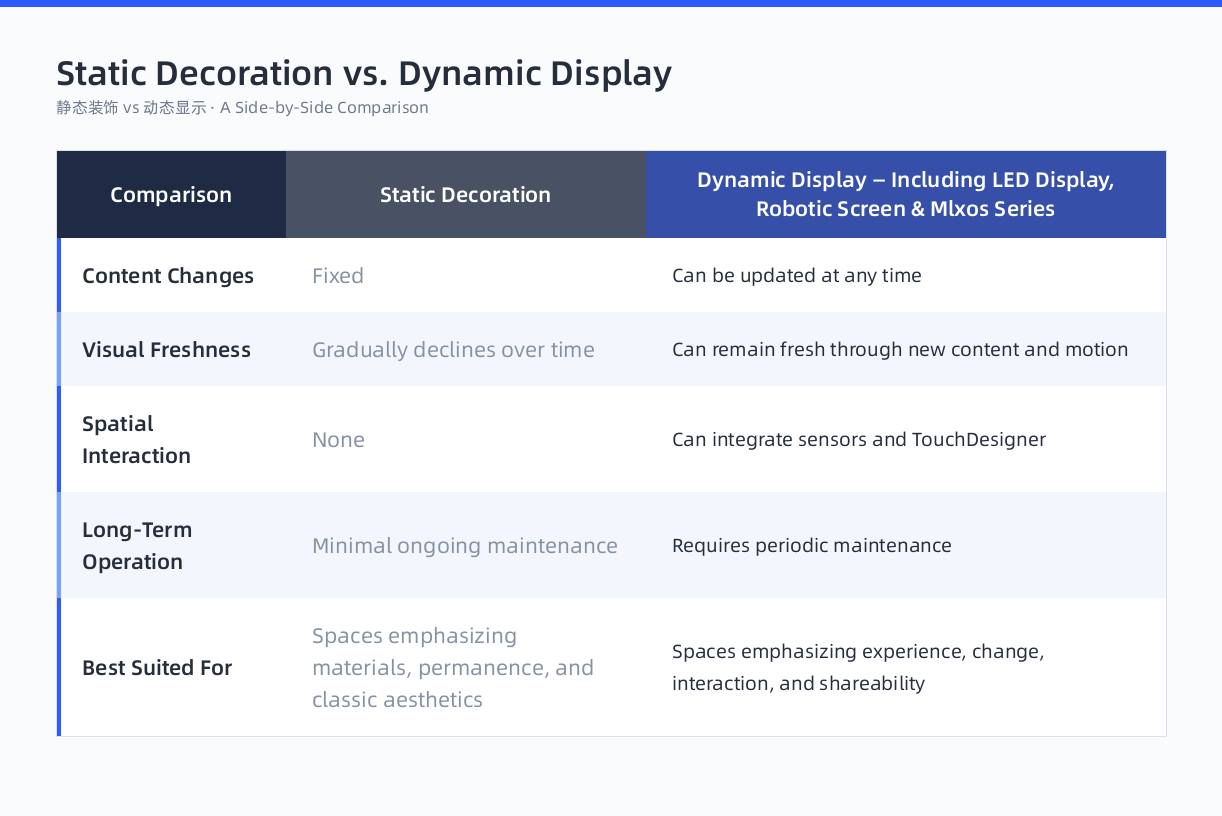
Static decoration and dynamic display are not substitutes for one another. They serve different project objectives.
A luxury hotel guest room may be better suited to static materials, while a shopping mall atrium may benefit more from dynamic display.
The key is matching the visual approach to the actual project requirements.
Does the space need to create an experience, or does it need to emphasize material quality and permanence?
If the priority is experience, change, and engagement, dynamic display may be more appropriate.
If timeless material texture and visual stability matter more, static decoration may be the better choice.
If the project mainly needs video, advertising, or real-time information:
→ LED Display
If it requires physical movement, changing forms, and strong spatial impact:
→ Robotic Screen
If it requires ultra-low power consumption, ambient-light reflection, and architectural integration:
→ Mlxos Series
If the goal is an enveloping immersive experience:
→ Immersive LED Space or Projection Blending
Is there enough installation depth?
LED display systems may require rear maintenance access depending on the configuration, while Mlxos Series can support front-maintenance solutions.
Can the structure support the system?
Both LED systems and Mlxos Series require structural assessment based on the actual installation conditions.
Is sufficient power available?
Depending on the configuration and operating conditions, the electricity cost of an LED display can be several times higher than that of Mlxos Series.
Do not compare solutions based only on initial purchase price.
An LED display may have a lower upfront equipment cost than Mlxos Series, but over a three-to-five-year operating period, the difference in electricity costs can be significant enough to offset the initial price gap.
It depends on the project objective.
If the space needs to be memorable, support continuously changing visual experiences, or interact with visitors, dynamic display may be more suitable.
If the priority is material quality, timeless aesthetics, and a relatively fixed long-term appearance, static decoration may be the better choice.
Choose an LED Display when video playback and information display are the main requirements.
Choose a Robotic Screen when physical movement, changing forms, and spatial impact are important.
Choose Mlxos Series when the project prioritizes ultra-low power consumption, ambient-light reflection, and architectural integration.
The three approaches can also be combined within the same project.
The initial purchase cost of a conventional LED display is typically lower, while Mlxos Series can offer significantly lower operating costs.
For a 100㎡ project, the annual electricity cost of Mlxos Series is approximately RMB 105,000, compared with approximately RMB 350,000–520,000 for a conventional LED display. Over three to five years, the difference in electricity costs may be sufficient to offset the initial price difference.
Mlxos Series uses standardized quick-install cabinets. Each cabinet measures 500 × 500 mm, with a cabinet depth of approximately 160–225 mm.
The modular system can be configured according to project conditions and supports wall-mounted installation, suspended ceiling installation, upward-facing installation, and custom-shaped configurations.
Yes.
A common combination is LED Display + Mixos Series: a large LED surface handles video and information content, while Mlxos Series is used at key focal points to create physical movement and a stronger spatial experience.
Another option is Static Decoration + Mixos Series: conventional architectural materials define the overall environment, while Mixos Series serves as the dynamic visual focal point.
The objective is not to choose one technology simply because it is newer or more visually striking. It is to select the combination that best matches the space, content, audience, and long-term operating requirements.