2026-07-23
Share


One-sentence definition:
An immersive LED display system is an LED solution that creates "being inside the picture" experiences through curved structures, multi-surface displays, or full-space coverage—breaking the boundary between "screen" and "audience" to deliver a truly immersive visual environment.
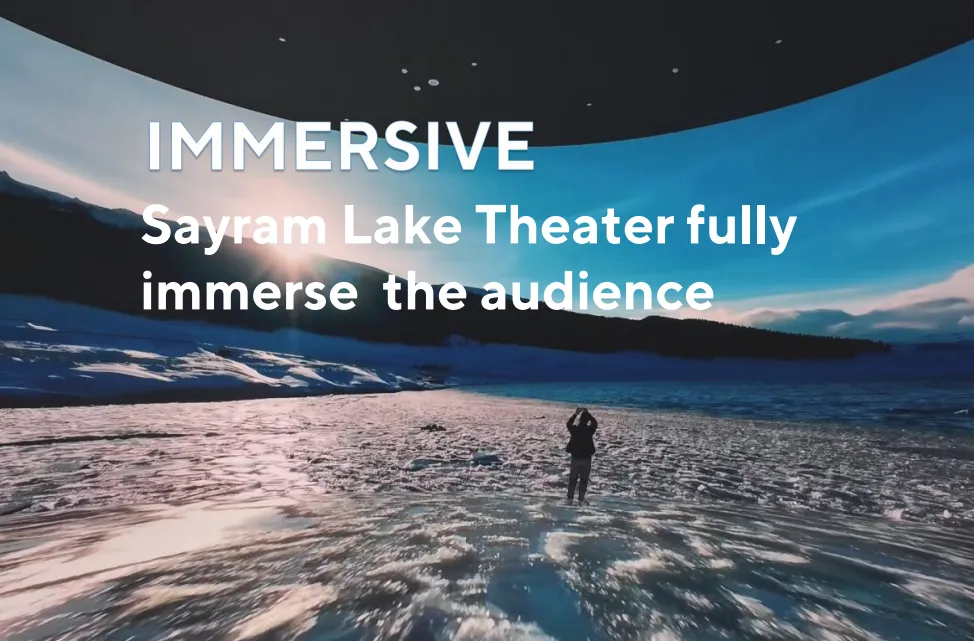
Table of Contents
1. What Is an Immersive LED Display System?
2. What Types of Immersive LED Displays Are There?
3. How Does Immersive LED Transform Spatial Experience?
4. Application Scenarios for Immersive LED
5. Spectrum Creative Immersive LED Solutions
6. FAQ
From "Watching a Screen" to "Stepping into the Picture"
The logic of a standard LED display is simple—you stand outside the screen and watch what's inside. No matter how large the screen or how sharp the image, there is always an invisible wall between the "audience" and the "content."
Immersive LED display systems fundamentally change this logic. They break down the wall through three approaches:
🔘Curved structures: The screen is no longer flat but bends around the viewer's field of view
🔘Multi-surface displays: Walls, floors, and ceilings display simultaneously, creating full-dimensional visual wrapping
🔘Spatial coverage: The audience stands "inside" the picture, not "in front" of it.
Core differences between immersive LED and standard LED:
Dimension | Standard LED | Immersive LED |
Viewing position | Outside the screen | Inside / wrapped by the screen |
Field of view coverage | < 60° | 180° – 360° |
Audience role | Viewer | Participant |
Content form | Flat images | Spatial visual environment |
Core experience | "Watching" content | "Being in" content |
According to Spectrum Creative project data, average dwell time in immersive LED spaces is 2‑3 times higher than in traditional flat‑panel LED displays, with information retention improved by approximately 60%. This is not a screen—it is a "visual container."
Based on spatial configuration and application requirements, immersive LED display systems come in four primary types:
1. Curved LED Screen
Morphology: The screen curves in an arc or wave, wrapping around the viewer's forward field of view.
Applications: Main feature walls in showrooms, brand experience centers, stage backdrops.
Key advantage: Expands horizontal field of view while maintaining high resolution, creating a "wrapped by the image" sensation. Compared to flat screens, curved screens deliver significantly enhanced depth and presence.
2. LED Cave
Morphology: A "room" formed by three or four LED walls—typically including a front wall, left/right side walls, and the floor.
Applications: Scientific visualization, engineering design reviews, high‑end product launches.
Key advantage: The audience stands at the center of the cave, surrounded by display surfaces on all sides. Paired with 3D content, this creates exceptional spatial immersion—ideal for professional scenarios requiring deep interaction and precise visual presentation.
3. LED Dome
Morphology: A hemispherical or spherical screen covering the area above and around the audience.
Applications: Science museums, planetariums, immersive art exhibitions, theme parks.
Key advantage: Fully envelops the audience—look up, turn around, glance sideways—every direction reveals content. Combined with immersive audio systems, it delivers the ultimate immersive experience.
4. 360° Immersive Space
Morphology: Full six‑surface display—walls, floor, and ceiling—creating a fully enclosed visual environment.
Applications: High‑end brand flagship stores, immersive art galleries, XR virtual production studios.
Key advantage: Every square inch of the space is a display surface. No matter which direction the viewer looks, they see dynamic content—truly achieving the "step inside the picture" experience.
Immersive LED transforms spatial experience at three levels:
1. Visual Immersion – From "Seeing" to "Feeling"
Standard LED displays "pictures." Immersive LED creates "environments."
When the screen curves around and the visuals extend to the edges of the viewer's field of vision, the brain naturally generates the illusion of "being there." This is not about higher resolution—it's about fuller field‑of‑view coverage. When the picture fills every direction the viewer looks, they no longer "watch" the picture—they are "in" it.
2. Content Expression – From "Linear Narrative" to "Spatial Narrative"
Flat‑panel LED content is linear—images flow from left to right, top to bottom.
Immersive LED content is multidimensional—visuals can flow, surround, and travel through space. Content creators are no longer confined to a rectangular canvas—they can choreograph visual language across an entire three‑dimensional space. The narrative evolves from "watching a story" to "walking into a story."
3. User Interaction – From "Passive Reception" to "Active Exploration"
In front of a flat‑panel LED, the audience's role is receiver. In an immersive LED space, their role becomes explorer.
When the picture wraps the entire space, the viewer's gaze naturally moves—looking up, turning around, glancing sideways—each movement reveals new content details. This "exploratory viewing" significantly extends dwell time and deepens memory retention.
Scenario 1: Museums & Cultural Exhibitions
Museums are shifting from "displaying artifacts" to "telling stories." Immersive LED enables historical scenes, natural landscapes, and artworks to "surround" the audience—elevating exhibitions from "viewing artifacts" to "stepping into history."
Typical applications: Historical/cultural immersive exhibitions, ecosystem reconstructions in natural history museums, holographic presentations of master artworks.
Scenario 2: Science Centers & Planetariums
The core mission of science centers is "making the abstract tangible." Immersive LED can visualize the universe, cells, physical laws—things invisible or unreachable—wrapping them visually around the audience.
Typical applications: Space exploration immersive theaters, micro‑world visualizations, interactive physics demonstrations.
Scenario 3: XR Virtual Production
XR (extended reality) virtual production is a major emerging market for immersive LED. Immersive LED walls + LED floors + real‑time rendering engines can generate virtual scenes directly within studios, replacing traditional green‑screen shooting.
Typical applications: Virtual production studios, real‑time scene rendering, virtual launch recordings.
Scenario 4: Exhibitions & Brand Experience Spaces
Brand showrooms and exhibition spaces are pursuing one goal: "making the audience remember." Immersive LED spaces create awe‑inspiring "entry moments" that make brand messages memorable through spatial experience rather than flat posters.
Typical applications: Brand flagship store immersion zones, auto show new‑model experience areas, tech product interactive displays.
Scenario 5: Commercial & Public Spaces
Commercial spaces are seeking to "make people stay longer." Immersive LED installations become the "visual anchor" of a commercial space—drawing foot traffic, extending dwell time, and driving consumption.
Typical applications: Shopping mall atrium installations, hotel lobby art screens, airport lounge experience zones.
Spectrum Creative is a brand under JDStrong Technology dedicated to immersive LED solutions, offering end‑to‑end services from solution design and product manufacturing to content production and on‑site delivery.
Product capabilities cover:
🔘Curved LED screens (custom curvature, supporting inward curves, outward curves, wave shapes, etc.)
🔘LED Cave immersive environments (three‑side/four‑side enclosure, with floor screen support)
🔘LED Dome / Planetarium screens (hemispherical / spherical customization)
🔘360° full‑dimension immersive spaces (six‑surface full display)
Representative project: HKUST Immersive Cave
The immersive LED cave system delivered by Spectrum Creative for The Hong Kong University of Science and Technology (HKUST) is a benchmark project in the research and education sector:
🔘Project scale: A multi‑surface LED‑enclosed immersive space
🔘Application: Data visualization, scientific simulation, teaching demonstrations
🔘Core value: Transforming complex research data into visual immersive environments—enabling researchers and students to "walk into the data"
🔗 Learn more: HKUST Immersive Cave
Why choose Spectrum Creative:
🔘Complete immersive LED product portfolio (curved, cave, dome, full‑dimension space)
🔘Independently developed control systems and content synchronization technology
🔘End‑to‑end delivery from hardware to content
🔘Cross‑industry project experience covering research, exhibitions, commercial, and cultural sectors
Q1: Is there a big price difference between immersive LED and standard LED?
Immersive LED involves custom curvature, multi‑surface splicing, and more complex control systems—resulting in higher per‑unit costs than standard flat‑panel LEDs. However, the project value lies in the "experience premium." The commercial conversion and communication power of immersive spaces far exceed standard screens—ROI should be evaluated from a holistic project perspective.
Q2: What size space is needed for immersive LED?
This ranges from small curved walls of tens of square meters to full‑dimension immersive spaces of hundreds of square meters. Spectrum Creative provides space assessment services from the design phase, tailoring solutions to actual site conditions.
Q3: Is content production for immersive LED complicated?
Yes—immersive LED requires specialized multi‑surface/spatial content production that differs significantly from standard video production. Spectrum Creative offers content production consulting services, and can recommend professional content production partners.
Q4: Is immersive LED difficult to maintain?
The system uses modular design with front‑maintenance or rear‑maintenance options (depending on installation method). Curved modules follow the same maintenance logic as flat modules—single‑module replacement can be completed on‑site quickly.