
2026-08-07
Share


One-Sentence Definition
Mlxos Series is a non-self-illuminating display device that uses triangular prism rotating modules as its basic units, driven by motors to physically flip three-sided color blocks to create dynamic visual effects. Relying on physical flipping and ambient light reflection for imaging—with precise control systems and video synchronization—it transforms digital content into mechanically textured motion. It occupies a new category between digital displays and architectural decoration.
1. From Traditional Billboards to the Mlxos Series: A Two-Decade Technological Leap
2. The System Imaging Logic of Mlxos Series: How Does It “Display” Dynamic Images Without Emitting Light?
3. Control System Architecture: The Complete Signal Path from Video Source to Physical Flipping
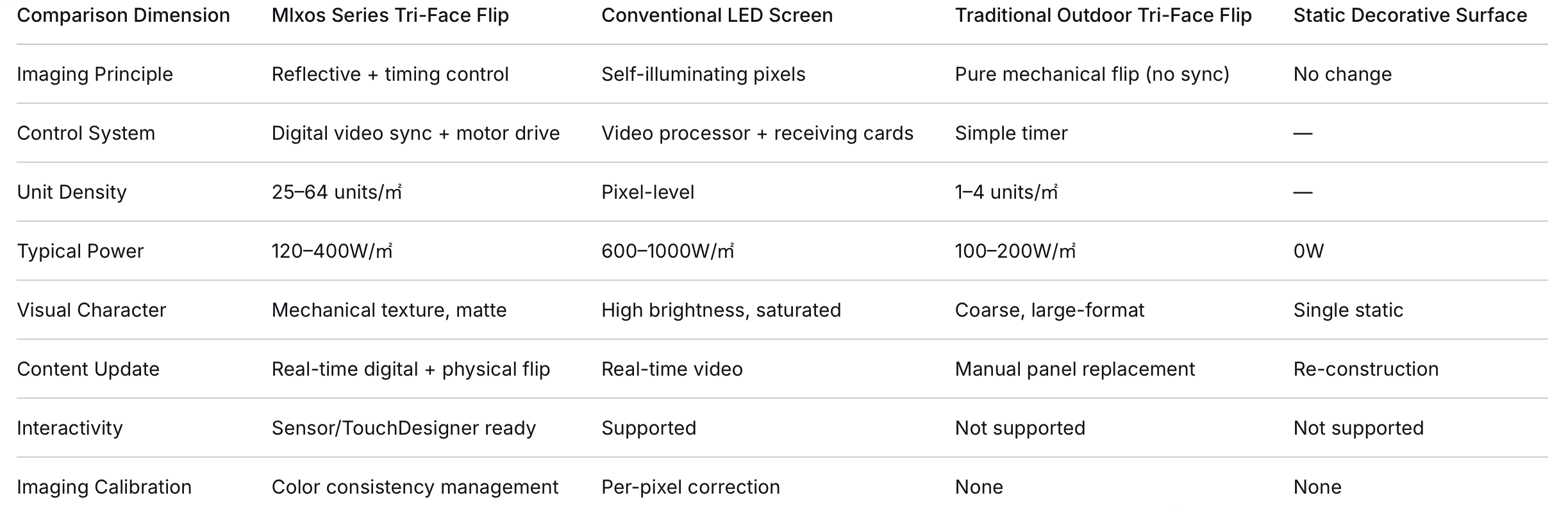
4. Mlxos Series Mlxos Series vs. LED Screens vs. Traditional Static Surfaces
5. Four-Model Overview: Mlxos 100 / 168 / 138L / 138P
6. Five Core Advantages Decoded
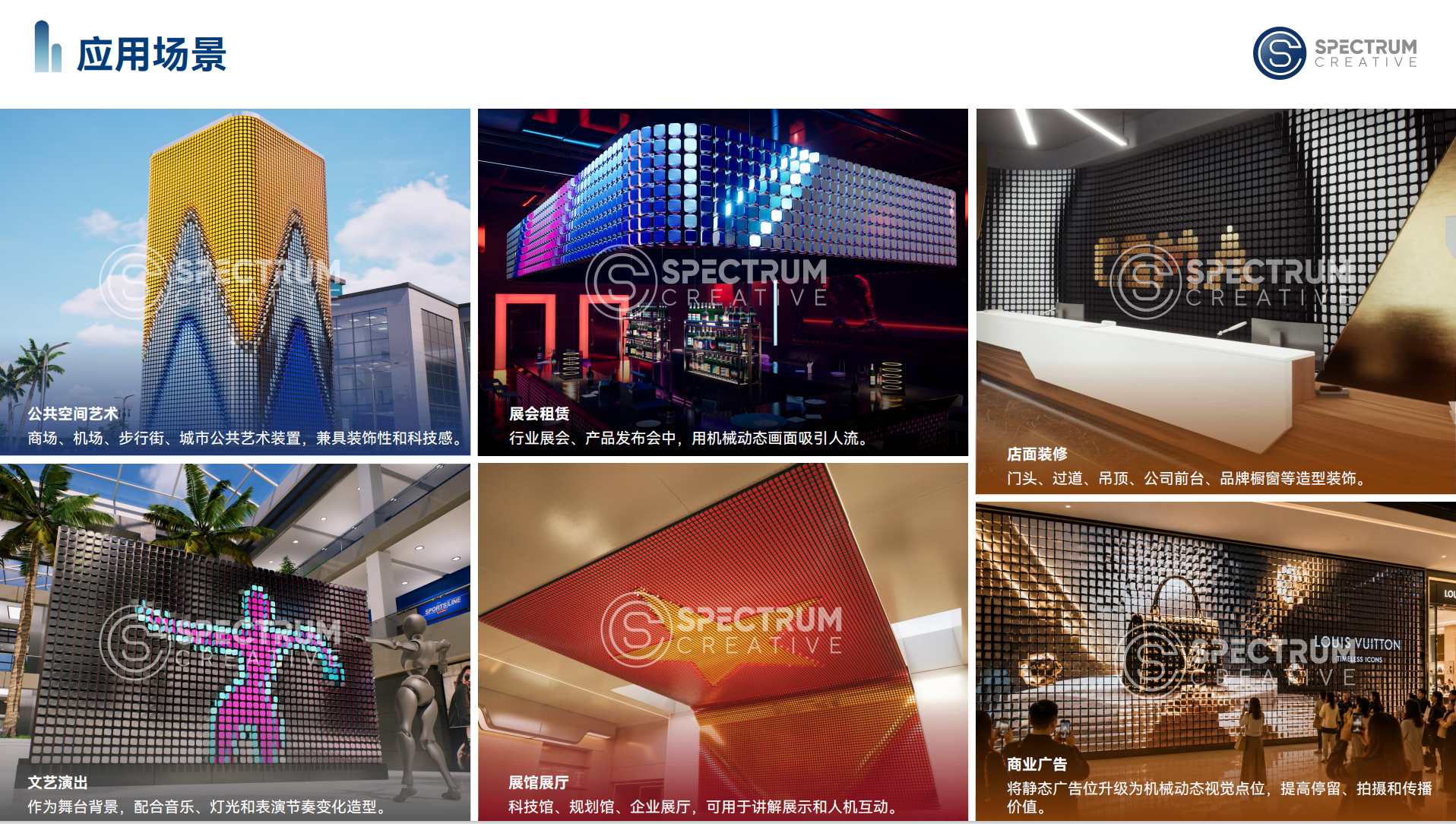
7. Typical Application Map: From Storefronts to Airports, Exhibition Halls to Stages
8. FAQ
9. Further Reading
Traditional outdoor Mlxos Series billboards emerged in the 1990s, using mechanical rotation to cycle through three advertising panels. They were once the mainstream form of outdoor advertising. However, with unit densities measured in single digits per square meter, coarse imagery, lack of interactivity, and manual panel replacement, they can no longer meet today’s demands for visual quality and dynamic experiences.
The global digital signage market reached approximately $22–26.45 billion in 2024 and is expected to grow at a CAGR of 8.5%. Against this backdrop, Spectrum Creative’s Mlxos Series elevates unit density from single digits per square meter to up to 64 units/㎡, integrating digital control and real-time interactivity—transforming the Mlxos Series from a “coarse billboard” into a “precision imaging system.” More importantly, the Mlxos Series introduces a complete “system imaging” architecture: it is no longer a simple mechanical flipping device, but an imaging system that deeply coordinates video sources, control systems, and signal paths.
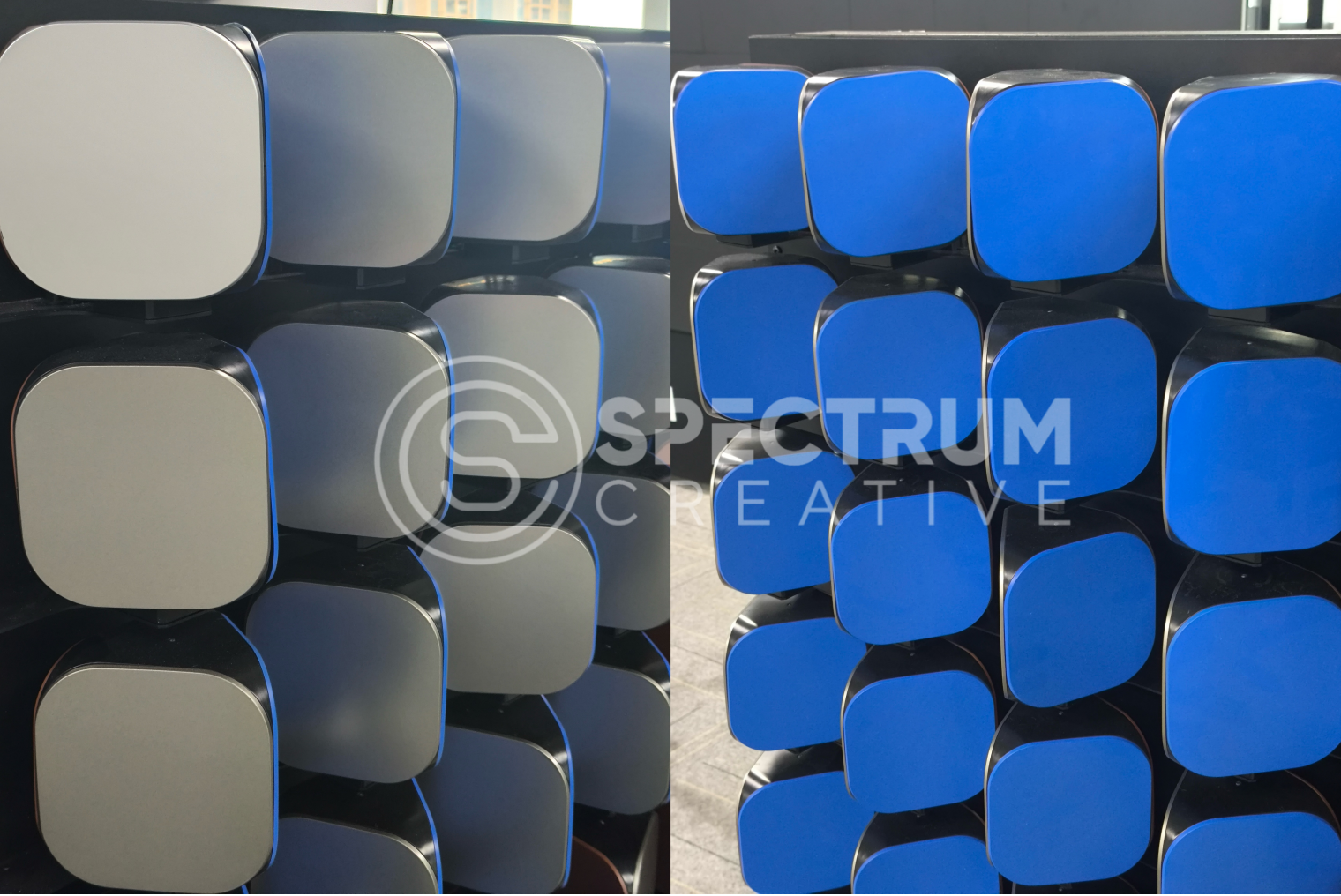
The imaging logic of the Mlxos Series is fundamentally different from self-emitting LEDs. It relies on ambient light reflection combined with persistence of vision. Each triangular prism unit can present different colors, patterns, or materials on its three faces—when units flip at speeds up to 3 revolutions per second, the human eye perceives continuously changing dynamic imagery.
But “flipping” alone is only a mechanical action. Transforming it into a stable, clear, tear-free dynamic image requires a complete imaging chain:
1. Content Input: Video sources (standard 16:9 video, custom animations, or real-time interactive data) enter the playback server.
2. Signal Processing: The control system decomposes each video frame into color instructions for each “virtual pixel.”
3. Timing Synchronization: Motor drive signals are precisely synchronized with the video frame rate (e.g., 60fps), ensuring that flipping actions and frame transitions align perfectly in time.
4. Physical Execution: Each triangular prism unit flips to the corresponding face according to instructions, forming a color matrix through ambient light reflection.
This “reflective imaging” approach offers two unique advantages: zero blue light emission(suitable for long-duration viewing in exhibition halls and classrooms) and ultra-low power consumption (the Mlxos 168 requires only 120W/㎡, compared to 600–1000W/㎡ for conventional LED screens). At the same time, it places extremely high demands on control system precision—any minor timing deviation can cause image jitter or tearing.
The imaging quality of the Mlxos Series does not depend solely on the motors or color blocks themselves, but on the collaborative precision of the entire signal chain. Its control system architecture is as follows:
[Playback Server / Video Source]
         │ (HDMI / DP video stream output)
         ▼
[Video Processor / Main Controller]
         │ (Frame sync / Color calibration / Flip timing generation)
         ▼
[Distributed Motor Driver Boards] ────> [Triangular Prism Units 1…N]
         │ (CAN / RS-485 bus)
         └──> [LED modules (for 138L/138P models)]
Three Critical Components:
1. Video Frame Decomposition and Mapping
The system maps the color information of each video frame to the corresponding unit position. For pure color-block versions (100/168), the mapping algorithm is relatively straightforward—assigning color values to each prism face. For versions with LED ambient lighting or LED screens (138L/138P), the system must simultaneously handle both mechanical flipping and LED pixel overlay.
2. Motor Timing Control
Each unit of the Mlxos Series is independently controlled. The system calculates when each unit should flip and to which face, based on the video frame rate. For example, 60fps video means updating the image every 16.67ms—the motor must complete the flip and stabilize within this window. The Mlxos Series’ 0.15-second flip transition time (equivalent to about 9 frames of buffer) ensures smooth visual transitions.
3. Global Synchronization and Tear Prevention
When multiple units flip simultaneously, a lack of a unified sync clock can cause misalignment between different areas, resulting in “tearing lines.” The Mlxos Series employs hardware-level global sync signals (similar to Genlock in LED systems), ensuring that all units trigger their actions within the same microsecond, achieving consistent global visual integrity.
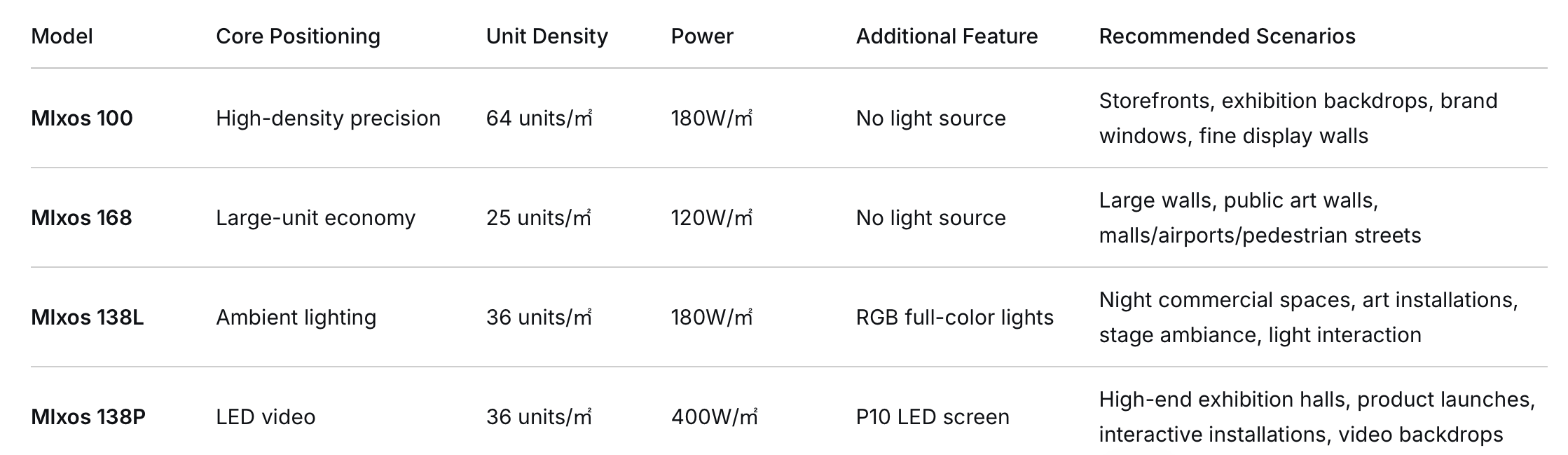
Selection Note: P10 refers to a pixel pitch of 10mm, suitable for viewing distances above 3 meters. The Mlxos 100 and 168 are pure mechanical flip versions (no light source), ideal for daytime or well-lit environments; the 138L and 138P add lighting and LED display capabilities respectively on top of the mechanical flip foundation, requiring the control system to handle dual synchronization of flip timing and LED driving signals.
1. Mechanical Aesthetics and Imaging Texture
Dynamic effects such as wave patterns, matrix transformations, and multi-face switching achieved through physical flipping offer a spatial presence and material warmth that LED screens cannot replicate—a unique visual language of reflective imaging.
2. Ultra-Low Power Consumption and Operational Savings
The Mlxos 168 requires only 120W/㎡, saving over 80% energy compared to conventional LED screens, significantly reducing long-term operating costs.
3. Modular Quick-Install and Dual Maintenance
The quick-install cabinet design supports both front and rear maintenance, making installation, disassembly, and transport easy. Single cabinet weight is only 7–8kg.
4. Strong Interactivity and Real-Time Feedback
Compatible with TouchDesigner, cameras, and LiDAR, enabling audience-triggered screen changes—system latency is controlled at the millisecond level to ensure immediacy of interaction.
5. Deep Customization
6. color schemes, 6 processes (injection molding, metal foil, painting, electroplating, stickers, UV printing), and 4 textures (gloss, matte, mirror, color-shift) to match brand identity and exhibition themes.
l Storefronts & Windows: Mlxos 100 delivers fine metallic brand patterns with 64 units/㎡ high density.
l Large Walls & Public Spaces: Mlxos 168 covers large areas with 25 units/㎡ low density for impressive distant viewing.
l Night Commercial & Art Installations: Mlxos 138L creates immersive light-and-shadow atmospheres with RGB full-color lights.
l High-End Exhibitions & Launches: Mlxos 138P plays dynamic video content on its P10 LED face.
Q1: What is the difference between the Mlxos Series Mlxos Series and traditional outdoor Mlxos Series billboards?
A: Traditional Mlxos Seriess have unit densities of only 1–4 units/㎡, rely on manual panel changes, and lack digital content synchronization. The Mlxos Series offers unit densities up to 64 units/㎡, supports real-time digital content driving, sensor interactivity, and multiple material customizations—a leap from “billboard” to “precision imaging system.”
Q2: Is the Mlxos Series loud? Is it suitable for quiet indoor exhibition halls?
A: The Mlxos Series uses precision servo motors and low-noise transmission design, operating below 45dB under normal conditions—suitable for art museums, exhibition halls, and other noise-sensitive indoor environments.
Q3: What is the expected service life of the Mlxos Series?
A: The mechanical flip structure is designed for a service life exceeding 10 years (based on 8 hours daily, 300 days annually). LED light source modules have a lifespan of over 50,000 hours.
Q4: When the screen is not in operation, what position do the three faces stop at?
A: The stop position can be preset via the control system—it can stop on any face or at a specific angle to create a partially open decorative effect, serving both display and spatial decoration functions.
Q5: What is the waterproof rating of the Mlxos Series? Can it be installed outdoors?
A: The Mlxos Series offers an IP65 protection rating option to meet outdoor installation requirements. Specific protection levels can be customized based on project conditions.
Q6: How does the Mlxos Series ensure no image tearing?
A: The Mlxos Series employs hardware-level global synchronization signals, ensuring all flipping units act under the same timing sequence. Combined with the 0.15-second fast flip transition time, this eliminates image tearing and misalignment.
l Spectrum Creative Official Website: www.spectrumcreative.cn