2026-08-10
Share


Mlxos Series selection is a decision-making process that optimizes the match among four models—Mlxos 100 (high-density precision), Mlxos 168 (large-unit economy), Mlxos 138L (ambient lighting), and Mlxos 138P (LED video)—based on four core project variables: viewing distance, installation area, content requirements (solid color blocks / lighting / LED video), and budget. The essence of selection lies in finding the optimal balance between imaging precision, power consumption, and visual performance for the specific project scenario.
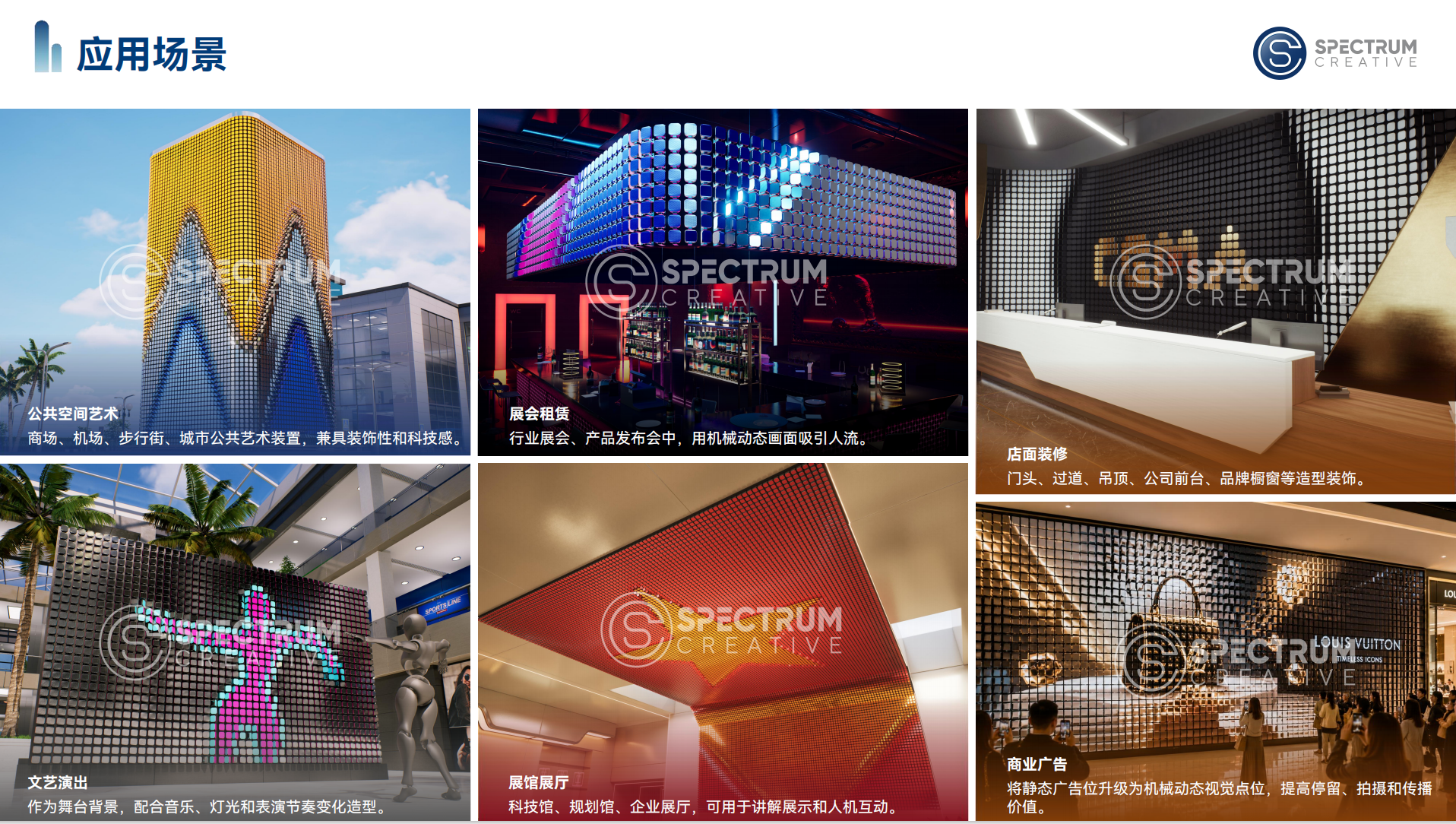
1. Selection Step One: Clarify What Your Project Actually Needs to "Display"
2. Four-Model Core Specification Cross-Reference Table
3. In-Depth Model Analysis
l Mlxos 100: 64 units/㎡, High-Quality "Pixel Art" for Close Viewing
l Mlxos 168: 25 units/㎡, The Cost-Performance King for Large Walls
l Mlxos 138L: RGB Full-Color Lights, The "Light Brush" for Night and Ambient Scenes
l Mlxos 138P: P10 LED face enables video playback on the Mlxos Series
1. Selection Decision Flowchart: Quick Positioning by Viewing Distance + Content Type
2. Can Different Models Be Mixed in the Same Project?
3. Hidden Cost Reminders: Power, Spare Parts, Steel Structure, and Content Production
4. FAQ
5. Further Reading
Before diving into specific specifications, the project team must first answer a fundamental question: What is the core mission of this display?
Different content formats impose completely different requirements on the hardware and control system of the :
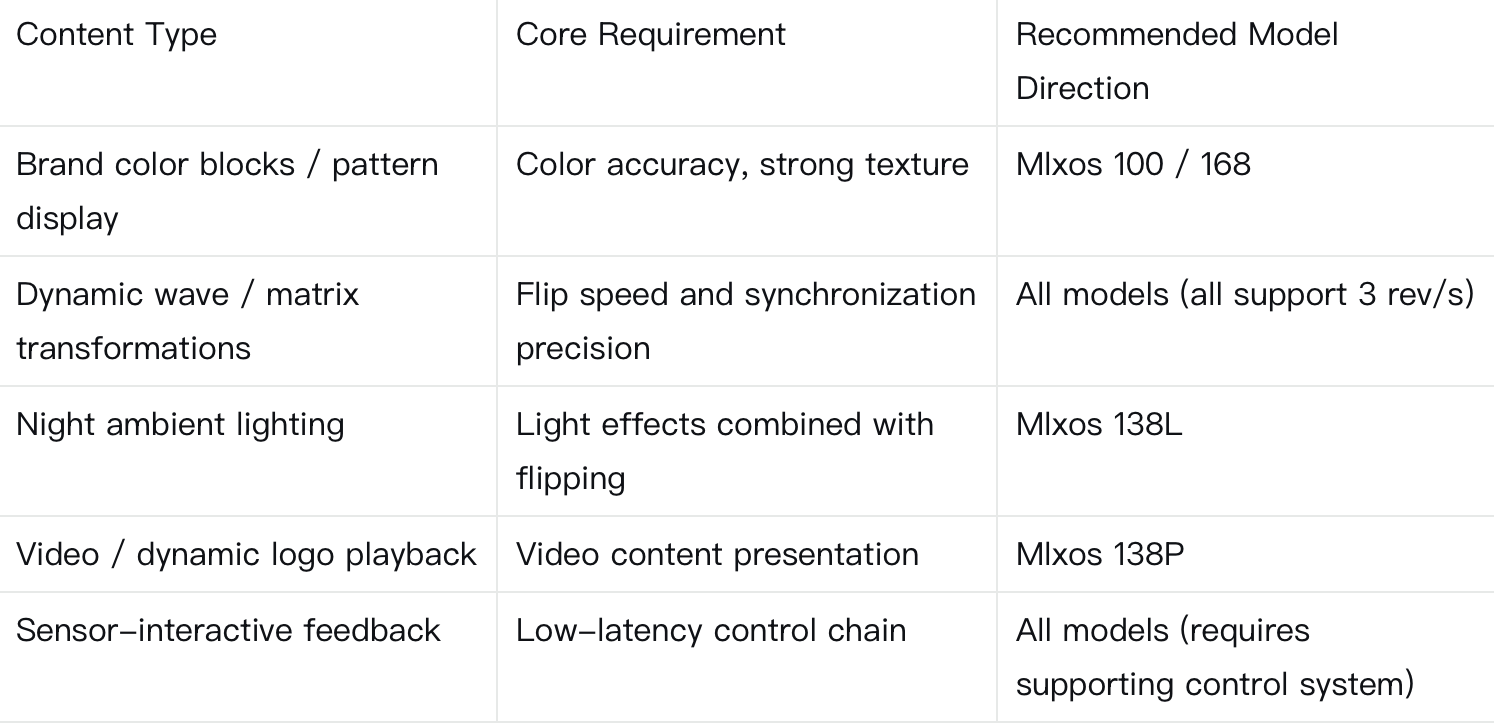
The answer to this question will directly determine the selection direction. The following chapters will help you further refine your positioning from technical specification and engineering perspectives.
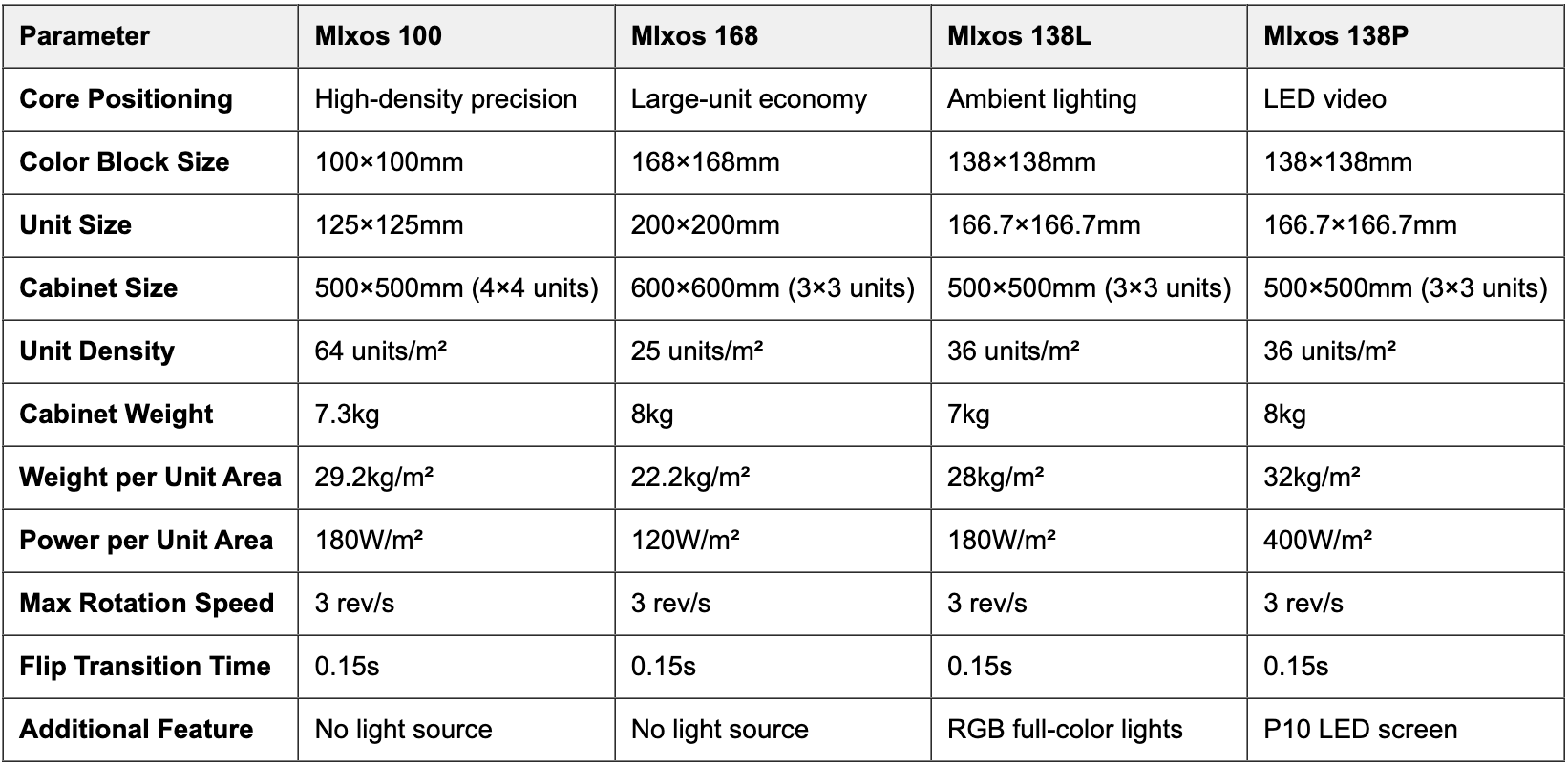
All four models share the same rotation speed and transition time (3 rev/s, 0.15s), meaning the fundamental dynamic response capability is consistent across the entire series. The differences lie primarily in imaging precision, power consumption, and additional features.
Core Positioning: High-density precision
The Mlxos 100 has the highest unit density in the product line at 64 units/㎡. Each unit measures only 125×125mm with a color block size of 100×100mm, meaning the greatest number of independently controlled points per unit area.
l Imaging Characteristics: Higher density delivers finer image quality. Transitions between color blocks are smoother, making it ideal for presenting detailed brand graphics, text, and patterns.
l Optimal Viewing Distance: <5m. Maintains clear color matrix imaging at close range without a "large-grain" appearance.
l Power: 180W/㎡, moderate level.
l Weight: 29.2kg/㎡; wall load-bearing capacity must be assessed.
l Recommended Scenarios: Storefronts, exhibition backdrops, brand windows, fine display walls.
Core Positioning: Large-unit economy
The Mlxos 168 features the largest unit size (200×200mm) with only 25 units/㎡—the lowest density and largest individual unit visual scale in the entire lineup.
l Imaging Characteristics: Low density creates a pronounced "unit" and "mechanical" feel—the flipping motion of each prism is clearly distinguishable, producing a distinctive decorative visual effect rather than fine imaging.
l Optimal Viewing Distance: >8m. At longer viewing distances, low density becomes an advantage—the bold unit arrangement delivers powerful visual impact at large scales.
l Power: 120W/㎡, the lowest in the series, saving over 80% energy compared to conventional LED screens.
l Weight: 22.2kg/㎡, the lightest in the series, placing the least structural load on buildings.
l Recommended Scenarios: Large walls, public art walls, malls/airports/pedestrian walkways.
Core Positioning: Ambient lighting
The Mlxos 138L integrates RGB full-color lighting modules into each unit on top of the mechanical flip foundation. It is not just a , but a programmable lighting matrix.
l Imaging Characteristics: Mechanical flipping provides textured daytime display; RGB lighting delivers ambient nighttime illumination. The two modes can operate independently or in superposition.
l Visual Performance: Ideal for dynamic light effects, color gradients, rhythmic changes, and other non-figurative content.
l Power: 180W/㎡ (including lighting modules).
l Weight: 28kg/㎡.
l Recommended Scenarios: Night commercial spaces, art installations, stage ambiance, light interaction.
Core Positioning: LED video
The Mlxos 138P integrates a P10-format LED display on one face of the triangular prism. This gives it dual capability: mechanical flipping and LED video playback.
l Imaging Characteristics: One of the three faces is an LED screen (video-capable), while the other two are color blocks (static display). The system must simultaneously handle dual synchronization of mechanical flip timing and LED driving signals.
l P10 Specification Note: 10mm pixel pitch, optimal viewing distance above 3 meters. Suitable for mid-to-long-range video viewing.
l Power: 400W/㎡, the highest in the series (due to integrated LED screen driving).
l Weight: 32kg/㎡, the heaviest in the series.
l Recommended Scenarios: High-end exhibition halls, product launches, interactive installations, video display backdrops.
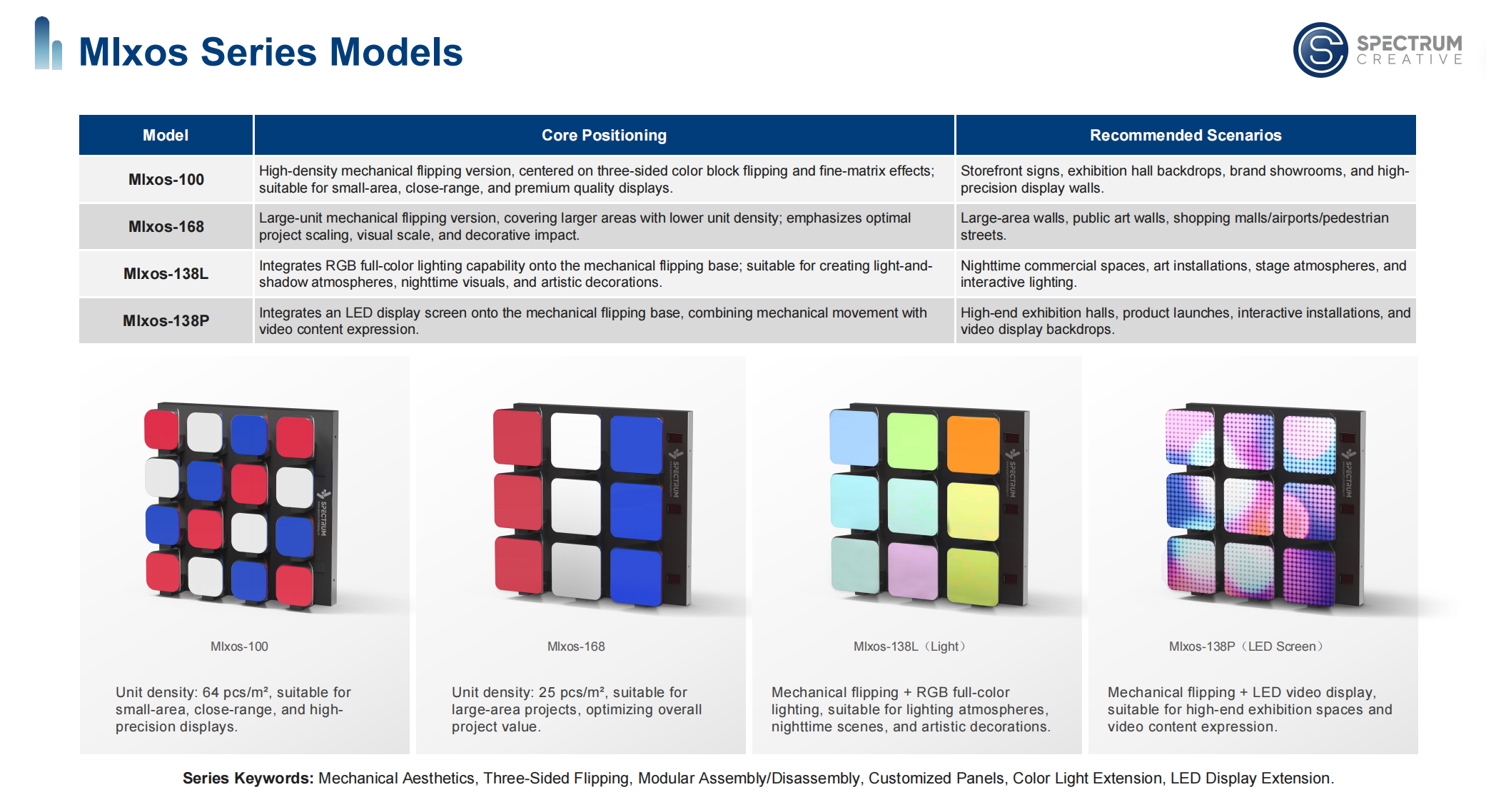
The following decision process allows project teams to complete an initial selection within 5 minutes:
Step 1: Determine Core Content Type
l Need to play video / dynamic logo? → Mlxos 138P
l Need night lighting effects / stage ambiance? → Mlxos 138L
l Pure color blocks / pattern flipping? → Proceed to Step 2
l Step 2: Determine Viewing Distance and Area
l Close-range display (<5m), pursuing fine detail → Mlxos 100
l Long-range viewing (>8m), large-area coverage, budget priority → Mlxos 168
l Step 3: Review Engineering Constraints
l Can the wall support the weight? (100: 29.2kg/㎡, 168: 22.2kg/㎡, 138L: 28kg/㎡, 138P: 32kg/㎡)
l Is the power capacity sufficient? (especially the 138P at 400W/㎡)
l Is maintenance access reserved? (all models support front and rear maintenance)
Selection Note: The Mlxos 100 and 168 are pure mechanical flip versions (no light source), suitable for daytime or well-lit environments. Their imaging relies entirely on ambient light reflection, creating visual effects akin to high-end decorative materials rather than traditional screens. The 138L and 138P add lighting and LED display capabilities respectively on top of the mechanical flip foundation, requiring the control system to handle dual synchronization of flip timing and LED driving signals—placing higher demands on control system computing power and signal chain design.
Yes. Mixing different models is a common strategy for achieving the "optimal balance between effect and cost."
Typical Mixed-Use Configurations:
l Base Coverage + Focal Emphasis: Large walls use Mlxos 168 (low density, low cost, low power) for base coverage, while core visual focal points incorporate Mlxos 138P for video content, creating a "large-area mechanical texture + localized dynamic video" composite effect.
l Day/Night Mode Switching: Daytime uses pure mechanical flipping of Mlxos 100/168; nighttime activates Mlxos 138L RGB lighting for ambiance.
Mixed-Use Considerations:
1. Cabinet Size Differences: The 100, 138L, and 138P all use 500×500mm cabinets; the 168 uses 600×600mm cabinets. Mixed use requires appropriate installation positions at the structural design stage.
2. Control System Compatibility: All models use the same communication protocols (DMX512/Art-Net) and can be centrally scheduled within a single control system.
3. Visual Consistency: Different models have different color block sizes and unit densities. Content design must be specifically adapted to avoid visual "discontinuity" when mixing models.
When selecting a model, consider not only the unit price but also hidden costs in the following four dimensions:
1. Power Consumption and Distribution Costs
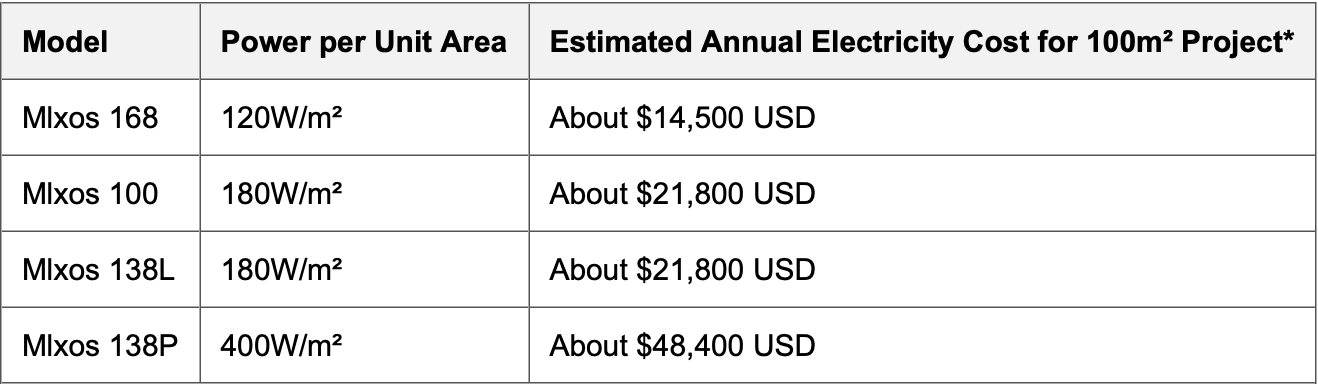
Based on 8 hours daily operation, $0.12/kWh electricity rate, 300 days annual operation.
2. Steel Structure and Load-Bearing Costs
l The Mlxos 138P (32kg/㎡) and Mlxos 100 (29.2kg/㎡) have the highest wall load requirements and may require additional reinforcement.
l The Mlxos 168 (22.2kg/㎡) is the lightest, suitable for renovation projects with load limitations.
3. Spare Parts Inventory Costs
It is recommended to stock 5%–8% of total units as spare parts. Spare parts for different models are not interchangeable (unit sizes and color block sizes all differ) and must be procured separately.
4. Content Production Costs
l Mlxos 100/168: Content consists of color block pattern arrangement, with relatively low production costs.
l Mlxos 138L: Requires simultaneous design of flip patterns and lighting effects; moderate production costs.
l Mlxos 138P: Requires video content production (adapted to P10 resolution), with significantly higher production costs than the former three.
Q1: Do the Mlxos 100 and Mlxos 168 have the same flip speed?
A: Yes. Both models share the same maximum rotation speed of 3 rev/s and flip transition time of 0.15s. The difference lies primarily in unit density and image detail.
Q2: The 138L and 138P have the same cabinet dimensions. Can the L version be upgraded to the P version later?
A: The cabinet dimensions are identical (both 500×500mm, 3×3 units), but the internal module structures and driving circuits differ. Upgrade interfaces can theoretically be reserved at the design stage, but it is recommended to clarify requirements at project inception to avoid retrofitting costs.
Q3: How do I calculate the number of quick-install cabinets needed for my project?
A: Formula: Total project area (㎡) ÷ Area covered by a single cabinet = Number of cabinets. Single cabinet coverage area: 100 type: 0.25㎡ (500×500mm), 168 type: 0.36㎡ (600×600mm), 138L/138P: both 0.25㎡ (500×500mm).
Q4: Are spare parts interchangeable across the four models?
A: No. Each model has different unit sizes, color block sizes, and driving circuits. Spare parts must be procured separately for each model.
Q5: How much lower is the power consumption of the compared to LED screens?
A: Taking the Mlxos 168 as an example, 120W/㎡ is only 12%–20% of conventional LED screens (600–1000W/㎡)—an energy saving of over 80%.
Q6: When the P10 LED face of the Mlxos 138P is playing video, what state are the other two faces in?
A: The other two faces can be set to static color blocks or patterns. The system supports three modes: pure LED playback, pure mechanical flip, and hybrid mode (LED face plays video while the other two faces flip according to preset timing).
l Spectrum Creative Official Website: www.spectrumcreative.cn