
2026-09-03
Share


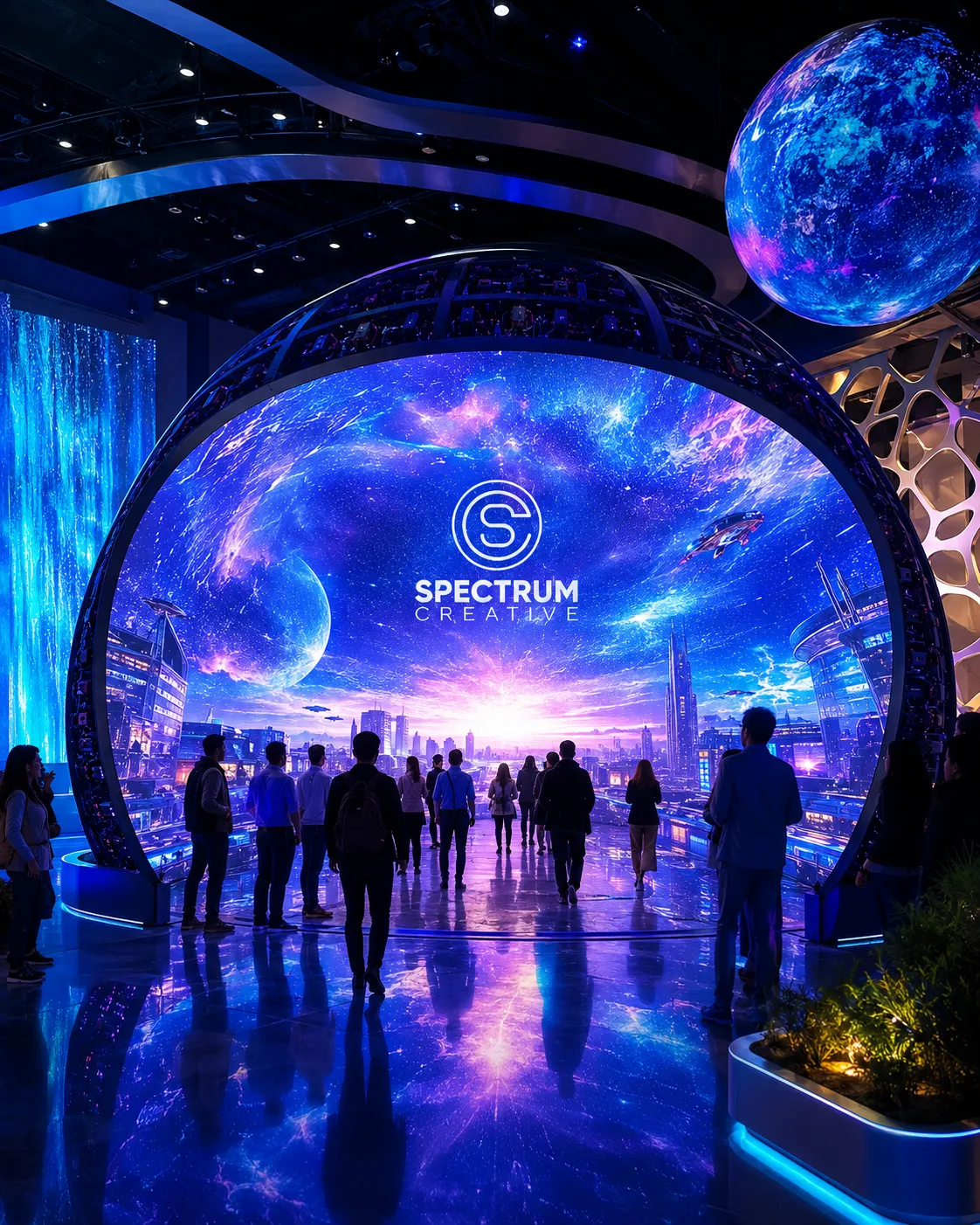
For decades, spherical display technology was strongly associated with planetariums and science museums.
A dome-shaped screen represented humanity’s desire to visualize the universe — stars, planets, galaxies, and astronomical phenomena. These spaces relied on spherical projection systems to create immersive educational experiences.
However, the role of spherical displays is undergoing a fundamental transformation.
In 2026, LED Sphere technology is moving beyond its traditional boundaries. From scientific visualization centers to luxury shopping malls, from digital art exhibitions to advanced research environments, spherical LED systems are becoming a new category of immersive infrastructure.
The reason behind this transformation is simple:
A sphere is no longer only a screen shape.
It is becoming a complete experience platform.
Modern LED Sphere solutions combine:
l high-resolution LED modules
l precision structural engineering
l spherical image mapping algorithms
l intelligent playback systems
l customized content adaptation
to create digital environments that can attract visitors, support scientific research, and become long-term commercial assets.
Market research indicates that the global LED spherical display market continues to expand as demand increases for immersive and three-dimensional visual experiences. Some industry forecasts estimate that the LED spherical screen market will approach hundreds of millions of dollars in the coming years, while immersive entertainment markets continue to experience rapid growth. One published forecast estimates immersive display in entertainment growing from USD 3.65 billion in 2025 to USD 4.48 billion in 2026, representing a CAGR of 22.7%.
At the same time, official projects such as the Shanghai Science and Technology Museum’s LED Dome Theater demonstrate how LED dome technology is entering mainstream educational and public experience environments. The museum describes its dome theater as China’s first LED Dome theater in a science popularization venue, featuring a 23-meter diameter dome structure, 8K ultra-high-definition LED imaging, and a fully immersive panoramic experience.
The evolution is clear:
LED Sphere is moving from a scientific visualization tool into a universal immersive experience platform.
An LED Sphere is not simply a curved display surface. It is a complete immersive system combining LED hardware, structural engineering, spatial mapping algorithms, playback technology, and content adaptation to create a seamless three-dimensional visual environment.
Unlike traditional flat LED displays, an LED Sphere requires the integration of multiple disciplines:
l mechanical structure design
l optical calibration
l image processing
l content mapping
l system control
l long-term operation planning
The challenge is not only making a spherical screen illuminate.
The real challenge is making digital content behave naturally on a complex three-dimensional surface.
A successful LED Sphere must answer several engineering questions:
l How can flat video content be accurately transformed onto a curved surface?
l How can thousands of LED modules maintain consistent brightness and color?
l How can the system operate reliably in commercial environments?
l How can maintenance be completed without disrupting daily operations?
This is why leading immersive display projects are no longer simple hardware installations.
They are integrated digital ecosystems.
The development of LED Sphere technology can be understood through four major application stages.
The earliest and most recognized application of spherical displays was astronomy education.
Planetariums used dome structures because the sky itself is spherical.
A curved environment allows audiences to experience:
l planets
l galaxies
l solar systems
l cosmic simulations
in a way that traditional flat screens cannot achieve.
The value of spherical visualization comes from spatial perception.
Instead of watching information on a screen, audiences feel surrounded by information.
This principle created the foundation for modern immersive display systems.
However, traditional projection-based planetariums also faced limitations:
l limited brightness
l complex projector alignment
l strict dark-room requirements
l frequent optical calibration
As LED technology developed, spherical displays gained new possibilities.
LED-based systems provide:
l higher brightness
l stronger contrast
l longer operating life
l more flexible installation environments
This allowed spherical displays to move beyond astronomy.
The second breakthrough came from digital art.
Artists and designers began exploring spherical displays as a new visual medium.
Compared with traditional rectangular screens, spherical surfaces provide:
l 360-degree storytelling
l stronger emotional impact
l immersive spatial interaction
A digital artwork displayed on a sphere is no longer viewed from one direction.
The audience becomes surrounded by the artwork.
This created new opportunities for:
l museums
l cultural exhibitions
l art installations
l brand experiences
Spectrum Creative’s immersive solutions are designed around this concept — combining display technology with spatial engineering to create customized immersive environments rather than standalone screens.
The biggest commercial breakthrough of LED Sphere technology is happening in retail and public spaces.
Modern shopping malls face increasing competition.
Retail brands, restaurants, and entertainment facilities are becoming more similar.
As a result, commercial spaces need new ways to create emotional connections with visitors.
A traditional advertising screen communicates information.
A landmark LED Sphere creates an experience.
This difference changes the commercial value.
A well-designed LED Sphere can become:
l a visual landmark
l a social media attraction
l a brand storytelling platform
l a permanent digital asset
Visitors naturally:
l stop
l photograph
l record videos
l share content online
The display becomes part of the identity of the location.
This is why premium commercial complexes are increasingly investing in immersive visual landmarks.
The highest level of LED Sphere application is scientific simulation.
In research environments, a spherical display is no longer designed only for visual entertainment.
It becomes a controlled physical simulation environment.
For example, Spectrum Creative developed a 6-meter RGBW immersive dome system for a leading Austrian research institution.
The system was designed not only as an immersive display but as a full-spectrum daylight simulation environment capable of reproducing natural lighting conditions.
Key capabilities include:
l RGBW light architecture
l 17,000 nits peak brightness
l Ra ≥97 color rendering
l ΔE <1.5 color accuracy
l 2500K–10000K color temperature simulation
This demonstrates how LED Sphere technology is expanding from:
visual display to scientific infrastructure
Projection domes played an important role in immersive visualization history.
However, LED Sphere technology provides several advantages for modern applications.
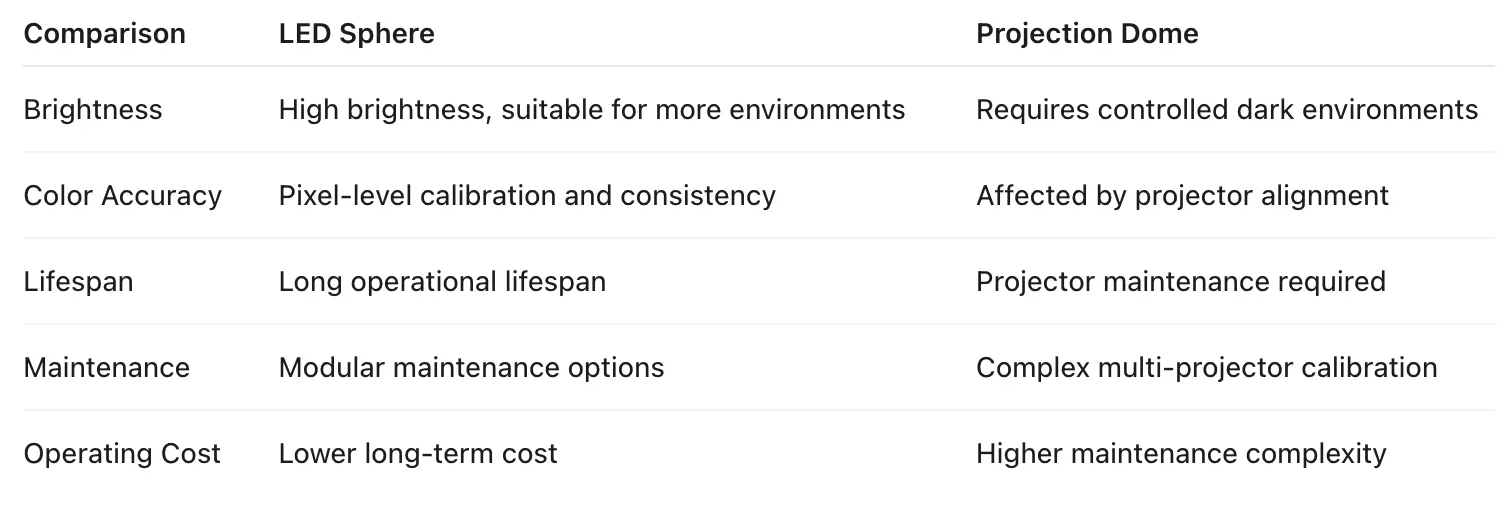
Projection systems rely on reflected light.
Environmental lighting can significantly affect image quality.
LED Sphere systems generate light directly from each pixel, allowing:
l stronger brightness
l higher contrast
l better visibility
This makes them suitable for:
l commercial spaces
l public areas
l exhibition halls
where complete darkness is impossible.
A projection dome depends on multiple projectors working together.
Small differences can create:
l brightness inconsistency
l color variation
l visible seams
LED systems use pixel-level control.
Each LED module can be calibrated individually.
This provides more consistent visual performance.
For commercial venues, installation is only the beginning.
The real challenge is:
“How can the system operate reliably for years?”
Modern LED Sphere solutions focus on:
l modular design
l front maintenance
l intelligent control
l stable signal systems
Spectrum Creative applies engineering concepts such as customized structures, intelligent playback control, and system integration to support long-term immersive display operation.
A spherical display creates a unique challenge:
Digital content is usually created on flat surfaces.
But the display surface is curved.
Without advanced algorithms, visual distortion is unavoidable.
Imagine placing a flat world map onto a globe.
The result:
l the equator stretches
l the poles compress
l details become distorted
The same problem occurs when displaying video content on LED Sphere systems.
This is why 3D Mapping technology becomes the digital foundation of spherical displays.
A spherical display is not simply a collection of LED modules arranged into a round shape.
The real challenge lies in transforming digital content created on a flat plane into a physically curved three-dimensional surface.
Without advanced mapping algorithms, even high-resolution LED Sphere systems can experience:
l image stretching
l pixel distortion
l incorrect perspective
l inconsistent brightness
l visual discontinuity between modules
Therefore, 3D Mapping technology becomes the “digital brain” behind modern LED Sphere systems.
Spectrum Creative addresses this challenge through its Dome Playback Control System V1.0, a software platform designed for spherical image processing, mapping, and intelligent playback control.
The system provides the algorithm foundation required for accurate 360-degree immersive visualization.
The first challenge is converting flat digital content into spherical coordinates.
Common panoramic content is usually created through:
This format represents a 360-degree environment using a 2:1 rectangular image.
Advantages:
l widely used
l compatible with panoramic content production
l efficient for VR workflows
However, when directly applied to a sphere, distortion occurs.
The reason:
The rectangular image and spherical surface do not share the same geometry.
Near the equator:
l pixels stretch horizontally
Near the poles:
l pixels become compressed
For advanced LED Sphere systems, more accurate projection methods are required.
Cube mapping divides the spherical environment into multiple directional surfaces.
Advantages:
l better pixel utilization at polar regions
l improved spatial accuracy
l easier adaptation for complex rendering engines
For immersive commercial and scientific applications, optimized projection conversion ensures that every region of the sphere receives appropriate visual information.
After projection conversion, the next step is creating a digital twin of the physical sphere.
The system builds a 3D mesh model that matches:
l sphere diameter
l module arrangement
l LED position
l viewing angle
Each physical point on the LED Sphere corresponds to a digital coordinate.
This creates a 1:1 relationship between:
Digital Content Space
and
Physical Display Space
Spectrum Creative’s Immersive LED Display Virtual Scene Building Software V1.0 follows this principle by enabling digital environment construction and visual simulation before physical installation.
The process helps reduce:
l onsite calibration time
l perspective errors
l installation uncertainty
The third step focuses on pixel-level accuracy.
A spherical LED display contains thousands or even millions of individual light points.
The system must understand:
l where each LED module is located
l how each pixel corresponds to the spherical surface
l how content should be distributed
Through coordinate sampling and LUT (Look-Up Table) generation, the system creates a mapping relationship between:
Content Pixel
↓
Physical LED Pixel
This allows the playback system to accurately place every visual element.
Whether displaying:
l digital earth models
l astronomical scenes
l brand animations
l immersive landscapes
each pixel can be precisely controlled.
A sphere does not distribute pixels evenly from every viewing angle.
Different areas of the sphere have different visual characteristics.
For example:
l polar areas have higher pixel density
l equatorial areas have different viewing angles
Therefore, brightness compensation and calibration are essential.
Through:
l Alpha Masking
l brightness adjustment
l pixel-level calibration
the system ensures:
l balanced brightness
l consistent color
l smooth visual transition
This technology is especially important for premium commercial and scientific applications where visual accuracy directly affects user experience.
The four-step mapping logic forms the core technology foundation behind Spectrum Creative’s spherical display solutions.
The company’s:
Dome Playback Control System V1.0
is designed to solve:
l 360-degree image distortion
l spherical content adaptation
l multi-module synchronization
while its:
Immersive LED Display Virtual Scene Building Software V1.0
supports:
l digital twin modeling
l virtual scene construction
l immersive environment optimization
Together, these technologies allow Spectrum Creative to deliver not only spherical hardware, but complete immersive digital environments.
Commercial complexes around the world are searching for new ways to increase visitor engagement.
The challenge is no longer simply creating a beautiful interior.
The challenge is creating a reason for people to stop, experience, and share.
Siam Paragon Bangkok represents this new generation of commercial experience.
Inside the newly developed shopping environment, Spectrum Creative delivered a customized indoor LED Sphere Display designed to become a visual landmark.
Location:
Siam Paragon, Bangkok, Thailand
Application:
Premium commercial complex
Display Type:
Indoor LED Sphere Display
Diameter:
4.8 meters
Pixel Pitch:
P3
A spherical LED display creates unique engineering challenges.
Unlike traditional flat LED walls, a sphere requires:
l customized module arrangement
l structural optimization
l precise calibration
l content adaptation
The challenge is not only creating a visually impressive installation.
It is ensuring stable operation in a commercial environment.
Shopping malls require:
l long operating hours
l easy maintenance
l minimal disruption
For a high-profile commercial project, delivery time was critical.
Spectrum Creative adopted a standardized engineering workflow:
Before shipment, the team completed:
l structural simulation
l module arrangement testing
l system calibration
l playback verification
This reduced onsite uncertainty.
Commercial spaces have strict requirements regarding:
l weight
l safety
l installation conditions
Spectrum Creative optimized the internal structure using lightweight engineering approaches, reducing structural pressure while maintaining stability.
After transportation to Bangkok, the modular system allowed efficient installation.
The project achieved approximately:
8-week delivery from solution confirmation to final activation.
This demonstrates that customized LED Sphere projects can move from experimental concepts toward repeatable commercial deployment.
A commercial LED Sphere cannot rely only on physical construction.
Content adaptation is equally important.
Spectrum Creative’s Dome Playback Control System provides:
l spherical mapping
l distortion correction
l synchronization optimization
The system allows standard panoramic and 3D content to be adapted for spherical surfaces without requiring excessive manual adjustment.
This improves:
l content production efficiency
l operational flexibility
l long-term commercial value
A visual landmark only creates value when it can operate continuously.
Spectrum Creative designed the Siam Paragon LED Sphere with operational requirements in mind.
Traditional spherical displays may require complex disassembly for maintenance.
A commercial environment cannot accept long interruptions.
Front-maintenance design allows:
l individual module replacement
l faster troubleshooting
l minimal impact on visitors
After activation, the LED Sphere became a recognizable visual attraction within the shopping environment.
Its value extended beyond display performance.
It created:
The sphere became a destination point where visitors naturally gathered.
Unique immersive installations encourage:
l photography
l video creation
l online sharing
The LED Sphere became a self-generating communication channel.
Instead of being a one-time decoration, the LED Sphere became a reusable platform supporting:
l seasonal campaigns
l brand collaborations
l special events
l digital art content
While Siam Paragon demonstrates the commercial potential of LED Sphere technology, the Austrian RGBW Dome project demonstrates its scientific depth.
Designed for a leading Austrian research institution, this project required something beyond visual immersion.
The customer needed a controlled environment capable of simulating natural daylight conditions.
The result was a 6-meter RGBW immersive dome system functioning as a full-spectrum physical simulation environment.
Application:
Scientific daylight simulation
Diameter:
6 meters
Structure Diameter:
Approximately 6.5 meters including structure
Display Area:
72㎡
Technology:
RGBW LED Dome
Traditional RGB displays create white light by mixing:
l Red
l Green
l Blue
However, natural sunlight contains a continuous spectrum that cannot be perfectly reproduced through RGB mixing alone.
This creates a challenge for scientific applications.
The research requirement included:
l realistic daylight simulation
l accurate color reproduction
l precise temperature adjustment
RGBW introduces an independent white channel.
Compared with traditional RGB systems:
RGB:
l relies on color mixing
l may create spectral gaps
RGBW:
l adds dedicated white light output
l improves spectral continuity
l creates more natural illumination
The system supports:
2500K–10000K color temperature adjustment
allowing simulation of:
l sunrise
l daylight
l sunset
l changing natural environments
The system achieved:
l Peak brightness: 17,000 nits
l Color rendering index: Ra ≥97
l R9 ≥90
l Color difference: ΔE <1.5
These specifications allow the dome to function as both:
A high-resolution display
and
A high-precision scientific light source.
A spherical structure creates complex installation challenges.
Spectrum Creative applied customized geometric optimization to:
l distribute modules accurately
l reduce visual seams
l maintain continuous illumination
The system supports:
l 16-bit processing
l up to 22-bit internal processing
This ensures smooth performance even under extremely low illumination conditions.
The Austrian RGBW Dome demonstrates a new category:
Not only display.
Not only lighting.
But:
Display + Light Source + Simulation Environment
This represents the future direction of immersive technology.

The Siam Paragon project answers one important question:
Can LED Sphere become a scalable commercial asset?
The answer is yes.
Through:
l modular engineering
l factory pre-assembly
l intelligent playback systems
l front-maintenance design
a spherical display can move beyond temporary visual attraction.
It can become a permanent digital landmark that continuously generates:
l visitor engagement
l social media exposure
l brand value
The Austrian research dome answers another question:
How far can LED Sphere technology go?
The answer extends beyond entertainment.
With:
l RGBW full-spectrum control
l scientific-grade color accuracy
l high-brightness simulation
l advanced grayscale processing
the spherical display becomes a precision instrument.
It can support:
l research experiments
l architectural lighting studies
l daylight simulation
l scientific visualization
The next stage of LED Sphere development will not only focus on hardware improvements.
The industry is moving toward:
immersive environments.
In the past, LED Sphere systems were often considered:
“one-time customized installations.”
Each project required:
l unique structure design
l custom module arrangement
l extensive onsite adjustment
However, as engineering methods mature, LED Sphere technology is becoming increasingly standardized.
The future direction will include:
l modular spherical structures
l repeatable manufacturing processes
l optimized software platforms
l faster deployment cycles
This transformation allows LED Sphere solutions to move from rare artistic installations toward broader commercial applications.
Market research continues to show increasing demand for spherical and immersive display formats. Some forecasts estimate continued growth for spherical display markets through 2032, driven by applications including retail, entertainment, museums, and interactive experiences.
The future LED Sphere will no longer be limited to landmark projects.
It will become a deployable commercial product category.
The next generation of LED Sphere systems will become more interactive.
Future systems will integrate:
l cameras
l LiDAR sensors
l AI recognition
l real-time rendering engines
l interactive content systems
The sphere will no longer simply display content.
It will respond.
Examples include:
A shopping mall sphere could react to:
l visitor movement
l crowd density
l customer interaction
and dynamically adjust content.
Museums could create:
l interactive historical environments
l personalized educational experiences
l immersive storytelling
Brands could transform the sphere into:
l interactive product showcases
l digital campaign platforms
l social media engagement points
The LED Sphere becomes not only a display.
It becomes an interface between people and digital worlds.
The future of immersive spaces will not stop at visual impact.
The next generation will combine:
LED Sphere displays
Spatial sound systems
Sensors and responsive environments
Lighting, temperature, and environmental simulation
This evolution is already visible in advanced immersive projects.
For example, Spectrum Creative’s large-scale immersive solutions integrate display engineering with environmental requirements such as acoustic transparency, thermal management, and spatial synchronization.
The result is not simply a brighter screen.
It is a complete experience ecosystem.
The development of LED Sphere technology requires more than LED manufacturing.
It requires integration across multiple disciplines:
Creating:
l spherical frameworks
l lightweight structures
l precision module layouts
Managing:
l color calibration
l brightness consistency
l spherical image accuracy
Supporting:
l image mapping
l digital twin simulation
l content adaptation
Connecting:
l hardware
l software
l content
l operation
Spectrum Creative’s technology foundation includes:
l Immersive LED Display Virtual Scene Building Software
l Dome Playback Control System
l Kinetic Screen Motion Editing System
These systems support different categories of creative display applications, from immersive environments and LED Sphere systems to dynamic mechanical display solutions.
An LED Sphere uses self-emitting LED pixels, while a projection dome relies on external light projection.
LED Sphere advantages include:
· higher brightness
· stronger contrast
· better environmental adaptability
· pixel-level calibration
· longer operational stability
Projection systems can still be effective in controlled dark environments, but LED Sphere technology provides stronger flexibility for commercial and public applications.
A spherical surface creates complex visual distortion because flat images must be converted into curved coordinates.
Spectrum Creative addresses this through advanced spherical mapping technology, including:
· 3D coordinate calculation
· image remapping
· pixel-level calibration
· synchronization control
The result is smoother, more accurate 360-degree visual presentation.
Traditional RGB systems create white light through color mixing.
RGBW adds an independent white channel.
Benefits include:
· improved spectral continuity
· more natural white light
· higher color accuracy
· better daylight simulation capability
For scientific applications, RGBW enables more realistic full-spectrum lighting reproduction.
The installation period depends on:
· sphere size
· structural complexity
· application environment
For the Siam Paragon 4.8m P3 LED Sphere project, Spectrum Creative completed the project through factory pre-assembly and modular installation methods, achieving approximately eight weeks from solution confirmation to final activation.
Modern LED Sphere systems can be designed for long-term operation.
Features such as:
l modular structures
l front maintenance design
l intelligent monitoring systems
help reduce downtime and simplify maintenance.
For commercial environments, maintenance design is a critical factor because the display must continue operating without affecting daily business activities.
How Immersive LED Spaces Are Transforming Commercial and Educational Environments
The Engineering Behind Dynamic Mechanical Display Experiences
How Mechanical Display Technology Creates New Forms of Digital Interaction
The journey of LED Sphere technology reflects the evolution of immersive experiences.
It began with:
planetariums and scientific education
then expanded into:
digital art and exhibitions
and is now becoming:
commercial landmarks and scientific simulation platforms.
The future of LED Sphere is not only about creating impressive visuals.
It is about building digital environments that can:
l attract people
l communicate stories
l support research
l generate commercial value
Through the integration of hardware engineering, intelligent algorithms, and immersive system design, Spectrum Creative continues to push LED Sphere technology beyond traditional displays.
The next generation of digital landmarks will not simply show images.
They will create worlds.