
2026-09-07
Share


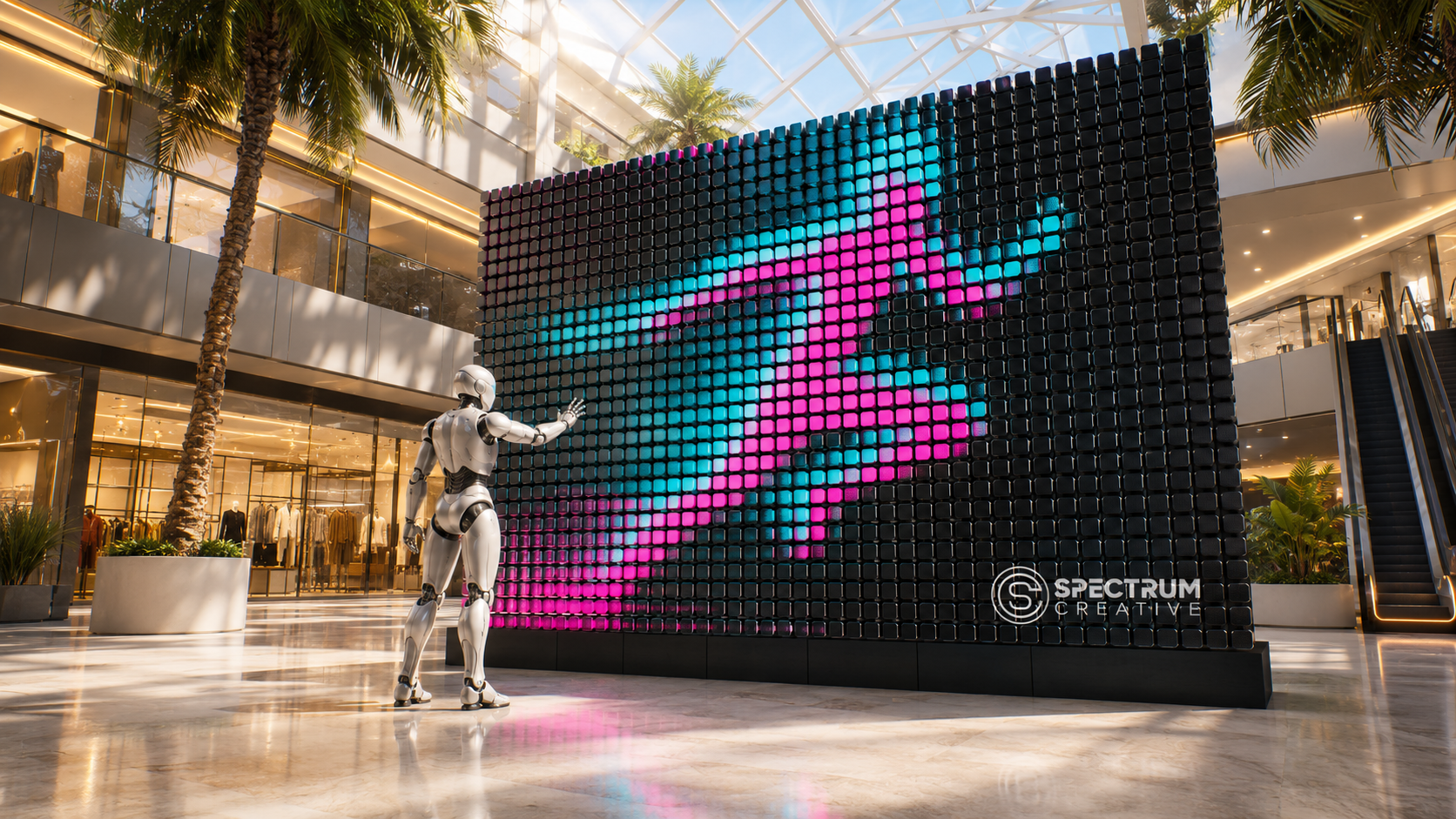
Imagine a display that does not simply “play” content.
A display that can sense your presence, respond to your movements, and evolve with your interaction.
When a Mlxos series installation composed of thousands of independently moving units is activated, it is no longer just a display surface.
It becomes a system of intelligent pixels — a digital organism capable of sensing, responding, and creating conversations with its environment.
This is the new display paradigm Spectrum Creative is building:
Mlxos series + Intelligent Control System + Real-Time Interactive Experience
Traditional display systems are essentially playback devices.
Content is created in advance, encoded, stored, and played according to a fixed timeline.
The relationship between audience and display is one-directional:
The screen communicates.
The audience watches.
The only choice is whether to look or not.
Mlxos series changes this relationship.
When triangular prism units rotate independently at speeds of up to 3 rotations per second, their movement is no longer controlled by a fixed timeline.
Instead, an intelligent control system can:
l Receive sensor data
l Understand audience behavior
l Generate real-time commands
l Convert digital instructions into thousands of precise mechanical movements
This is not simply “playing content”.
This is communication.
The future direction of display technology is moving toward integrated digital spaces rather than standalone screens. Modern immersive LED solutions are increasingly combining content creation, spatial design, interactive systems, and intelligent control into one complete experience ecosystem.
The intelligent control system behind Mlxos series consists of four layers:
Sensor Layer → Control Layer → Transmission Layer → Execution Layer
Each layer represents a transformation from physical reality into digital intelligence, and finally back into physical movement.
Every interactive experience begins with perception.
Mlxos series can integrate multiple sensing technologies to capture information from the surrounding environment and audience.
Cameras can detect:
l Human position
l Gesture movement
l Facial expressions
l Visitor flow
Through computer vision algorithms, physical behavior can be converted into digital signals.
For example:
A visitor approaching the installation can trigger:
l Color changes
l Rotation patterns
l Wave effects
LiDAR creates three-dimensional spatial point clouds through laser scanning.
Compared with traditional cameras, LiDAR provides stronger spatial perception capabilities, especially for:
l Multi-person tracking
l Motion trajectory recognition
l Complex environments
This makes it suitable for large-scale interactive installations.
Depth cameras measure distance information and provide stable tracking even in:
l Low-light environments
l Indoor interactive spaces
l Crowded scenarios
Audio sensors allow Mlxos series to respond to:
l Music rhythm
l Sound frequency
l Environmental audio changes
This enables applications such as:
l Stage performances
l Night entertainment spaces
l Music-driven installations
Touch systems allow visitors to actively select:
l Interaction modes
l Visual effects
l Content experiences
Together, these sensors transform physical signals:
Human movement
↓
Sound
↓
Touch
↓
into digital data that intelligent systems can understand.
Sensor data is only raw information.
The control layer transforms this information into meaningful instructions.
TouchDesigner is one of the key platforms used for real-time interactive visual systems.
It can:
l Receive data from cameras, LiDAR, microphones, and other sensors
l Analyze human movement and spatial information
l Generate real-time control parameters
l Connect with Unreal Engine and other 3D rendering platforms
l Create particle simulations and AI-driven visual effects
Within a Mlxos series interactive system, TouchDesigner can determine:
l Which units should rotate
l Which direction they should turn
l How fast they should move
l When transitions should happen
The result is a transformation from:
Audience behavior → Digital instruction → Physical movement
Unlike traditional displays that rely on pre-rendered videos, interactive Mlxos series applications can generate visuals dynamically.
The system can respond to:
l Human movement
l Time
l Environmental changes
l Event themes
The result is a constantly evolving visual experience.
MADRIX is another important control platform for creative lighting applications.
Its capabilities include:
l Pixel mapping
l Real-time visual generation
l Complex lighting effects
l Music synchronization
Through features such as Music2Light, lighting effects can synchronize with audio rhythm.
This enables:
l Music
l Lighting
l Mechanical Movement
to become one coordinated performance.
Once the control system generates commands, these instructions must travel from the digital world into physical hardware.
This is the role of the transmission layer.
Art-Net is an Ethernet-based lighting control protocol that packages DMX512 signals into network data.
Its advantages include:
Compared with traditional DMX512 connections, Art-Net supports significantly larger control networks.
Because it uses standard Ethernet infrastructure, it is suitable for large venues.
Art-Net supports:
l Multiple devices
l Large installations
l Distributed control systems
DMX512 remains one of the most widely used lighting control protocols.
Developed in 1986 by the United States Institute for Theatre Technology, DMX512 became a global standard because of:
l Stability
l Simplicity
l Compatibility
A DMX512 universe contains:
l 512 control channels
l Precise parameter adjustment
Including:
l Brightness
l Color
l Movement parameters
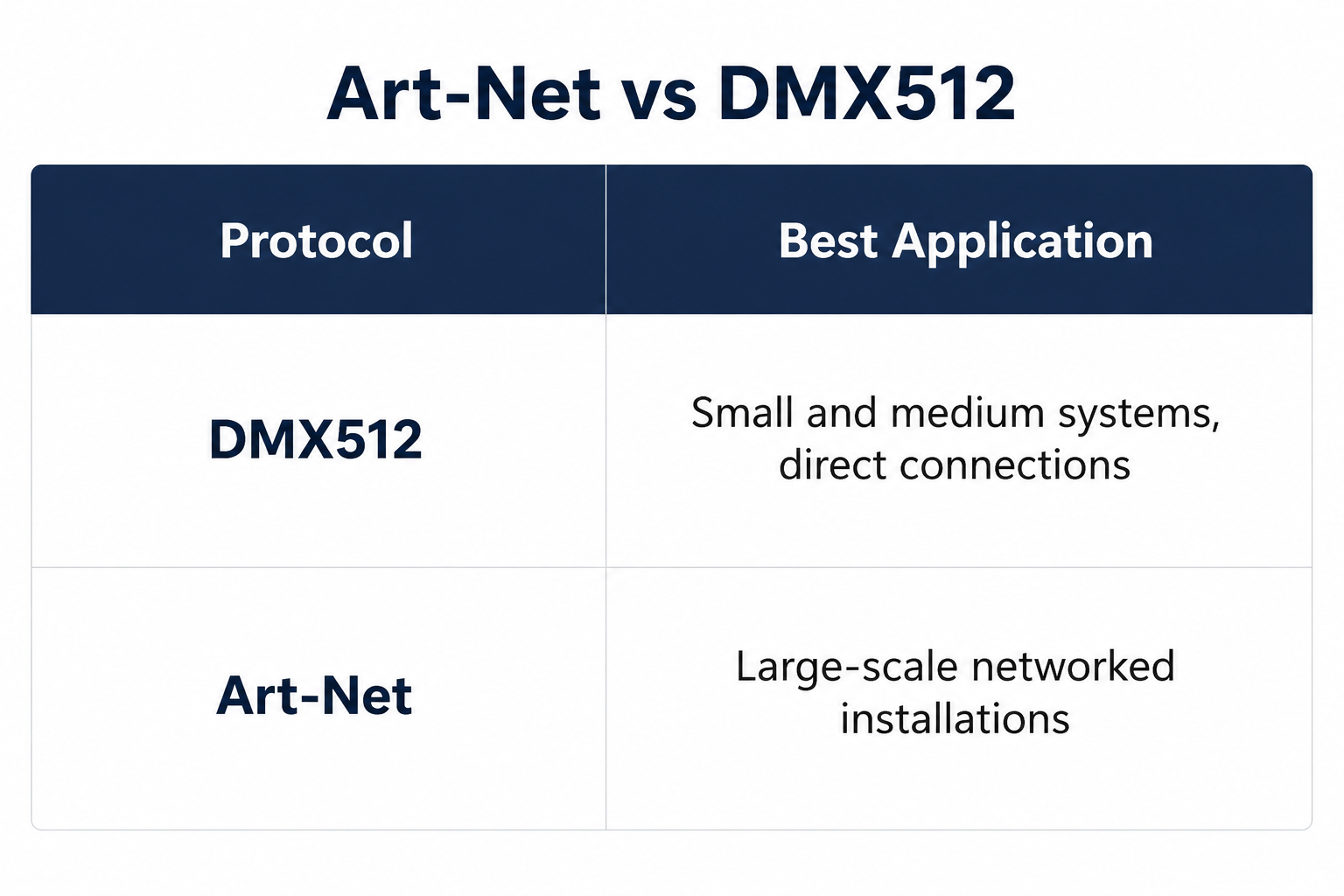
Mlxos series supports both systems, allowing projects to select the most suitable control architecture according to scale and complexity.
At the final stage, digital instructions become physical movement.
Each triangular prism unit in Mlxos series is connected to a precision motor system.
The control system creates a direct relationship between:
Digital pixels
and
Physical movement units.
From sensor detection to physical movement:
The complete process is controlled at millisecond-level response speed.
Mlxos series supports:
l Up to 3 rotations per second
l Approximately 0.15 seconds switching time
Thousands of independent units can move under the same timing system.
This prevents:
l Visual tearing
l Motion inconsistency
l Mechanical disorder
The result is a true physical 3D experience beyond traditional 2D displays.
When visitors enter the sensing range:
Cameras or LiDAR capture their position and movement.
TouchDesigner analyzes the information and generates corresponding commands.
Examples:
Visitor approaches:
→ Wave movement appears
Visitor waves:
→ Rotation speed changes
Visitor moves:
→ Visual patterns transform
The display becomes responsive.
The audience is no longer watching content.
They are influencing it.
Mlxos 138L integrates RGB full-color lighting capabilities.
Through DMX512 or Art-Net:
l Mechanical rotation
l Lighting effects
can be controlled simultaneously.
The result is a synchronized performance where:
l Prism movement
l Color transitions
l Music rhythm
work together.
In entertainment venues and nighttime commercial spaces, Mlxos series becomes more than a display.
It becomes a living visual performance system.
The content of Mlxos series does not have to be a fixed video file.
The control system can dynamically adjust:
l Rotation patterns
l Color combinations
l Movement rhythm
based on:
l Time
l Audience flow
l Environment
l Campaign themes
Morning atmosphere.
Afternoon energy.
Nighttime spectacle.
Festival celebration.
Every moment becomes a different visual story.
Every movement unit can be independently controlled.
Through tools such as After Effects, designers can create black-and-white height maps.
The logic is simple:
Black:
0% position
White:
100% position
Grayscale:
Precise movement percentage
This allows designers to create complex mechanical movements without writing complicated programs.
Creative teams can focus on artistic expression rather than technical execution.
Mlxos series creates a new canvas for digital artists.
Unlike traditional LED screens, this canvas is:
l Physical
l Three-dimensional
l Dynamic
Artists can create:
l Waves
l Spirals
l Particle transformations
l Mechanical sculptures
Through TouchDesigner and Unreal Engine integration, digital art can move beyond the screen.
In:
l Museums
l Science centers
l Brand experience spaces
Mlxos series evolves from a display device into an interactive installation.
Visitors become participants.
The system responds to:
l Movement
l Emotion
l Interaction
Luxury retail stores, automotive showrooms, and premium commercial spaces can use Mlxos series to strengthen brand storytelling.
Through customized:
l Colors
l Materials
l Textures
brands can integrate their visual identity into every moving element.
The mechanical structure of Mlxos series:
l Precision triangular prisms
l Motors
l Aluminum frames
forms its physical foundation.
But what truly brings it to life is the intelligent control system behind it.
Sensors are its senses.
TouchDesigner and MADRIX are its brain.
Art-Net and DMX512 are its nervous system.
Motors and mechanical units are its muscles.
The complete ecosystem is:
Spectrum Creative = Mlxos series + Control System + Interactive Experience
These are not three separate technologies.
They are three dimensions of one intelligent display ecosystem.
When a display can sense, think, and respond, it is no longer just a display.
It becomes a digital organism capable of communicating with space and connecting with people.
The intelligent control system behind Mlxos series is redefining what the word “display” means.
Mlxos series uses a four-layer architecture:
Sensor Layer
→ Control Layer
→ Transmission Layer
→ Execution Layer
Cameras, LiDAR, and other sensors collect information. TouchDesigner and MADRIX process data and generate commands. Art-Net and DMX512 transmit signals. Motor systems execute physical movement.
TouchDesigner works as the core real-time interaction engine.
It receives sensor data, analyzes movement information, and generates real-time control parameters for mechanical units.
DMX512 is suitable for smaller direct-control systems.
Art-Net expands DMX512 through Ethernet networking and is designed for larger, more complex installations.
Mlxos series supports both protocols.
Yes.
Through MADRIX Music2Light and DMX/Art-Net control, mechanical movement and lighting effects can synchronize with music rhythm.
Yes.
Spectrum Creative provides simplified creative workflows that allow designers to create movement effects through visual tools such as height maps, while advanced interactive projects can be customized by professional teams.
How Mlxos series Redefines Visual Experiences in Commercial Spaces