
2026-09-10
Share


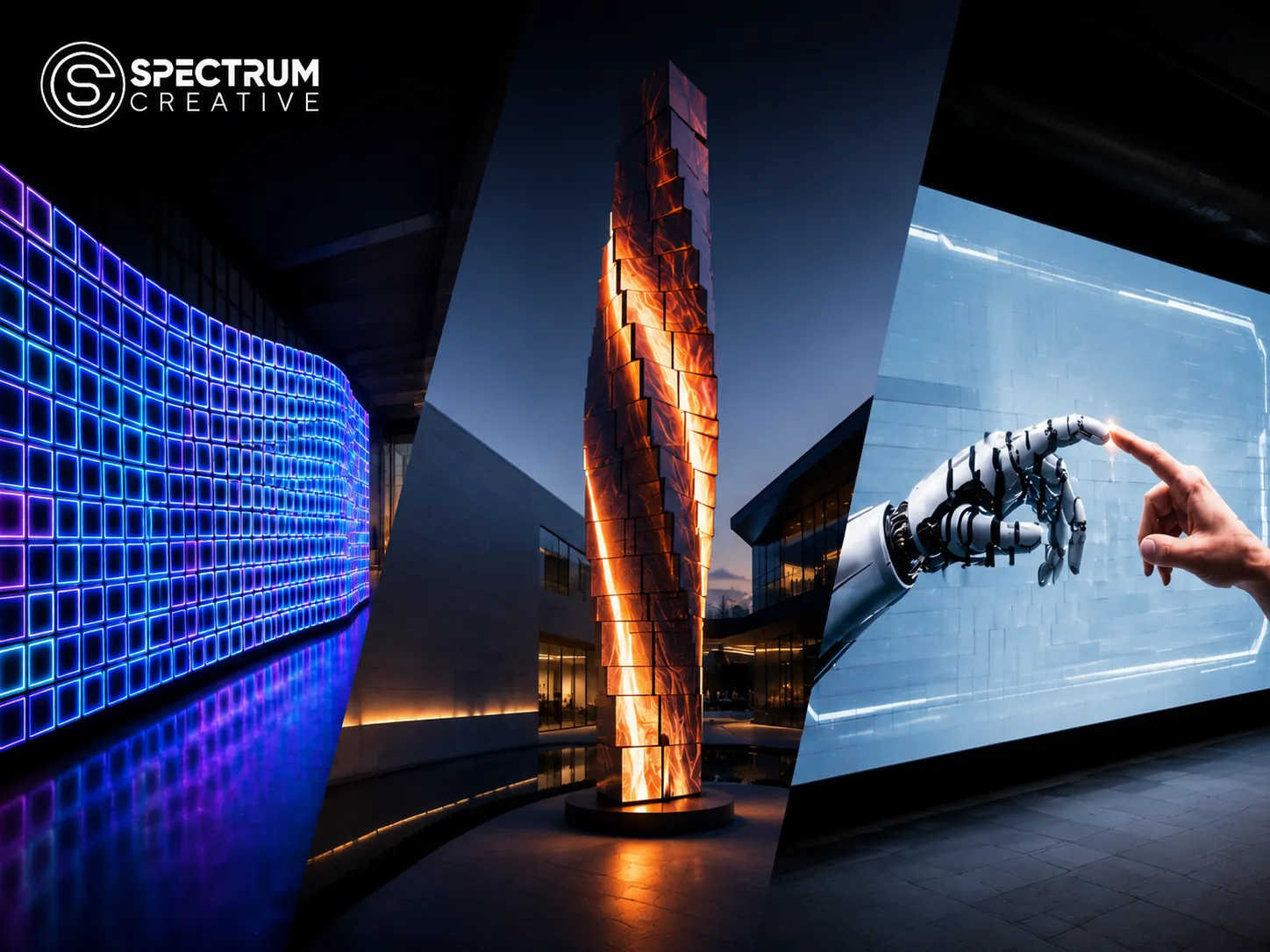
Las Vegas, ISE 2026.
At one of the world’s most influential professional audiovisual exhibitions, thousands of exhibitors competed to showcase the latest innovations in display technology.
But in the Robotic Screen category, there was only one company that truly stood out — Spectrum Creative.
While many exhibitors focused on pixel pitch, brightness, and resolution, Spectrum Creative’s Robotic Screen was moving with the rhythm of music — expanding, rising, falling, and breathing.
Visitors did not stop for three seconds.
They stayed for minutes.
Because this was not simply a display.
It was a system capable of transforming the space itself.
To understand Robotic Screen, we first need to understand the limitations of traditional LED displays.
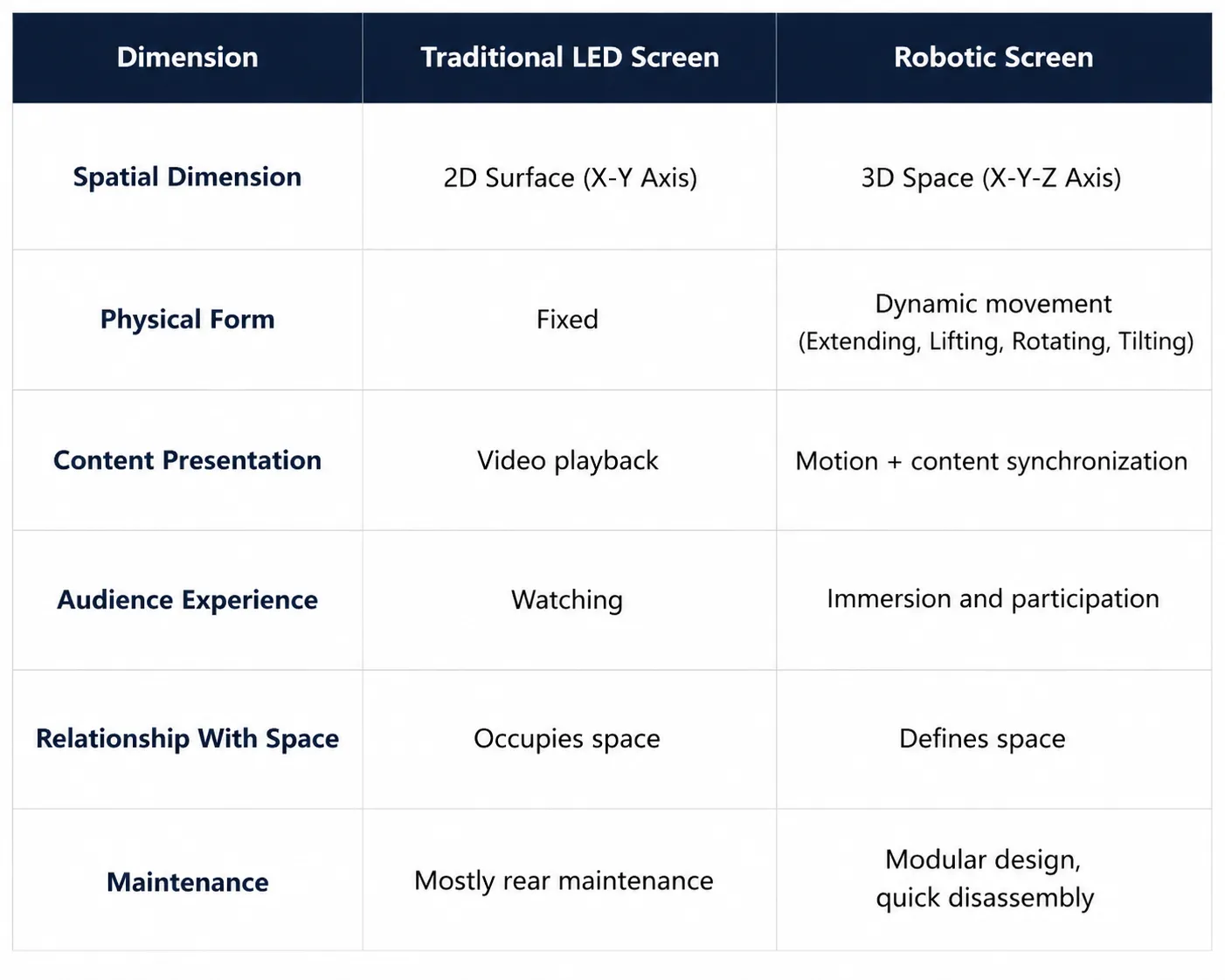
A conventional LED screen, regardless of its resolution or color accuracy, is fundamentally a fixed flat surface.
Pixels are restricted within a two-dimensional grid:
X-axis + Y-axis
No matter how impressive the content is, the display remains a “bright wallpaper”.
Its only function is:
Playing content.
Robotic Screen completely redefines the meaning of display.
Instead of a fixed surface, it is a dynamic system composed of matrix-based mechanical modules.
Each LED unit is installed on a precision mechanical structure, including:
l Linear guides
l Servo motors
l Actuators
l Motion control systems
Each unit can independently:
l Extend
l Retract
l Rise
l Lower
l Tilt
l Rotate
Through intelligent software control, thousands of modules can move together, allowing the screen itself to physically transform in space.
Traditional LED is a picture.
Robotic Screen is a living sculpture.
Every movement becomes a physical story.
When the screen rises and falls with music.
When the matrix spreads like a wave as visitors approach.
When a flat image transforms into a three-dimensional structure.
The audience is no longer seeing pixels turning on and off.
They are experiencing real physical movement.
Research has shown that 3D visual experiences can achieve stronger engagement and recall performance compared with traditional 2D content. Robotic Screen goes one step further by combining digital visuals with real mechanical depth — creating a true physical 3D experience.
The limitation of traditional LED is simple:
It always remains a screen.
No matter how beautiful the content is, there is still an invisible boundary between the audience and the display.
People know:
“I am looking at a screen.”
Robotic Screen breaks this boundary through physical movement.
When the screen begins to:
l Move
l Change
l Respond
it becomes part of the environment itself.
At ISLE 2026 and LED CHINA 2026 in Shenzhen, Spectrum Creative demonstrated its Robotic Screen technology through matrix-based mechanical movement.
The system achieved:
l Music-synchronized movement
l Sensor-based interaction
l Real-time physical 3D visual feedback
The result was a transition from:
Watching a screen
to:
Experiencing a space.
Robotic Screen is far more complex than a conventional LED display.
It requires four major technology capabilities.
Every Robotic Screen movement unit is built on industrial-grade mechanical engineering.
The system may include:
l Servo drive systems
l High-precision linear guides
l Synchronized transmission structures
l Gear-rack mechanisms
l Screw drive systems
The positioning accuracy must be extremely precise.
When thousands of units move simultaneously, even a small mechanical deviation can affect the entire visual experience.
Spectrum Creative adopts a modular mechanical architecture.
Individual modules can be independently removed and maintained without dismantling the entire system.
This design improves:
l Installation efficiency
l Maintenance convenience
l Long-term reliability
For high-pressure environments such as exhibitions and international events, modular engineering ensures stable operation under demanding schedules.
Motion control determines how accurately the screen moves.
The system must manage:
l Home positioning
l Movement trajectories
l Real-time synchronization
l Video-motion coordination
Robotic Screen supports integration with professional control systems through:
l DMX512
l Art-Net
This creates a familiar workflow for lighting professionals.
A lighting operator can control mechanical movement almost like controlling lighting channels.
The result:
Mechanical movement becomes part of the show.
This is one of the biggest technical challenges.
When a display moves, the image cannot:
l Tear
l Freeze
l Shift incorrectly
The system must continuously calculate the relationship between:
Physical position
and
Visual content.
Through dynamic rendering algorithms and high-refresh-rate processing, the system adjusts image output according to mechanical movement.
For Spectrum Creative’s Robotic Screen systems, high-refresh-rate display technology enables smooth synchronization between motion and visual content.
The screen does not simply move.
The image moves with it.
When thousands of modules move independently in three-dimensional space, collision prevention becomes essential.
A Robotic Screen system requires:
l Spatial calculation
l Motion prediction
l Real-time position monitoring
l Collision avoidance logic
The system continuously evaluates:
l Current position
l Movement trajectory
l Potential conflicts
Before a collision occurs, the system can automatically adjust movement instructions.
This active safety architecture allows Robotic Screen to operate reliably in:
l Stage environments
l Exhibitions
l Commercial spaces
In:
l Concerts
l Music festivals
l Large-scale events
Robotic Screen is replacing traditional static backgrounds.
When the screen:
l Expands with music
l Moves with rhythm
l Creates three-dimensional forms
it becomes part of the performance itself.
The display is no longer the background.
It becomes the stage.
At exhibitions and brand experience spaces, movement creates immediate attraction.
Unlike traditional booths that rely only on visual content, Robotic Screen creates a physical spectacle.
At major industry exhibitions, dynamic mechanical displays have increasingly become a key attraction because they combine:
l Technology
l Art
l Interaction
For:
l Product launches
l Pop-up stores
l Experience centers
Robotic Screen transforms brand communication.
Instead of:
“Seeing” a brand message
audiences can:
“Experience” the brand story.
Physical movement creates emotional memory that traditional flat displays cannot replicate.
In:
l Shopping malls
l Hotels
l Airports
l Public spaces
Robotic Screen is evolving from a display device into an architectural experience.
It is no longer something attached to a wall.
It becomes part of the space itself.
It defines:
l Rhythm
l Atmosphere
l Emotion
Spectrum Creative’s robotic display solutions extend mechanical LED applications from indoor environments into broader commercial and public spaces.
Spectrum Creative integrates:
l Precision mechanical engineering
l LED module development
l Structural design
l System integration
Through:
l DMX512
l Art-Net
Spectrum Creative’s Robotic Screen can integrate with professional control workflows.
This significantly lowers the learning curve for users familiar with lighting systems.
From international exhibitions to complex custom installations, Spectrum Creative demonstrates the ability to deliver under demanding conditions.
The combination of:
l Engineering capability
l Manufacturing strength
l Software integration
allows Robotic Screen projects to move from concept to reality.
When a screen begins to move, it stops being only a screen.
It becomes:
A spatial sculptor.
A visual storyteller.
A memory creator.
The ultimate value of Robotic Screen is not simply:
l Higher brightness
l Higher resolution
l More pixels
Its true breakthrough is changing the meaning of display itself.
Traditional LED development focuses on:
l Larger size
l Smaller pixel pitch
l Higher brightness
Robotic Screen moves toward something completely different:
Redefining the space around us.
The future of displays is not only about what we see.
It is about what we experience.
Traditional LED displays are fixed two-dimensional surfaces.
Robotic Screen uses precision mechanical structures to enable LED units to move independently, including extension, rotation, lifting, and tilting — transforming display from a 2D surface into a 3D spatial experience.
Through dynamic rendering algorithms and high-refresh-rate synchronization, the system continuously adjusts visual output according to mechanical movement, ensuring smooth and accurate image presentation.
No.
Spectrum Creative’s Robotic Screen supports DMX512 and Art-Net integration, allowing operators to control mechanical movement through familiar professional lighting workflows.
No.
The modular design allows individual units to be independently maintained without affecting the entire structure.
Robotic Screen can be applied in:
l Stage performances
l Exhibitions
l Brand activations
l Shopping malls
l Airports
l Public spaces
From entertainment venues to commercial landmarks, Robotic Screen is becoming the visual heart of next-generation spaces.